Posts tagged ‘God’
A Tenuous Time

It wasn’t supposed to be this way. As Christianity faded from prominence in the West, a secularized culture was supposed to emerge to take its place that was more tolerant, more enlightened, more harmonious, and less politically polarized than any other society in the history of the world. But as Peter Beinart explains in an excellent article for The Atlantic, what has emerged as Christianity’s western influence has waned is nothing of the sort:
As Americans have left organized religion, they haven’t stopped viewing politics as a struggle between “us” and “them.” Many have come to define us and them in even more primal and irreconcilable ways.[1]
Beinart goes on to explain how the traditional battle lines between conservatives and liberals have shifted in the wake of this irreligious surge. Specifically, with regard to the spiritually skeptical alt-right, Beinart notes:
They tend to redraw the boundaries of identity, de-emphasizing morality and religion and emphasizing race and nation…
The alt-right is ultra-conservatism for a more secular age. Its leaders like Christendom, an old-fashioned word for the West. But they’re suspicious of Christianity itself, because it crosses boundaries of blood and soil. As a college student, the alt-right leader Richard Spencer was deeply influenced by Friedrich Nietzsche, who famously hated Christianity. Radix, the journal Spencer founded, publishes articles with titles like “Why I Am a Pagan.” One essay notes that “critics of Christianity on the Alternative Right usually blame it for its universalism.”
It turns out that as faith allegiances have crumbled, a universal concern for others in the spirit of the Good Samaritan has too. Christianity’s cross-ethnic, cross-cultural, and international appeal has proven too much for the self-interested – or, perhaps more accurately, self-obsessed – spirit of our age.
As Christians, we must think through this irreligious political surge and provide a faithful witness in the midst of it. We also must be prepared to live in a very tricky tension because of this surge. As Rod Dreher explains in his newly released book, The Benedict Option:
Faithful Christians may have to choose between being a good American and being a good Christian. In a nation where “God and country” are so entwined, the idea that one’s citizenship might be at radical odds with one’s faith is a new one.[2]
Dreher’s analysis of the tension between being a citizen of a nation and being a child of God is true, but it is also somewhat amnesic. He is right that there is indeed an increasing tension. But he is wrong that this tension is anything new. Tensions between God and government have been longstanding, even in our society. And these tensions should not surprise us. It was a Roman governmental official, after all, who approved the request for Jesus’ crucifixion. Government has, for a great portion of history, had a problem with God, especially when people put Him before it.
The New Testament understands that this tension between God and government will never be fully resolved, at least on this side of the Last Day. While we may give to Caesar what is his, God also demands what is His, and when what Caesar wants contradicts what God wants, conflict ensues. Just ask Daniel, or Shadrach, Meshach, and Abednego, or the apostles. Our calling, as Christians, is to resist the urge to comfortably resolve this tension, whether that be by condemning this world and cloistering ourselves off from it or by compromising our faith for the lucrative perks of political power. Our calling is to live in this tension both faithfully and evangelically – holding fast to what we confess while lovingly sharing with others what we believe.
Beinart concludes his article:
For years, political commentators dreamed that the culture war over religious morality that began in the 1960s and ’70s would fade. It has. And the more secular, more ferociously national and racial culture war that has followed is worse.
Yes, indeed, it is worse – which is why we, as the Church, need to offer something better. We need to offer something loving. We need to over something hopeful. We need to offer something reconciling. We need to offer something that continually and conscientiously questions our nation’s nearsighted political orthodoxies for the sake of a time-tested theological orthodoxy. We need to offer Jesus, unabashedly and unashamedly. This is our mission. I pray we are up to it.
______________________________________
[1] Peter Beinart, “Breaking Faith,” The Atlantic (April 2017).
[2] Rod Dreher, The Benedict Option (New York: Sentinel, 2017), 89.
God and Country in Order

In his book, Destroyer of the gods, Larry Hurtado writes about why the Christian claim that there is only one God was especially offensive to those in the ancient Roman world. His analysis is worth quoting at length:
In the eyes of ancient pagans, the Jews’ refusal to worship any deity but their own, though often deemed bizarre and objectionable, was basically regarded as one, rather distinctive, example of national peculiarities…
The early Christian circles such as those addressed by Paul…could not claim any traditional ethnic privilege to justify their refusal to worship the gods. For, prior to their Christian conversion, these individuals, no doubt, had taken part in the worship of the traditional gods, likely as readily as other pagans of the time among their families, friends, and wider circles of their acquaintances…
Of course, a pagan might choose to convert fully to Judaism as a proselyte, which meant becoming a Jew and ceasing to be a member of his or her own ancestral people. By such a drastic act, proselytes effectively changed their ethnic status and so could thereafter try to justify a refusal to participate in worshipping the pagan gods as expressive of their new ethnic membership and religious identity. But this was not the move that Paul’s pagan converts made…
Indeed, Paul was at pains to emphasize that his pagan converts must not become Jewish proselytes. For Paul saw his mission to “Gentiles” as bringing to fulfillment biblical prophecies that the nations of the world would forsake idols and, as Gentiles, would renounce their idolatry and embrace the one true God. That is, unlike Jewish proselytes, Paul’s pagan converts did not change their ethnic identity.[1]
Categories of ethnicity and faith were not clearly delineated in the ancient world. Instead, they were broadly interchangeable. To be a part of the Jewish nation was to adhere to the Jewish faith. To be a Roman Gentile was to be a worshiper of the Roman gods. There was no concept of religious freedom like we know it today – where a person can worship and live out their convictions freely quite apart from their nationality. Thus, part of what made Christianity so offensive to the ancient pagans was that it began to decouple a presumed synonymy between ethnicity and faith. A person’s ethnicity, in the Christian conception, no longer informed ipso facto a person’s faith. A person could be a Roman Gentile and a Christian monotheist.
Not only did Christianity decouple ethnicity from faith, it actually claimed that a person’s ethnicity was subservient to faith! Again, to quote Hurtado:
Paul writes, “There is no longer Jew or Greek, there is no longer slave or free, there is no longer male or female; for all of you are one in Christ Jesus” (Galatians 3:28)…Whether you were Jew or Greek, slave or free, male or female, this was now to be secondary to your status “in Christ”…Irrespective of their particular ethnic, social, or biological categories, therefore, all believers were now to take on a new and supervening identity in Christ.[2]
According to Paul, Christ comes before clan.
Like the ancient Romans, we too have a tendency to couple our ethnicity with our faith, or, to put it in another, more recognizable, way, to couple our country with our God. When this happens, however, it is almost always our God who winds up serving our country. When it appears particularly expedient or reassuring in the midst of a dangerous and changing world, we can be all too willing to sacrifice fidelity to our faith for the prosperity of our nation. Hurtado offers us an important reminder: though we may retain our ethnicities and citizenships and still be Christians, ethnicities and citizenships are subservient to faith. Faith cannot be sacrificed for the sake of the State. Furthermore, as we are learning our increasingly secularized society, faith is often at odds with the goals of the State. Everything from the legal enshrinement of the sexual revolution to the often raucous and raunchy rhetoric of our most recent presidential campaign demonstrates this. So let’s makes sure we keep the State and our faith straight. Faith comes first. After all, the God of our faith will continue to stand, long after the State has fallen.
_______________________
[1] Larry Hurtado, Destroyer of the gods (Waco: Baylor University Press, 2016), 53, 55.
[2] Ibid., 55-56.
Who’s Afraid of Election Day?

Credit: Darren McCollester / Getty Images
Tomorrow is the big day. Tomorrow, we the people turn out to vote for the next President of the United States. Though literally thousands of other politicians will be on the ballots that are cast tomorrow, the presidential election is the one that looms largest in the minds and hearts of most people. Indeed, I’ve heard it repeated over and over again throughout the course of this political season that “this is the most important presidential election of our lifetimes.” I honestly do not know whether or not it is. I do know that Walter Mondale told a crowd in 1984, “This is the most important election of our lives.” I would argue that history has probably proven him wrong. And history, eventually, may prove today’s claim about the importance of this election wrong – or, perhaps, right. We’ll just have to wait and see.
But whether or not voters and pundits prove to be historically correct in their estimation of the weightiness of this election, I do know that the immediate perceived importance of this election is enormous and is engendering deep fear in the minds and hearts of many. I have had conversation after conversation with people who are scared of what has happened and what will happen to our political system and to our nation.
This past weekend, I listened to a sermon on the topic of this year’s election. The pastor who preached this sermon argued forcefully, powerfully, and, at times, eloquently for what he believed about this election and even for whom he believed we, as Christians, should vote in this election. But what struck me most about this pastor’s sermon was its closing. He ended by talking about two fears that he has for the future of this nation. First, he explained his fear that there may be too many of “them” and too few of “us.” He sees postmodern secularism winning over the masses and driving Christianity to the fringes and he is worried that there is nothing we can do politically to beat it back. Second, he expressed his worry that we may simply be too late to make any difference. He thinks too many Christians have been too silent for too long, and now a day of reckoning has come.
Politically, this pastor seemed very knowledgeable. Theologically, however, if I can be so bold to say this, as I listened to his sermon, I became more and more convinced that he missed something very important. Here’s why I say that.
First, if anyone thinks that there are too many of “them” and too few of “us,” I would encourage that person to read the story of Gideon. When God takes the army Gideon has mustered to fight the Midianites and reduces it in force from 32,000 men to 300 men – a reduction of over 99 percent – it looks like there is no way Gideon and his tiny army can defeat the massive army of a whole tribe of people. But God specializes in doing great things when there are too many of “them” and too few of “us.” God made a whole nation out of one man Abraham. God redeemed a whole people from slavery through one man Moses. God changed the whole course of human history through twelve men He deemed “apostles.” And God brought salvation to our whole world in one man He calls His Son. God can do a lot with a little.
Second, if anyone thinks it is simply too late, I would point that person to the story of Jesus’ friend Lazarus. When Jesus learns that His friend has fallen ill, rather than rushing to see him, He waits for him to die. Why? Because, as Jesus says to Martha, He is “the resurrection and the life” (John 11:25). Even death is not too late for Jesus because He can snatch life from the jaws of death. When the hour on our clock strikes eleven and we begin to struggle and scramble, Jesus can bring forth a new dawn that we never saw coming.
What struck me most about this pastor’s sermon is that although he issued a clear call to his congregation to get out and vote, he never explicitly reminded his congregation to have faith – to trust in the One who holds everything from your house to the White House in His hands.
Politics has a bias toward action. Legislation gets passed when deals get made. Public officials are elected when votes are cast. Social change can be engineered when Supreme Court verdicts are rendered. Action is important to politics. But as Christians, we must remember that the centerpiece of who we are is not in what we do, but in whom we believe. “Believe in the Lord Jesus, and you will be saved” (Acts 16:31). Faith is the centerpiece of our life in Christ.
I think it’s this that gets to the root of our fear. Because if we get so stuck on the action of our vote and the action of our legislators and the action of some guy or gal who sits in an office that is shaped like an oval that we forget that our hope is nothing that we have done, are doing, will do, or can do, then we’ve missed what’s most important. Because we’ve missed Jesus. And you don’t get Jesus by action. You only get Jesus through faith. There’s a reason the Psalmist says, “When I am afraid, I put my trust in You” (Psalm 56:3).
So, if you are afraid of the outcome of this election and the future of this country, go ahead and vote, but don’t expect your vote to calm your fears. Because your fears cannot be calmed by electoral majority. Your fears can only be calmed by a Savior who died for you and me.
Trust in Him.
Pain, Suffering, and Morality
 I’ve been doing a fair amount of thinking lately on suffering and its effect on faith. In one way, I can’t help but believe and even assert that there is every reason to question God in the face of great suffering. Elie Wiesel’s gut-wrenching account of his time in a Nazi concentration camp comes to mind not only as a natural response to pain and suffering, but as a needed one:
Never shall I forget that night, the first night in camp, that turned my life into one long night seven times sealed. Never shall I forget that smoke. Never shall I forget the small faces of the children whose bodies I saw transformed into smoke under a silent sky. Never shall I forget these flames that consumed my faith forever.[1]
Elie’s description of his first night in a concentration camp should arouse in us nothing other than horror, grief, and sympathy. Although I don’t know precisely how I would react to such an experience, I would be naïve to think that Elie’s reaction could never be my reaction. The scene is just too jarring. The brutality is just too disgusting. The deaths are just too agonizing. I too could question God.
And yet…
Some did not respond to the concentration camps the way Elie Wiesel did. One survivor of the camps, Alex Seidenfeld, in an interview with the Associated Press, said simply, “We stayed alive. We survived. How could this have happened without the almighty?”[2]
Elie looked at all those who died and asked, “How can God be?” Alex looked at all those who survived and asked, “How can God not be?” Elie looked at all those who died and angrily shouted, “God didn’t stop this!” Alex looked at all those who survived and declared, “But God did save some of us from this!”
The question of where God is in the face of suffering is really a question of God’s role in the midst of suffering. Is God’s role to stop us from suffering or to save us through suffering? In one sense, it is both. But the first role, at least according to Scripture, doesn’t find its full expression until later, at the end of days.
Ultimately, I would argue that, even if God does not stop all suffering, it is difficult to surmise from the existence of suffering that God does not exist. C.S. Lewis famously explains why:
My argument against God was that the universe seemed so cruel and unjust. But how had I gotten this idea of just and unjust? A man does not call a line crooked unless he has some idea of a straight line. What was I comparing this universe with when I called it unjust? … Of course I could have given up my idea of justice by saying it was nothing but a private idea of my own. But if I did that, then my argument against God collapsed too – for the argument depended on saying that the world was really unjust, not simply that it did not happen to please my private fancies. Thus in the very act of trying to prove that God did not exist – in other words, that the whole of reality was senseless – I found I was forced to assume that one part of reality – namely my idea of justice – was full of sense.[3]
C.S. Lewis puts his finger on the reality that the problem we have with suffering is that we believe and perceive that it is, in some sense, wrong. It is unjust. But if we reject God, we lose the privilege of saying that anything is wrong or unjust because, without God and His ordering of the universe, standards of organized morality disappear into the ether of a universe that coalesced around the free-for-all of chance. This world and all that is in it, to borrow a phrase from the famous atheist philosopher Bertrand Russell, is nothing more than “the outcome of accidental collocations of atoms.”[4] In this view, suffering exists in the same way that a ball that lands on black 22 on a roulette wheel exists. It just happens to happen sometimes. There is nothing more to be said about it, at least not morally.
Arguing against a moral God in light of what is perceived to be immoral suffering, then, is an argument that collapses on itself. You can’t argue against God using a framework that has its basis in God. Either suffering just is, or it is somehow just wrong. To question how there can be a good God who allows bad things assumes that, even if implicitly, there is a God and that, in some regard, He is not playing by His own rules, or at least by what we perceive to be His rules. If this is the case, it may be fair to ask Him, “Why?” But, as a Christian, I would propose that it might be even better to ask Him for help. From what I hear, even if God doesn’t always stop suffering, He is quite adept at blessing people in suffering.
_____________________
[1] Elie Wiesel, Night (New York: Hill and Wang, 2006), 33.
[2] Aron Heller, “Observant survivors keep the faith after Holocaust,” The World Post (1.26.2016).
[3] C.S. Lewis, Mere Christianity (New York: Harper Collins Publishers, 1980), 38
[4] Bertrand Russell, “A Free Man’s Worship,” The Collected Papers of Bertrand Russell, vol. 12 (London: Routledge, 1985).
Do Muslims and Christians Worship the Same God?

Dr. Larycia Hawkins
Last week on this blog, I discussed the danger of trading theological integrity for political expediency in the wake of Donald Trump’s proposed ban on all non-resident Muslims entering our country. As I explained, Mr. Trump’s claim that his ban is “not about religion,” though politically palatable, cannot be factually truthful. His ban, I argued, is necessarily about religion because it affects a whole group of thoroughgoingly religious people.
I also argued that it is important for us, as Christians, to have honest theological conversations with our Muslim friends. We may disagree on a great number of things, but at least we agree that theology matters. Categories like orthodoxy and heresy, truth and deity are important to us. In a culture that is far too dismissing of theology, Muslims and Christians should be enthusiastically engaging in theology.
This is what I argued for last week. And now this week, almost providentially, I have an opportunity to practice what I blog.
One of America’s premier evangelical institutions, Wheaton College, is embroiled in an imbroglio after one of its professors, Dr. Larycia Hawkins, claimed that Muslims and Christians worship the same God. Wheaton placed Dr. Hawkins on paid administrative leave, explaining in a press release:
As a Christian liberal arts institution, Wheaton College embodies a distinctive Protestant evangelical identity, represented in our Statement of Faith, which guides the leadership, faculty and students of Wheaton at the core of our institution’s identity. Upon entering into a contractual employment agreement, each of our faculty and staff members voluntarily commits to accept and model the Statement of Faith with integrity, compassion and theological clarity … Dr. Hawkins’ administrative leave resulted from theological statements that seemed inconsistent with Wheaton College’s doctrinal convictions.[1]
Dr. Hawkins’ assertion is well worth our time and attention because it is an example of precisely the kind of theological discussions I would argue Christians and Muslims ought to be having. Do Christians and Muslims worship the same God? Is Dr. Hawkins correct?
As a Christian, I would answer the question of a shared deity among Christians and Muslims in two ways: “No, but…” The answer “no” is necessary for theological honesty. The answer “but” is crucial to Christian hospitality. Let me briefly explain both answers.
“No”
It is very difficult to assert, at least in any way that demands a nuanced theology of divinity, that Muslims and Christians worship the same God. In defending her assertion on social media, Dr. Hawkins cited theologian Miroslav Volf, who, in an interview for Christianity Today, explained:
I think that Muslims and Christians who embrace the normative traditions of their faith refer to the same object, to the same Being, when they pray, when they worship, when they talk about God. The referent is the same …
God is one in both traditions. That’s very important. Two, God is merciful. Also, God is just. God’s oneness, God’s mercy, and God’s justice are significant commonalities. We have different understandings of each of these, but the overlaps are really impressive.[2]
Volf argues that Christians and Muslims worship the same God based on a list of divine attributes that happen to be the same between the two faiths. His list of divine attributes, however, strikes me as ad hoc. What about the Christian contention that God is one, yet also three persons? Muslims do not believe this (cf. Surah 4:171). What about God’s humanity? At the heart and soul of a Christian’s faith is the God-man Jesus Christ. Muslims flatly reject this (cf. Surah 10:68). What about God’s greatest attribute – that He is love (cf. 1 John 4:8)? Though one of the 99 names Muslims have for God is “the Loving One,” that God is love seems to be a bridge too far for Islamic theology.
Volf acknowledges such differences, but then moves quickly to downplay them:
There are significant differences that are the subject of strenuous debates. Some differences really are foundational to the faith, like the doctrine of the Trinity. At the same time, there’s this amazing overlap and similarity. We need to build on what is similar rather than simply bemoan what’s different.
Volf’s assertion that Muslims and Christians worship the same God in spite of significant differences in their respective conceptions of Him begs a question: where would Volf draw his line? When do differences in theology become profound enough for there to be a difference of divinities?
If somebody postulates the existence of more than one God, I would have to say we don’t worship the same God. If somebody says that God is basically one with the world, I would also have to say we don’t worship the same God.
Again, all of this seems very ad hoc to me. For Volf, the attributes of God’s oneness and His distinction from creation are vital. The attribute of God as three persons is not. Why? Simply because Volf says so?
Jesus is quite clear that, in order to be a true worshiper, a person must worship “in the Spirit and in truth” (John 4:23-24). It is quite difficult to worship “in the Spirit” while denying the Spirit’s personhood, as do Muslims, and it is impossible to worship “in truth” while denying at least parts of what Scripture says is true about God. It is important to note that the issue here is not whether a person has a complete understanding of God. Jesus affirms that a person can worship the true God while not having a complete understanding of Him when He says of the Samaritans, “You Samaritans worship what you do not know” (John 4:22). Worship does not require perfect knowledge. True worship does, however, require faith.
But the Scriptures are also very clear that if a person perverts what can be known about God from biblical revelation, he has moved from worship to idolatry. This is why the apostle Paul, when he was in Athens, was “greatly distressed to see that the city was full of idols” (Acts 17:16), but was also willing to engage the Athenians in a theological conversation around the altar the they had built “TO AN UKNOWN GOD” (Acts 17:23). The Athenians’ altar stemmed from ignorance. Their idols were built on false and dangerous ideas about divinity. The altar propelled Paul to further conversation. The idols incited his unapologetic condemnation.
Considering that Islam does not claim to be ignorant of God, but rather claims that God is widely different from whom Christians claim He is, it is difficult to see how either a Christian or a Muslim can honestly say that both faiths worship the same God. Just because two divinities share a short list of attributes does not mean they are the same God any more than a mother and a daughter who share some genes are the same person. This is why I must answer “No” to the question, “Do Christians and Muslims worship the same God?” If this is all I was to say, however, I would not be saying enough.
“But”
I firmly believe that Christians and Muslims do not worship the same God. This is not to say that I think Muslims have no knowledge of what I as a Christian would confess to be the true God or that the God of Muhammad does not reflect in certain ways the God of the Bible. In Romans 1, Paul reminds us that “since the creation of the world God’s invisible qualities – His eternal power and divine nature – have been clearly seen, being understood from what has been made” (Romans 1:20). It is no surprise, then, from a Christian standpoint, that the God of Muhammad would have attributes that are influenced and informed by the God of the Bible, for the God of the Bible is not only particularly revealed in Scripture, but generally, though not salvifically, knowable through creation.
Ultimately, even if someone believes that Christians and Muslims do indeed worship the same God, this still does not settle the question of what is true about God, how one is to approach God, and how one receives eternal life with God. The Quran, for instance, speaks of Jesus, but rejects His death for sinners (cf. Surah 4:157-158). The Bible makes Jesus’ death for sinners the very locus of His identity (cf. 1 Corinthians 2:2). Thus, when Muslims and Christians talk about Jesus, the question should not be, “Do the Bible and the Quran talk about the same Jesus?” Even if they do, this is finally of little consequence. A better question would be, “Does the Bible or the Quran authoritatively reveal the true Jesus?” After all, who Jesus is matters just as much as that He exists.
What is true of Jesus specifically is true of God generally. We need to be asking, “Does the Bible or the Quran authoritatively reveal the true God?” Who has the true and supreme revelation about God from God? As a Christian, my answer must be that the Bible has the true and supreme revelation about God from God. My guess is a Muslim would beg to differ. But this is why a willingness to have hospitable theological discussions is so important. And this is why, if a Muslim friend would like to offer his or her thoughtful and respective perspective on the God of Muhammad and the God of the Bible, I would love to hear it. Understanding may not always lead to agreement, but it does generally lead to charity. And that’s a virtue both our religions share.
_________________________
[1] “Wheaton College Statement Regarding Dr. Larycia Hawkins,” Wheaton College (12.16.2015).
[2] Mark Galli, “Do Muslims and Christians Worship the Same God?” Christianity Today (4.15.2011).
Everyday Thankfulness
 It was truly a mountaintop moment. I’ll never forget seeing her rush down Concordia’s breezeway in her stunning white dress, bursting through the back doors of the worship center, and coming toward me. The day I married Melody was a day I will always cherish. But, as seems to be the way of life, you must eventually leave the mountaintop moments of life and tread into the valley of reality.
The valley of reality struck less than a week after our wedding. By then, the ceremony was ancient history, the reception had long passed, and we had returned from our brief honeymoon to the apartment we were living in at the time, littered with wedding gifts – lots of wedding gifts. Mixers, crock pots, flatware, bed linens, personal effects, and hundreds of dollars of gift cards to Target. “Okay,” Melody announced, a towering stack of cards in her hand, “It’s time to put this stuff away, but as we do, we need to write a thank you card for each of these gifts!” Each of these gifts? But there were hundreds of them! Nevertheless, gift after gift, I wrote these thank you notes, even though my hand got cramped and my tongue got dry from licking all those envelopes. I must confess that that more notes I wrote, the briefer my expressions of gratitude became. I appreciated the gifts, but the overwhelming task of writing hundreds of cards led to the underwhelming nature of my notes of thankfulness.
Sadly, like my thank you cards, many modern day expressions of gratitude are underwhelming. We do not respond adequately to, or even bother to notice, the many things for which we have to be thankful. This is what makes some words from the famed poet Ralph Waldo Emerson in a sermon he delivered on Thanksgiving Day of 1830 so striking to me: “At first, brethren, consider whether each of us has not had some reason to acknowledge the special favor of God Himself.”[1] Emerson is calling on us to reflect on our lives and find some gift from God for which we might be thankful. This kind of a call from a pastor to his people at Thanksgiving is common. And yet, the reason Emerson offers as to why we should give thanks is striking: “Twelve months are past.”
Did I hear that right? We ought to be thankful to God simply because a year has passed from one Thanksgiving to the next? Sure enough, Emerson’s first reason for thankfulness is the simple gift of time. Perhaps the simple gift of time was especially poignant to Emerson because his beloved wife Ellen lie sick in bed during this period with tuberculosis. She would die from the disease the following February. God’s gift of time with his wife, then, became suddenly precious to Emerson.
The text on which Emerson based his sermon for that Thanksgiving Day was from the Psalms: “Give thanks to the LORD, for He is good; His love endures forever” (Psalm 107:1). The Psalmist, like Emerson, references time. Except the Psalmist does not call us to give thanks for twelve months; rather, the Psalmist calls us to give thanks for “forever.” For long after our lives have passed from this earth, we will have an eternity with a God who loves us. And that should be enough to move any heart to thankfulness.
As we celebrate another Thanksgiving this week, do not let your expressions of gratitude wallow in mediocrity. Instead, make them hearty and overwhelming. For God’s gifts are hearty and overwhelming. And if you need something for which to be thankful, consider this: twelve months have passed. Not only that: eternity awaits. Give thanks to the LORD for this!
___________________________
[1] Ralph Waldo Emerson, The Complete Sermons of Ralph Waldo Emerson, vol. 3 (Columbia, Missouri: University of Missouri Press, 1991), 46.
The Value of Patience
Credit: baycitizen.org
I am not a patient person. I wish I was, but I’m not sure I really have the patience to learn patience.
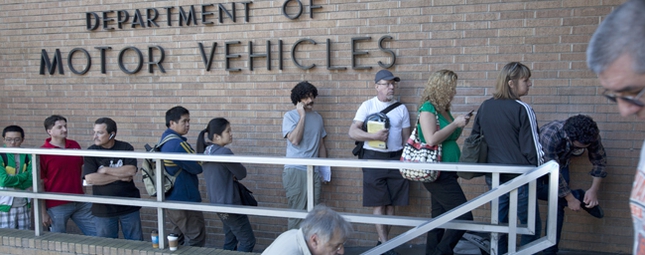
The other day I had to go to the DMV to get a registration sticker for my truck. I had renewed my registration online some two months earlier, but my registration sticker never came. When I called inquiring about my vehicle registration, they informed me that the sticker must have gotten lost in the mail and that it was my responsibility to drive to a DMV office and purchase a replacement sticker.
So that’s what I did.
When I arrived, I found two lines. One line took care of vehicle registration renewals and the other line took care of everything else. I was hoping I could wait in the registration renewal line, but because I was not renewing my registration and instead getting a replacement sticker, I had to wait in the other line. Did I mention that the other line was longer and moving much slower?
After over an hour waiting in line, I finally got my sticker. It took less than a minute. Needless to say, I walked out with less than a smile on my face.
I am not a patient person. God, however, is patient. The Bible regularly celebrates God’s patience: “The LORD is compassionate and gracious, slow to anger, abounding in love” (Psalm 103:8). Rather than getting upset easily and quickly, God’s patient love prevails.
For all of God’s patience, it is important to note that even His patience does not last forever. When Israel rebels against God for centuries in wickedness, God warns: “You have rejected me … You keep on backsliding. So I will reach out and destroy you; I am tired of holding back” (Jeremiah 15:6). God will only tolerate unrepentant sin for so long. Such sin will eventually lead to divine judgment. Thus, although we are called to trust God’s patience, we should not try God’s patience.
I got frustrated because I had to wait an hour to get my vehicle registration sticker at the DMV. God has been waiting thousands of years so more and more people might repent and trust in Him. And if God is can wait that long for us, maybe I can wait a little longer for others.
Tornadoes and Satan
 Crises have a strange way of calling people to faith. In a day and age where many are bemoaning that our nation is becoming increasingly secular, the devastating EF 5 tornado that struck Moore, Oklahoma on May 20 gave rise to an abundance of prayers and cries to God. Ed Stetzer paints the scene well in his article for USA Today, which is worth quoting at length:
Times of grief reaffirm our identity as a religious nation. Shortly after the horrific news of the tornado devastation in Oklahoma, “#PrayforOklahoma” quickly rose to the top of Twitter’s trending list as millions shared their prayers for the people who lost loved ones and had their homes destroyed.
In times of prosperity, far removed from tragedies, many people in our culture reject expressions of faith. In the moments of hopelessness, however, the desire to reach out to a higher power is an instinctive reflex.
Some may say, “But that’s Oklahoma – it’s the Bible Belt.” Yet, after the Sandy Hook tragedy, I was struck by the comment made by Connecticut Gov. Dan Malloy referencing our collective religious heritage:
“In the coming days, we will rely upon that which we have been taught and that which we inherently believe: that there is faith for a reason, and that faith is God’s gift to all of us.”
Many are embarrassed by this national identity – until it is time to grieve. Then, politicians, celebrities and reporters can unashamedly say they are praying for those affected. News networks will show church bells ringing in memory of those lost. Nightly news shows feel the need to broadcast excerpts from sermons delivered by pastors in the area. Journalists interview religious leaders about how God can help us through.
And yes, that is where the discussion often begins. We consider why this would happen. Some people representing faith groups may speak quickly (and unwisely), assuming they can connect the dots between something in our culture and the most recent tragedy.
Others simply ask the question, “How could God allow this to happen?”[1]
Tragedies of the sort that struck Moore, no matter how supposedly “secularized” our nation has become, call forth faith. And, as Stetzer duly notes, they also call forth questions. Most often, tragedies like the one in Moore call forth the question that Stetzer poses: “How could God allow this to happen?” But in the wake of the tragedy at Moore, I received another question that, though less common, is certainly worthy of a moment of our reflection: “Can Satan cause a tornado?” When a tragedy strikes, most people wonder about God’s power to prevent tragedies and His ultimate purpose in allowing them. But it is also worth asking what kind of prerogative Satan has to wreak havoc in our world.
Satan does seem to have some power to cause trouble in our world. One needs to look no farther than the story of Job. In nearly an instant, Job’s life goes from riches to rags. A quick sequence of four calamities, instigated by Satan himself, robs Job of nearly everything he has. The fourth of these calamities is especially instructive for our purposes: “Yet another messenger came and said, ‘Your sons and daughters were feasting and drinking wine at the oldest brother’s house, when suddenly a mighty wind swept in from the desert and struck the four corners of the house. It collapsed on them and they are dead, and I am the only one who has escaped to tell you’” (Job 1:18-19)! Notice that it is a windstorm that Satan sends to destroy Job’s family. Satan, it seems, does seem to have limited power to incite natural disasters.
It is important to note that, as the story of Job clearly delineates, Satan incites calamities on a person not because a person is somehow particularly sinful or deserving of such calamities, for Job was “was blameless and upright; he feared God and shunned evil” (Job 1:1). No, Satan incites calamities out of depraved delight – he enjoys watching people suffer.
Certainly we cannot know, nor should we speculate on, the transcendental cause of Moore’s devastating tornado. The most we can say is that natural disasters are part of living in a sinful, fallen world and Satan takes cynical delight in the effects of sin on our world.
But there is hope. For even if Satan can incite calamities, his ability to do so is severely – and blessedly – limited. Jesus describes Satan as a “strong man” whose fate is sealed: “How can anyone enter a strong man’s house and carry off his possessions unless he first ties up the strong man” (Matthew 12:29)? Satan may be a strong man. But Jesus is the stronger man. And He came to tie up Satan by defeating his favorite calamity – death – on the cross.
Ultimately, then, no matter what the spiritual causes of the natural disasters that plague our world may be, in this we can take consolation: no matter how much strength sin and Satan may have for ill, Jesus is stronger. He’s so strong, in fact, that “even the wind and the waves obey Him” (Matthew 8:27). He has things under control. And He holds Moore’s victims in His heart and hands. May we hold them in our prayers.
[1] Ed Stetzer, “We still cry out to God when tragedy strikes: Column,” USA Today (5.22.2013).
ABC Extra – Daunting Decisions
 This past weekend in worship and ABC, we kicked off a new series called “Unresolved” where we are addressing some of the biggest issues and struggles which are often left unresolved in people’s hearts and lives. This weekend, we asked the question, “What happens when you are unresolved as to which direction you should take or which decision you should make for your life? How do you receive direction from God?”
I have learned that, in general, God gives us direction in one of the three ways. First, there are some things on which God directs us, “Go!” These are things we ought to do and directions we ought to take. For instance, God instructs the prophet Jonah, “Go to the great city of Nineveh and preach against it, because its wickedness has come up before me” (Jonah 1:2). Jonah, however, disregards God’s commission and hops a ship to Tarshish, a city in the opposite direction of Nineveh. Understandably, God is not pleased with Jonah’s rebellion and sends a storm in judgment on Jonah and his sailing companions. In order to save themselves, the sailors throw Jonah overboard so that God will calm the crazy seas. When Jonah is cast overboard, God appoints a fish to swallow Jonah and spit him up, poetically enough, right on the banks of Nineveh! From Jonah, then, we learn that there is grave danger in not heeding God’s direction to “Go!” In theological parlance, we call a failure to “Go” a “sin of omission.” That is, when we know what we should do and where we should go, but we fail to do and go, we commit a sin of omission. We omit God’s direction and instruction from our lives.
Second, there are some things on which God directs us, “Whoa!” These are things we ought not to do and directions we ought not to take. For instance, the famous “Thou shalt nots” of many of the Ten Commandments are things to which God says, “No!” Should I sneak away with a lover and ruin my marriage? “Thou shalt not commit adultery” (Exodus 20:14). Should I tell a lie about someone else? “Thou shalt not bear false witness against your neighbor” (Exodus 20:16). Should I spend my time trying to coax others into giving me their things? “Thou shalt not covet” (Exodus 29:17). If we do not heed God’s commands and go where God says “Whoa,” in theological parlance, we call this a “sin of commission.” That is, we cross a boundary God has drawn and thus commit a sin. These sins too, like sins of omission, are gravely dangerous and offensive to God.
Finally, there are some things on which God directs us, “Grow!” These are some decisions that God leaves us to make. For instance, there are times that God will leave it up to us to choose a job, choose a place to live, or choose the stocks we invest our money in. God can give us clear guidance on these decisions, but He does not promise to. Therefore, sometimes He guides us in a specific direction concerning these issues and sometimes He does not. The times when He does not specifically guide us help us grow, for we learn to make wise, reasonable decisions for ourselves. The times when He does specifically guide us also help us grow, for they teach us to listen closely and carefully for God’s leading and prompting.
As I mentioned in ABC, it is with decisions like these – where God gives us no clear direction in His Word – that we do well to include three things in our decision making process. First, we must ask for God’s wisdom and guidance. Though this may sound obvious, far too many people do not do this! They do not even consider the possibility that God may indeed have an opinion on a life decision! Thus, learning simply to take your decisions – big and small – to God in prayer not only allows you to experience God’s guidance, it also strengthens your relationship with Him because you are speaking with Him about the significant and small things of your life on a daily basis. Second, we should wait expectantly and intentionally for God’s answer. So often, even when we do pray to God about a decision we must make or a challenge we must face, we do not wait for God’s answer. We simply continue charging ahead at full speed, expecting God to strike us like a lightning bolt out of the blue with His answer. But we must not only learn how to ask God for guidance, we must also learn how to listen. This means taking time in slowness and solitude, seeking God’s direction. Finally, we should counsel with other Christians. Just as God can lead and guide us, he can lead and guide others. Thus, the wisdom of other Christians is invaluable in helping us make wise decisions..
God can and does direct you. As the Psalmist prays, “Direct my footsteps according to Your word.” May his prayer be our prayer! And may God give you His guidance!
Want to learn more? Go to
www.ConcordiaLutheranChurch.com
and check out audio and video from Pastor Tucker’s
message or Pastor Zach’s ABC!
Cosmology and Philosophy
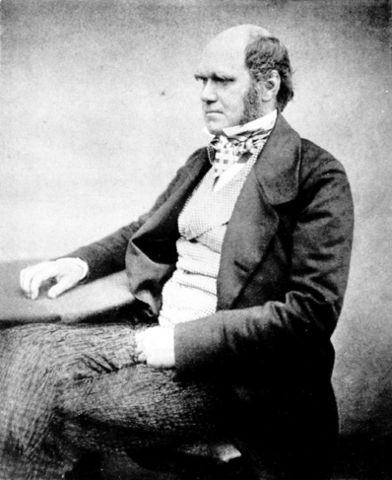 Your philosophy is an inextricable concomitant of your cosmology. Charles Darwin knew this all too well. Most people are at least passingly familiar with Darwin’s seminal work, The Origin of Species. In it, he proffers a framework for understanding the origins of human life – and all life – using his mechanism of evolution by natural selection. In his own words, here is Darwin’s theory in a nutshell:
As many more individuals of each species are born than can possibly survive, and as, consequently, there is a frequently recurring struggle for existence, it follows that any being, if it vary however slightly in any manner profitable to itself, under the complex and sometimes varying conditions of life, will have a better chance of surviving, and thus be naturally selected. From the strong principle of inheritance, any selected variety will tend to propagate its new and modified form. (Origin of Species, p. 29)
Darwin begins with the assumption that life, at its root, is a struggle for survival. He then concludes that those who win the struggle for survival carry on while those who lose the struggle do not. This is natural selection. Moreover, those who win the struggle for survival propagate more of their kind and develop “modified” characteristics which further benefit them in their struggle. This is evolution. Over time – indeed, over lots and lots of time – these beneficial characteristics continue to evolve so radically that whole new species arise from common ancestors while other, weaker species die out. This, then, is the origin of species. This is the origin of our species. We are the product of the cold hand of evolution by natural selection. This is Darwin’s cosmology, that is, his view of the laws of the world and, by extension, the cosmos.
But how you view things cosmologically inevitably informs how you view things philosophically. That is why, after publishing The Origin of Species, Darwin published The Descent of Man, a philosophical take on his cosmological theory. Thus, Darwin lamented according to the presuppositions of his cosmological theory of evolution:
We civilized men do our utmost to check the process of elimination; we build asylums for the imbecile, the maimed, and the sick; we institute poor-laws; and our medical men exert their utmost skill to save the life of every one to the last moment. There is reason to believe that vaccination has preserved thousands, who from a weak constitution would formerly have succumbed to small-pox. Thus, the weak members of civilized societies propagate their kind. No one who has attended to the breeding of domestic animals will doubt that this must be highly injurious to the race of man. It is surprising how soon a want of care, or care wrongly directed, leads to the degeneration of a domestic race; but excepting in the case of man himself, hardly any one so ignorant as to allow his worst animals to breed. (Descent of Man, p. 168)
Darwin laments that humans work against evolutionary progress through wrongheaded ignorant attempts to save and care for those which natural selection would eliminate. If evolution by natural selection is the incontrovertible law of the forward progress of life, then to work against it by tending to the weak and sick is to take life backwards rather than forwards.
Most people, of course, are not nearly so bold connecting cosmological evolution to philosophical evolution as was Darwin. Allowing our sick and maimed to die in the name of natural selection would appall the vast majority us. And yet, Darwin is simply teasing out the philosophical inevitabilities of his cosmological presuppositions. He is being perfectly consistent. Why aren’t we?
The fact of the matter is, the way one views the universe informs and, finally, dictates the morals and ethics one holds. Darwinian evolution, if it is perceived to be the engine behind the improvement of life, cannot be meddled with by the likes of so-called “do-gooders” who are not really doing good at all. For such people are slowing evolution’s forward march by caring for the lesser evolved among us.
Christianity, of course, has a very different view of humanity’s place and value. According to Christianity, human beings are not merely the products of an inexorable evolutionary march, eventually to be displaced as the kings of the cosmos by a better and higher form of life thanks to natural selection. Rather, we are specially created by God “in His own image” (Genesis 1:27) to be the caretakers of His creation (cf. Genesis 1:28-31). Thus, we can, and are even bound, not by some unfathomably lengthy evolutionary progress, but by the intentions of our Creator. And one of His intentions for us is “to love mercy” (Micah 6:8). So, we are merciful to each other. We care for those who cannot care for themselves.
Your philosophy is an inextricable concomitant of your cosmology. So what is your cosmology? One that is driven by evolution by natural selection? Or one that rejoices in the merciful, creative hand of our God? How you answer that question makes all the difference in how you view your life…and the lives of others.


 Pastor Zach's Blog