Posts tagged ‘Ethics’
“Don’t Ask, Don’t Tell” Lives!
 Apparently, “Don’t ask, don’t tell” didn’t die in our Armed Forces, it just moved to our marriages. Recently, Redbook published a part-confessional, part-apologetic exposé titled, “How Affairs Make My Marriage Stronger.” The author, who, not surprisingly, chose to remain anonymous, opens salaciously:
It’s a Wednesday night, and my boyfriend and I are drinking wine and making out in the back booth of a dimly lit bar. It feels like nothing else in the world exists…until my phone vibrates.
“It’s my husband. The kids are in bed,” I say, then put my phone in my purse and pull my boyfriend toward me. I spend half a second staring at the diamond on my engagement ring before hiding my hand from my sight line. It’s not a secret that I’m married, but it’s also not something I want to think about right now.
Am I a horrible person? Without context, I know I sound horrible. But in my marriage, having affairs works. My husband and I don’t talk about it. But I’m certain our don’t-ask-don’t-tell rule is what has allowed our marriage to last as long as it has.
Notice that I didn’t say we’re in an open marriage – we’re not. An open marriage is transparent, with agreed-upon rules and an understanding of what both parties will and will not do with others. My marriage is opaque.[1]
What a sham of a marriage – full of affairs and cover-ups. It should be a soap opera. Instead, it’s real life.
What I find most striking about this apologetic for adultery is how kitschy it is – even according to the author’s own admission. In a telling line, she concedes, “The more I think about it, the less okay I am with our lifestyle, so I’ve become pretty good at shutting down that part of my brain.” If there ever was a line that affirmed the inescapably reality of natural, moral law, this is it! No matter what she may claim about she and her husband’s affairs, she can’t escape the feeling that something isn’t right. As the apostle Paul explains: “The requirements of the law are written on [people’s] hearts, their consciences also bearing witness, and their thoughts now accusing, now even defending them” (Romans 2:15).
As much moral ire as this article raises in me, it raises even more sympathetic pain. It’s hard to listen to this woman divulge her deeply held fears without having my heart broken:
Truth be told, I do worry that Dave might fall in love with someone else. That’s why when I see his secret smiles or notice him spending tons of time texting, I step it up on my end, asking him to be home on a certain night and initiating sex. I remind him how much I love him and how much our marriage means to me.
What’s the title of this article again? “How Affairs Make My Marriage Stronger”? What a lie. So let’s try some truth:
I take you to be my wedded beloved, to have and to hold from this day forward, for better, for worse, for richer, for poorer, in sickness and in health, to love and to cherish, till death us do part, according to God’s holy will; and I pledge to you my faithfulness.
You took the vow. You made the promise. So keep it. You’ll be better for it. Your heart will be filled with it. And you’ll please God by it.
_______________________
[1] Anonymous, as told to Anna Davies, “How Affairs Make My Marriage Stronger,” Redbook (5.18.2014).
Beyond the Pale: What UK Hospitals Are Doing With Aborted Babies
 Moral standards are moving targets. Ask three people for their thoughts on a contentious moral or ethical issue and you’ll get four opinions. But there are some things so unequivocally horrifying – so undeniably mortifying – that they command universal and reflexive shock, outrage, and revulsion. Enter an exposé by London’s Telegraph newspaper on what’s heating some UK hospitals:
The bodies of thousands of aborted and miscarried babies were incinerated as clinical waste, with some even used to heat hospitals, an investigation has found.
Ten NHS trusts have admitted burning fetal remains alongside other rubbish while two others used the bodies in ‘waste-to-energy’ plants which generate power for heat.
Last night the Department of Health issued an instant ban on the practice which health minister Dr. Dan Poulter branded ‘totally unacceptable.’
At least 15,500 fetal remains were incinerated by 27 NHS trusts over the last two years alone …
One of the country’s leading hospitals, Addenbrooke’s in Cambridge, incinerated 797 babies below 13 weeks gestation at their own ‘waste to energy’ plant. The mothers were told the remains had been ‘cremated.’[1]
No matter how many times I read this article, it still makes me sick to my stomach. And I’m not the only one who finds this story nauseating, as the comments posted under the story indicate. One reader comments, “I think I am going to be sick.” Another writes, “The horror of it … what has our country become folks? This is just too much.” And still another existentially inquires, “Dear God, what have we become?”
Though much could be written about this story – and, I would add, I hope much is written about this because this is a story that needs to be thoroughly vetted – I want to offer two initial observations about this terrible, tragic report.
First, it must be admitted that here is an unabashed display of human depravity at it most dreadful depths. Just the thought of treating fetal remains so carelessly and callously should turn even the most hardened of stomachs. In Western society, we pride ourselves on making moral progress. We trumpet our advances on the frontier of human rights. A story like this one should give us a gut check. Moral progress is never far from moral regress. Indeed, even secular theorists are beginning to realize that humanity is not on an ever-improving, ever-increasing moral arc. Alan Dershowitz, one of the great secular thinkers of our time, admits as much in an interview with Albert Mohler when he says:
I think the 20th century is perhaps the most complicated, convoluted century in the history of the world perhaps because I lived in it, but it had the worst evil. Hitler’s evil and Stalin’s evil are unmatched in the magnitude in the world … On the other hand, it was the century in which we really ended discrimination based on race and based on gender. We made tremendous scientific progress … So I think the 20th century has really proved that progress doesn’t operate in a linear way … We don’t evolve morally, we don’t get better morally as time passes.[2]
Morally, we must be continually careful and endlessly vigilant. We will never become so good that we are no longer bad. To quote the caution of the apostle Paul: “If you think you are standing firm, be careful that you don’t fall” (1 Corinthians 10:12)!
The second observation I would offer on this story is that we are sadly deluded as a society if we decry the burning of fetuses on the one hand while supporting abortion on the other. There is a reason incinerating fetuses to heat hospitals has raised so many moral hackles. And it’s not because these fetuses are nothing more than “tissue.” Indeed, I find it quite telling that The Telegraph refers to these fetuses as “remains.” A quick perusal of a dictionary will find that the noun “remains” refers to “dead bodies,” or “corpses.” In other words, dead people. This is not just aborted tissue. These are aborted people. Aborted babies. But now these babies have passed. And to treat the dead in such an undignified manner as these UK hospitals have is unconscionable. The difference between the passing of these babies, however, and the passing of others who die in hospitals is that these babies have died intentionally at the hands of abortion doctors.
Yes, I am well aware of arguments for abortion that center on a woman’s right to do with her body as she pleases. But if she can do with her body as she wishes, I’m not sure why a hospital can’t do with its procedural remains as it wants. If it can throw away fluid drained from someone’s lungs in a biohazard bag, why can’t it burn a baby? Yes, I am aware that some may accuse me of making a fallacious “slippery slope” argument and they would counter-argue that you don’t need to ban abortion to decry the burning of fetal remains. But this counter-argument intimates that abortion is somehow a lesser evil than burning aborted corpses – an assumption I do not share. Indeed, I think abortion is a great and deep evil – but not just because I believe it deliberately ends the life of a child, but because I hate what abortions do to the women who suffer through them. Case in point: a recent study in The British Journal of Psychiatry shows that women who undergo abortions have an 81 percent higher risk of subsequent mental health problems.[3] Nevertheless, proponents of abortion could claim that one can support abortion without sliding all the way down the slope into the moral morass of these UK hospitals. But I would point out that we already have, in fact, slid all the way down this slope. The charred now non-remains of 15,500 babies testify to it. So perhaps it’s time to repent and, by the grace of God, start scaling the slope – and not just halfway up the slope, but all the way off the slope. Human depravity warns us that if we don’t, we’ll slide right back down again.
______________________
[1] Sarah Knapton, “Aborted babies incinerated to heat UK hospitals,” The Telegraph (3.24.2014).
[2] Albert Mohler, “Moral Reasoning in a Secular Age: A Conversation with Professor Alan Dershowitz,” albertmohler.com.
[3] Priscilla K. Coleman, “Abortion and mental health: quantitative synthesis and analysis of research published 1995–2009,” The British Journal of Psychology 199 (2011), 182.
Unreal Sales for Real Marriage
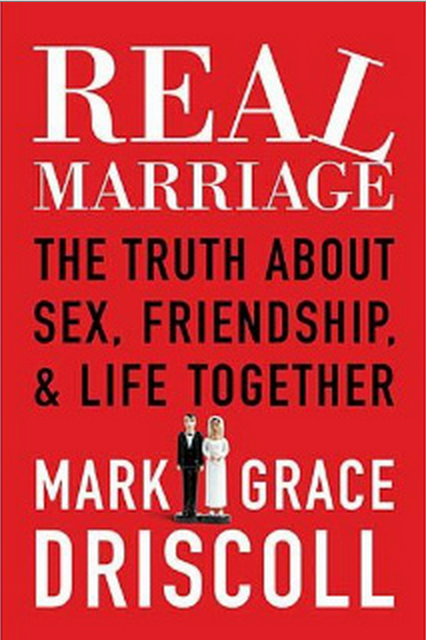 It seems as though the New York Times bestseller list just isn’t what it used to be. In an article for the Los Angeles Times, Carolyn Kellogg writes about the saga of a recent book that became a New York Times bestseller not because lots of people were buying it, but because a company called ResultSource was buying thousands of copies of the book with the express intent of turning it into a bestseller. Kellogg begins by citing from World magazine, the news outlet that broke the story:
“The contract called for the ‘author’ to ‘provide a minimum of 6,000 names and addresses for the individual orders and at least 90 names and address [sic] for the remaining 5,000 bulk orders. Please note that it is important that the makeup of the 6,000 individual orders include at least 1,000 different addresses with no more than 350 per state.’”
Measures like these are designed to game the systems set in place by BookScan and other book sales talliers to protect the integrity of their bestseller lists …
After getting thousands of names with geographic diversity, RSI took another step to place [the book] on bestseller lists, according to the World article. The agreement specifies, “RSI will use its own payment systems (ex. gift cards to ensure flawless reporting). Note: The largest obstacle to the reporting system is the tracking of credit cards. RSI uses over 1,000 different payment types (credit cards, gift cards, etc).”[1]
Wow. That sure sounds shady.
Did I mention the book in question is Real Marriage, written by famous mega-church pastor Mark Driscoll? And did I mention his church, Mars Hill in Seattle, shelled out, according to some reports, over $200,000 to get his book to the top of the New York Times bestseller list?
In many ways, Mark Driscoll and I are kindred spirits. We share many of the same theological commitments. When it comes to preaching, we both believe a good sermon must not primarily be about what we are to do, but about what God has done for us in Jesus Christ. When it comes to Scriptural authority, both of us hold doggedly to the doctrine of inerrancy, even though some voices are seeking to discredit it these days. When it comes to salvation, we both believe that, contrary to our society’s pluralistic ethos, salvation is found in no one but Christ. We share a lot in common. But for all our theological similarities, what happened with Real Marriage represents a weighty ethical difference.
I know sales number shenanigans are not at all unusual in the publishing world. Authors do this kind of thing all the time. Sarah Cunningham of the Huffington Post explains that Real Marriage’s marketing strategy is only a symptom of a systemic disease:
This book launch strategy … wasn’t shocking to anyone who has been involved in the publishing industry … There have always been ways to underwrite the success of authors in any field, religious or not, when the efforts were attached to a deep enough bank account. Don’t doubt for a second, then, that some of Mark’s … counterparts haven’t done (or tried to do) the same.[2]
According to Cunningham, when it comes to cooking sales numbers, “everybody’s doing it.” But this go-to teenage quip is a sorry justification for what is a seriously unethical practice.
When I visited ResultSource’s website, I found it curious that although they made all sorts of promises that they can get a book onto the New York Times bestseller list, they didn’t give a clear explanation of how they can get a book onto the New York Times bestseller list. Here’s a sampling of what their website boasts:
We partner with authors to create and tap an audience – to connect the potential buyers of your book directly with the bookseller to leverage your launch potential. Our goal is to reach further than just typical launch management – our deep relationships enable us to create opportunities outside of what’s expected, to gain substantial traction within the critical “first 90 days” of your launch – or booksellers will send your book back to the publisher.
RSI can:
Leverage our relationships with individuals in “Seven Channels of Influence” to promote your book. Research shows that people are influenced by multiple touch-points – and that our buying decisions are driven by as many as seven channels within our culture.
Send email promotions to as many as 300,000 book buyers on our proprietary database of business and self-help book buyers.
Write and design electronic promotions such as banners, excerpts, and Q&As.
Build a powerful merchandising program with key retailers like airport booksellers, Amazon, B&N (Brick-n-Mortar and BN.com), Borders, Books-A-Million and independent outlets. The key to a winning book launch campaign is to have copies of your book in prominent positions at as many retailers as possible – and then drive sell through.[3]
Now, besides being a little leery of any company that makes selling a book through Borders (NYSE: BGP $0.00 +0.00%) a featured component of their marketing strategy, I am also deeply unsettled by the ambiguity of their claims. I honestly have no idea what they’re talking about. What are the “Seven Channels of Influence”? What, exactly, does it mean to “build a powerful merchandising program with key retailers”? And why don’t they mention that their primary strategy to drive sales is for this company to buy thousands of copies of a particular book in a way that dupes bestseller lists into believing thousands of people are buying the book? If a company can’t talk openly and honestly about the services they offer, perhaps they shouldn’t be offering them.
Ultimately, I point out what happened with Real Marriage not to pick on Mark Driscoll, but because this scandal is indicative of a wider, toxic pattern that needs to be addressed. In this particular instance, I appreciate how the Board of Advisors and Accountability at Mars Hill has responded to this controversy, writing, “While not uncommon or illegal, this unwise strategy is not one we had used before or since, and not one we will use again.”[4] I am glad to hear that. I hope others follow suit.
From a theological perspective, Driscoll pinpoints the root of the problem in this whole saga in another one of his books when he writes, “This world’s fundamental problem is that we don’t understand who we truly are – children of God made in His image – and instead define ourselves by any number of things other than Jesus.”[5]
I couldn’t agree more. If the prestige of being a New York Times bestselling author is so bewitching that a whole company can be created to help authors pay their way onto this list, something is terribly and tragically awry. We are defining ourselves by all the wrong things.
Regardless of whether or not Mark Driscoll actually is a bestselling author, he is a child of God. So am I. And that’s good enough. Because, in the end, that’s what really matters.
[1] Carolyn Kellogg, “Can bestseller lists be bought?” Los Angeles Times (3.6.2014).
[2] Sarah Cunningham, “The Injustice of Silence: Why Our Culture Pulled Mark Driscoll Over For a Broken Headlight,” Huffington Post (3.6.2014).
[3] ResultSource.com, “Book Launch Campaigns.”
[4] “A Note From Our Board of Advisors & Accountability,” Mars Hill Church (3.7.2014).
[5] Mark Driscoll, Who Do You Think You Are? Finding Your True Identity In Christ (Nashville, Thomas Nelson, 2013), 2.
S.B. 1062
Credit: LA Times
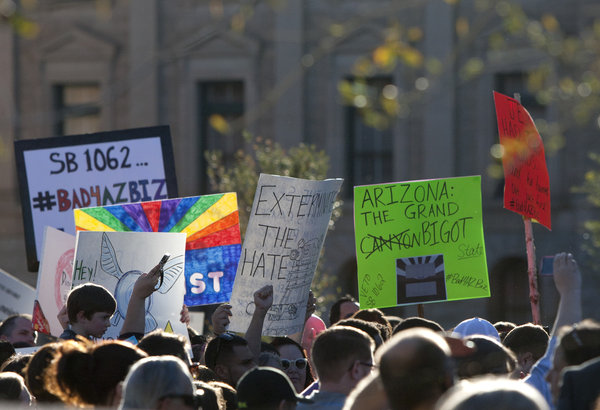
A funny thing happened on my way back from a recent trip I took to Arizona. The state became embroiled in a heated political battle over Senate Bill 1062.[1] Okay, it may not have been funny. But these kinds of battles are common.
According to some, S.B. 1062 championed religious liberty, allowing business owners with religious convictions to deny service to a party if the business owner felt that serving that party would substantially burden or contradict his religious convictions. According to others, S.B. 1062 violated the civil rights of homosexuals by formally and legally legitimatizing discrimination against them.
Last Wednesday, Governor Jan Brewer vetoed the bill, explaining, “I have not heard of one example in Arizona where business owners’ religious liberty has been violated … The bill is broadly worded and could result in unintended and negative consequences.”[2] Of course, the political pressure on Governor Brewer was hot:
Companies such as Apple Inc. and American Airlines, and politicians including GOP Sen. John McCain and former Republican presidential nominee Mitt Romney were among those who urged Brewer to veto the legislation. The Arizona Super Bowl Host Committee, which is overseeing preparations for the 2015 game, came out with a statement against the legislation. The Hispanic National Bar Association on Wednesday said it canceled its 2015 convention in Phoenix over the measure.[3]
In observing the volley between supporters and detractors of this bill, two things strike me.
First, homosexuality – and, specifically, gay rights – is not only a hot topic in our society, it is the hot topic in our society. Interestingly, nowhere does S.B. 1062 mention homosexuality. It simply speaks of “the free exercise of religion.” Yet, USA Today reported on Governor Brewer’s veto of the bill with this headline: “Arizona governor vetoes anti-gay bill.”[4] These days, how a piece of legislation will affect the gay community is the litmus test as to whether or not a bill can or should pass, even if that bill does not specifically mention the gay community. Gay rights, then, are front and center. They are the battleground du jour of our society.
Second, there are a lot of homosexuals who deeply despise Christians with orthodox beliefs concerning the sinfulness of homosexual activity and will go to great – and even duplicitous – lengths to paint Christians as homophobic bigots. Stories abound of people who have concocted heinous hate crimes against themselves. Take, for instance, the lesbian couple that spray-painted their own garage with the message “Kill the gay.”[5] Or how about the Tennessee man who falsely claimed that three men beat him and robbed his store in an anti-gay attack?[6] Then, of course, there was the famed incident of the waitress who falsely claimed she was stiffed on a tip because she was a lesbian.[7] Personally, I don’t want to think of anyone in the homosexual community as my enemy. Life is too short to keep an enemies’ list. But I am not so naïve as to believe that there aren’t some in the homosexual community who think of me as their enemy.
So what am I to do?
Jesus’ admonition to pray for those who are on the outs with you (cf. Matthew 5:44) seems to be especially apropos for a time such as this. To this end, I would invite you to join me in praying for three things as the culture war over sexual rights continues to rage.
First, pray for forgiveness. Though it is painful to admit, it was not too long ago that it was exponentially more likely for a message like “Kill the gay” to be spray painted not by someone self-imposing a hate crime, but by someone committing one. And sometimes, that someone was even a self-professed Christian. This, of course, directly defies a myriad of biblical commandments concerning our conduct as Christians. Our call to tell the truth about sin must never be a license to commit sin – especially the sin of hate. We need forgiveness for our missteps – which are plenty – in this debate.
Second, pray for understanding. I want to be understood. I want people to understand and believe that I am not a homophobic hate monger who wants to oppress, humiliate, and exile those who do not share my same faith and ethical commitments. But if I want this for myself, it is only fair that I afford the same courtesy to others. Martin Luther summarized the Eighth Commandment by saying that, when dealing with our neighbors, we should “put the best construction on everything.”[8] I can think of no better way to respond to those who put the worst construction on Christians’ intentions than by putting the best construction on theirs. Generous understanding offers our greatest hope for peace in the midst of a hotly contested and, sadly, dirtily fought culture war.
Third, pray that true love would prevail. The “true” is just as important as the “love” here, for our society has settled for a counterfeit love that reduces love to nothing more than tolerance. Just the other day, I heard a caller to a radio talk show explain how one of the primary virtues of Christianity is tolerance. Really? A quick search of the word “tolerate” in the Bible brings up verses like these:
- Whoever slanders their neighbor in secret, I will put to silence; whoever has haughty eyes and a proud heart, I will not tolerate. (Psalm 101:5)
- Your eyes are too pure to look on evil; You cannot tolerate wrongdoing. Why then do You tolerate the treacherous? (Habakkuk 1:13)
- It is actually reported that there is sexual immorality among you, and of a kind that even pagans do not tolerate: A man is sleeping with his father’s wife. (1 Corinthians 5:1)
Tolerance does not seem to be the high brow Scriptural virtue that some would like to peddle it as. This is not to say that we shouldn’t live with, work alongside with, and care for people who do not share our same moral commitments. In this way, we should indeed be tolerant. But tolerance does not necessarily entail endorsement.
Ultimately, as Christians, we ought to aspire to a much higher value than that of tolerance. We ought to aspire to love. “Love,” the apostle Paul reminds us, “does not delight in evil but rejoices with the truth” (1 Corinthians 1:6). To love someone well, we must tell him the truth, even when the truth is unpopular. This is our calling with all sin – sexual and otherwise.
So these are my prayers. Now, it’s your turn. Will you join me in praying the same?
[2] Aaron Blake, “Arizona governor vetoes bill on denying services to gays,” The Washington Post (2.26.2014).
[3] Bob Christie, “Arizona Religious Bill That Angered Gays Vetoed,” ABC News (2.27.2014).
[4] Dan Nowicki, Yvonne Wingett Sanchez and Alia Beard Rau, “Arizona governor vetoes anti-gay bill,” USA Today (2.26.2014).
[5] Alyssa Newcomb, “Lesbian Couple Charged With Staging Hate Crime,” ABC News (2.19.2012).
[6] Chuck Ross, “Report: Man falsified police report in alleged anti-gay attack,” The Daily Caller (12.26.2013).
[7] Cavan Sieczkowski, “New Jersey Waitress In Anti-Gay Receipt Saga Reportedly Let Go From Job,” The Huffington Post (12.9.2013).
Michael Sam Makes It Public

Credit: cnn.com
“Does the NFL have any gay players?” my wife asked me last Sunday. She was watching a Hallmark Valentine movie where one of the characters, an NFL quarterback, came out as homosexual. “No, sweetie,” I responded. “The NFL does not have any openly gay players. There have been some players who have come out after they left the NFL, but to date, no players currently in the NFL are openly homosexual.”
It didn’t take long for that to change.
The next morning, while I was working out and watching ESPN, there was Michael Sam, former Missouri Defensive End and candidate in the NFL draft, coming out on national TV as a gay football player. “I am an openly, proud gay man,” Sam told ESPN’s “Outside the Lines.” Granted, Sam is not an NFL player…yet. But his prospects are good.
I am surprised – pleasantly so – by how muted the negative response to Sam’s announcement has been. Some journalists have hinted that responses could turn negative, but to date there is no swell of detractors decrying Sam as a dangerous degenerate. By the same token, those who are writing and speaking about him are hailing him as a hero. Brendon Ayanbadejo, a former linebacker who is currently a free agent, was effusive about Sam’s announcement, comparing him to Jackie Robinson and Rosa Parks. To cap off his feelings concerning Sam, he said, “To borrow from Neil Amstrong, this is one small step for gay men and one giant leap for the LGBTQ community.”[1] Juliet Macur of the New York Times wrote a manifesto demanding that an NFL team draft Sam. She begins by writing, “It’s time,” and ends by declaring, “Sam must be drafted. It’s time to move forward. The teams and the league are on the clock.”[2] For Macur, Sam’s status as a future NFL star is not a matter of his talent, but of a moral imperative that says the NFL must have an openly gay player.
For orthodox Christians, all of this can be hard to sort out. On the one hand, there is something to be celebrated here. It is refreshing to see so many display a measured sensitivity to and deep compassion for those with same-sex attractions and those in same-sex relationships. The gay slurs, gay jokes, and gay bashing of yesteryear have drastically dissipated and, for my part, I say, “Good riddance.” Such speech is diametrically opposed to the biblical command to love, which Paul says is the fulfillment and summation of all biblical commandments (cf. Romans 13:8-9). On the other hand, Christians cannot pretend that our society’s sexual free-for-all, which demands not only the toleration of, but the celebration of sexual practices that are far from biblical standards for human sexuality, is nothing more than an issue of civil rights. Whether it’s Michael Sam touting his homosexuality or Richie Incognito and Jonathan Martin exchanging texts about how many women they have slept with and the use of prostitutes,[3] the spacious sexual ethic of our society is simply not something Christians can endorse. Partly because it’s immoral and Scripturally forbidden, yes. But also because it hurts, belittles, and objectifies people, which, in and of itself, is tragic, no matter what your ethical worldview.
Ultimately, the loose sexual standards of our society are nothing new. The path of sexual salaciousness is well worn – not only in twenty-first century America, but in all the societies that have come before her. But we can choose a different path. We can choose the path of sexual commitment in marriage while walking “humbly with our God” (Micah 6:8). I pray that we do. For when we do, we not only live out God’s sexual standard in our commitments, we show God’s lavish love by our humility.
[1] Mike Foss, “Ex-NFL player: Draft prospect who came out is like Jackie Robinson and Rosa Parks,” USA Today (2.10.2014).
[2] Juliet Macur, “It’s Time for the N.F.L. to Welcome a Gay Player,” New York Times (2.9.2014).
[3] Adam H. Beasley, “Texts shed light on relationship between Miami Dolphins’ Jonathan Martin, Richie Incognito,” Miami Herald (2.5.2014).
Pluralistic Ignorance, a.k.a., “Everybody’s Doing It”
 “Everybody’s doing it.” Before this line was used by teenagers in attempts to strong-arm their parents into allowing them to engage in all manner and kind of youthful foolishness, it was the title of a 1938 movie about an alcoholic who creates picture puzzles for a national contest only to get kidnapped before he can deliver the final batch of puzzles. From the reviews I’ve read, the movie wasn’t very good or very believable.[1]
“Everybody’s doing it.” Long after the movie, I remember using this line on my parents – with slight modifications, of course. If I wanted to go to a party, I’d tell my parents, “But everyone will be there!” Or if I wanted my parents to buy me something, I’d tell them, “But everyone else has one!”
“Everybody’s doing it.” This is more than just a teenager’s favorite line. It’s also a dangerous state of mind.
A few years ago, two researchers from Binghamton University in New York, Chris Reiber and Justin Garcia, published a paper titled, “Hooking Up: Gender Differences, Evolution, and Pluralistic Ignorance.”[2] In this paper, they explored the differences between the real and perceived comfort levels with different types of sexual activity among young adults. They discovered what psychologists refer to as “pluralistic ignorance.” They explain:
Pluralistic ignorance (PI) has been demonstrated to play a role in hook-up behavior. PI is characterized by individuals behaving in accordance with (generally false) beliefs attributed to the group, regardless of their own beliefs … Young adults routinely believe that others are more comfortable with various sexual behaviors than they, themselves, are. This leads them to behave as if they were more comfortable than they actually are, and engage in behaviors with which they are not actually comfortable.
After a myriad of charts and graphs illustrating this thesis, the researchers conclude, “Individuals of both genders attributed to others of the same gender higher comfort levels [with different kinds of sexual activity] than they themselves had.” In other words, those surveyed thought that “everyone was doing it,” but, as it turns out, they’re not. And if you think they are, you’re ignorant about what’s going on in the bedrooms of the plurality of people in our world.
Tragically, this perception of the nature and type of sexual activity among one’s peers often leads to the violation of one’s own ethical sensibilities. Thus, far too many people wind up breaching moral boundaries for the farcical, mistaken impression that “everyone is doing it.”
In his epistle to the Romans, the apostle Paul speaks of how “the requirements of [God’s] law are written on [people’s] hearts, their consciences also bearing witness, and their thoughts sometimes accusing them and at other times even defending them” (Romans 2:4). The apostle here contends that all people, whether or not they are Christian, have a conscience – a foundational moral compass that helps them distinguish right from wrong. My contention is that we ought to spend more time listening to our consciences and less time worrying and wondering about what “everybody else” is doing. As the research shows, we don’t really know what everybody else is doing and when we try to guess, we guess wrong.
So, to those who are thinking of breaching an ethical boundary so you can roll with a cultural tide, you need to know: the cultural tide will only roll you. Others are not doing what they say they’re doing and you don’t really know what they’re doing anyway. So listen to your conscience, not to them. Or, better yet, listen to God’s Word. You’ll wind up much less morally anguished and much more joyfully fulfilled.
[2] Chris Reiber & Justin R. Garcia “Hooking Up: Gender Differences, Evolution, and Pluralistic Ignorance,” Evolutionary Psychology 8, no. 3 (2010): 390-404.
The Court of Public Opinion

Credit: rmsbunkerblog.wordpress.com
We are a nation of polls. We poll public opinion on just about everything imaginable – from how Congress is doing their jobs to how the president is doing his job to how many people support gay marriage to how many people support tougher gun control laws to how many people support the legalization of marijuana.
It’s this last bit of polling data that formed the focus of an L.A. Times article by Robin Abcarian, which chronicled the shifting tide of public opinion on our culture’s most famous controlled substance:
The Gallup organization released a poll showing that for the first time in 44 years, a wide margin of Americans – 58% to 39% – believe marijuana should be legalized.
Less than a year ago, only 48% said pot should be legal. That is an astonishing leap of 10 points in the last 11 months alone.[1]
The article explains that Colorado and Washington have led the curve by legalizing recreational marijuana use and their progressive policies, in turn, are moving the country forward: “Like gay marriage, pot is here to stay. And just like gay marriage, it seems like the rest of the country is finally starting to catch on. Or light up.”
Personally, I find it ironic and more than a little medically disingenuous that at the same time cigarettes are increasingly controlled and decried because of the health risks associated with inhaling nicotine, tar, and smoke, using marijuana, which impairs motor abilities and adversely affects cardiopulmonary health, is increasingly accepted.
Regardless of the medical and, for the matter, moral arguments against the legalization of marijuana, I nevertheless must agree with Abcarian’s conclusion: “Like gay marriage, pot is here to stay.”
Why do I concur with Abcarian’s conclusion? Because we live in a society obsessed with and ruled by public opinion. Our working presupposition is that if the majority of people approve of something, that something ought to be implemented societally. And if the majority of people approve of something, that something ought to be considered good and right. Public opinion, then, shapes far more than our federal policy; it guides our society’s morality.
But there is a problem with public opinion. Because the people who proffer it are sinful, public opinion can be sinful. One need look no farther than Pontius Pilate’s opinion poll: “What shall I do, then, with Jesus who is called the Messiah” (Matthew 27:22)? I’m not sure the public was right or righteous when they gave their opinion on Jesus’ sentence.
The apostle Paul reminds us of the stark sinfulness that can sometimes mark public opinion when he writes:
[People] have become filled with every kind of wickedness, evil, greed and depravity. They are full of envy, murder, strife, deceit and malice. They are gossips, slanderers, God-haters, insolent, arrogant and boastful; they invent ways of doing evil; they disobey their parents; they are senseless, faithless, heartless, ruthless. Although they know God’s righteous decree that those who do such things deserve death, they not only continue to do these very things but also approve of those who practice them. (Romans 1:29-32)
According to Paul, the public delights in sanctioning sin. Far from being good and moral, the public is sinful and wicked. And lest we think we are somehow immune to the depravity of the general public, Paul reminds us that we too play a role in society’s degeneracy:
You, therefore, have no excuse, you who pass judgment on someone else, for at whatever point you judge the other, you are condemning yourself, because you who pass judgment do the same things. (Romans 2:1)
It’s not just that public opinion “out there” can be wrong, it’s that our own opinions can be wrong because our opinions are stained and maimed by sin.
In a culture where public opinion shapes nearly everything, Christians have a countercultural message: what is moral and best is not always what is popular and promoted. Instead, what is moral and what is best is that which is revealed by God.
So what does this mean for the debate over legalizing marijuana? It means that a debate such as this one cannot be settled by a poll. Instead, we, as Christians, need to think about this issue in light of God’s Word. Perhaps what Paul says in 1 Corinthians 6:20 is a good place to begin: “Therefore honor God with your body.”
[1] Robin Abcarian, “Like gay marriage, medical marijuana is here to stay,” L.A. Times (10.23.2013).
The Endurance of Ethics

Judge G. Todd Baugh
Credit: cnn.com
I’m not quite sure if she really believes what she wrote, or if she is just trying to make a name for herself.
When a Montana high school teacher was found guilty of raping one of his 14-year-old students who, two years later, committed suicide, the judge in the case shocked the victim’s family and all those following the trial when he handed down a sentence of a paltry thirty days in prison. The outrage was quick and hot. “I don’t believe in justice anymore,” the victim’s mother said in a statement. “She wasn’t even old enough to get a driver’s license.” A protest organizer against the judge’s verdict noted, “Judges should be protecting our most vulnerable children … not enabling rapists by placing blame on victims.”[1] It seemed the public disdain for what had transpired – both in the relationship between the teacher and his student and in the sentence that was passed down – was universal.
Except that it wasn’t.
Leave it to Betsy Karasik of the Washington Post to outline – and incite outrage with – an alternative view:
As protesters decry the leniency of Rambold’s sentence – he will spend 30 days in prison after pleading guilty to raping 14-year-old Cherice Morales, who committed suicide at age 16 – I find myself troubled for the opposite reason. I don’t believe that all sexual conduct between underage students and teachers should necessarily be classified as rape, and I believe that absent extenuating circumstances, consensual sexual activity between teachers and students should not be criminalized … There is a vast and extremely nuanced continuum of sexual interactions involving teachers and students, ranging from flirtation to mutual lust to harassment to predatory behavior. Painting all of these behaviors with the same brush sends a damaging message to students and sets the stage for hypocrisy and distortion of the truth.[2]
As I noted at the beginning of this post, I’m not quite sure if Karasik really believes what she wrote, or if she is just trying to make a name for herself. If it’s the latter, she has certainly succeeded. Her words have caused a big stir, as a perusal of the Washington Post’s comments section will readily reveal. Words like “disgusting,” “sick,” and “ridiculous” pepper the comments section of her article.
So why all the outrage over a woman who argues for the legality of teacher-student sexual relations? The answer is traditional ethics. And, more specifically, traditional sexual ethics. In a culture that sanctions all sorts of sexual shenanigans, our ethical compass on statutory rape stands strong. And this is good – not only for the victims of these crimes, but for society at large. Though I do not always agree with the way in which some express outrage at immorality, it is nevertheless important to note how our society’s occasional bursts of ethical outrage indicate that, despite our culture’s best attempts at relativizing and minimizing all sorts of ethical standards, traditional ethical standards just won’t die. They are here to stay.
The nihilist philosopher Friedrich Nietzsche famously sought to replace traditional ethical standards with one ethical standard – that of power. “What is good?” Nietzsche asked, “All that heightens the feeling of power in man, the will to power, power itself. What is bad? All that is born of weakness. What is happiness? The feeling that power is growing, that resistance is overcome.”[3] For Nietzsche, traditional notions of good and evil, right and wrong, needed to be discarded in favor of whatever gained a person the most power. This is why Nietzsche so vehemently railed against Christianity. He regarded Christianity as the font and foundation of a fundamentally broken ethic that favored servility over supremacy. Nietzsche wrote of Christianity:
I regard Christianity as the most fatal and seductive lie that has ever yet existed – as the greatest and most impious lie: I can discern the last sprouts and branches of its ideal beneath every form of disguise, I decline to enter into any compromise or false position in reference to it – I urge people to declare open war with it.[4]
According to Nietzsche, Christianity’s ethics had to be destroyed so an ethic of power might prevail. But here’s the funny thing about Nietzsche’s quest to destroy Christian ethics: in his quest to destroy Christian ethics, he appeals to a Christian ethic – that of truthfulness. He calls Christianity a “fatal and seductive lie.” Using Nietzsche’s own ethical standard, I am compelled to ask, “So what? If this fatal and seductive lie has led to the ascendency of Christian power, and power is the ultimate good, what’s the problem?”
Yes, traditional ethics – even in a Nietzschean nihilist worldview – stubbornly rear their heads. Yes, traditional ethics – even in our sexually saturated civilization – continue to inform our moral outrages. Traditional ethics just won’t die.
But why won’t they die, despite our most valiant efforts to vanquish them?
Maybe, just maybe, it’s because traditional ethics are true. And maybe, just maybe, truth has a pull on the human heart that can be clouded by lies of relativism and nihilism, but never eclipsed. And for that, I thank God.
“The light shines in the darkness, and the darkness has not overcome it” (John 1:5).
[1] Christine Mai-Duc, “Judge in rape case criticized for light sentence, remarks about victim,” Los Angeles Times (8.28.2013).
[2] Betsy Karasik, “The unintended consequences of laws addressing sex between teachers and students,” Washington Post (8.30.2013).
[3] Friedrich Nietzsche, The Antichrist, H.L. Mencken, trans. (New York: Alfred A. Knopf, 1920), 42-43.
[4] Friedrich Nietzsche, The Will To Power, 2 vols., Anthony M. Ludovici, trans. (Digireads.com Publishing, 2010), 82.
Chafed Over Chick-fil-A
 The firestorm is burning white hot. And it didn’t take much to spark it either. All it took was a passing statement from Chick-fil-A COO Dan Cathy in an interview with the Baptist Press:
We are very much supportive of the family – the biblical definition of the family unit. We are a family-owned business, a family-led business, and we are married to our first wives. We give God thanks for that.[1]
Cathy’s qualification of “family” as “the biblical definition of the family unit” upset and offended many of those who support same-sex marriage, which, by all traditional Christian accounts, falls outside the pale of “the biblical definition of the family unit.”[2] But Cathy wasn’t backing down. In an appearance on “The Ken Coleman Show,” Cathy solidified his stance:
I think we are inviting God’s judgment on our nation when we shake our fist at Him and say, “We know better than You as to what constitutes a marriage,” and I pray God’s mercy on our generation that has such a prideful, arrogant attitude to think that we have the audacity to try to redefine what marriage is about.[3]
The reactions to these two statements have predictably ranged from the genuinely offended to the bombastically outrageous. Equality Illinois, an LGBT advocacy group, plans a “kiss-in,” akin to the “sit-ins” of the 1960’s civil rights movement, in front of selected Chick-fil-A’s to protest Cathy’s statements. The group has also launched a “Flick the Hate” campaign, saying, “Rather than spend money at hateful businesses like Chick-fil-A, support businesses that support LGBT rights.”[4] Rosanne Barr tweeted, “Anyone who eats *Expletive* Fil-A deserves to get the cancer that is sure to come from eating antibiotic filled tortured chickens 4Christ.”[5] She later apologized for her incendiary statement. Then there was Juliet Jeske, a comedian, who posed the perennial hermeneutical quandary: “I don’t quite understand how Christians who cite these six scant verses in the Bible that condemn homosexuality conveniently ignore some of the more extreme laws. How is one verse the ‘WORD OF GOD’ and another discarded as being out-of-date?”[6] She cites a slew of peculiar-sounding passages from Leviticus and opines on why Christians no longer follow the Good Book’s restrictions concerning menstruating women and clothing made of more than one fabric while insisting on following the Bible’s moral verdict on homosexuality. If she is interested in the answer to her conundrum, I would suggest she read Tim Keller’s insightful article, “Making Sense of Scripture’s ‘Inconsistency.’” Considering how many times this question concerning the so-called “inconsistent” application of the Bible has been raised, however, and how many times it has been answered – quite well, I would add – I have begun to wonder if this article, and others like it, is not more of a cheap shot at Christian biblical interpretation rather than a genuine question about Christian biblical interpretation.
What disturbs me most about the Chick-fil-A controversy is not Cathy’s statements, for the immorality of all sex outside the confines of a marriage between one man and one woman is a longstanding Christian tenant. Nor do the objections of many in the LGBT community to Cathy’s statement disturb me, for such objections are to be expected. What disturbs me most about this controversy is the eventual response of Chick-fil-A as a corporation to the stir. The company issued a statement that read in part, “Going forward, our intent is to leave the policy debate over same-sex marriage to the government and political arena.”[7] Though people may debate whether or not it is prudent for COO’s of large corporations to express their theological convictions to news outlets that often make a habit out of subjecting theological convictions to the acerbic accusations of public opinion, I would submit that Chick-fil-A made precisely the wrong move when it so willingly relinquished this debate to the arena of government and politics.
At its heart, the debate over homosexuality and gay marriage is not a political debate, but a moral one. To relegate this debate to the realm of politics and wrangling legislators is to cheapen it and, ultimately, to give it less consideration and credence than it deserves. Moral debate should not be settled by majority vote, but by robust and respectful conversation grounded in something steadier and more transcultural than November’s ballot box – something like Holy Scripture for Christians, or, in broader society, natural, moral law.[8] Morality by democracy can lead only to disaster, for it encourages people to breezily act according to what is right in their own eyes (cf. Judges 17:6).
The mayor of Chicago, Rahm Emanuel, had it at least partially right when he said, “Chick-fil-A values are not Chicago values.”[9] Though, as a Christian, I heartily disagree with Rahm Emanuel’s values as they pertain to same-sex marriage, on this much we find common ground: this is about values and morals, not politics and opinion polls. Let’s not turn it into anything less.
[1] K. Allan Blume, “‘Guilty as charged,’ Cathy says of Chick-fil-A’s stand on biblical & family values,” Baptist Press (7.16.12).
[2] Read Concordia’s stance on same-sex marriage in “A Pastoral Statement on President Obama’s Endorsement of Same-Sex Marriage.”
[3] As cited in “Dan Cathy, Chick-Fil-A President, On Anti-Gay Stance: ‘Guilty As Charged,’” The Huffington Post (7.17.12).
[5] Cited in Paul Bond, “Roseanne Barr Responds to Critics After Controversial Chick-fil-A Tweet,” The Hollywood Reporter (7.26.12).
[6] Juliet Jeske, “Chick-Fil-A, Do You Really Want to Run Your Company on Biblical Values?” The Huffington Post (7.26.12).
[7] Cited in Shan Li, “Chick-fil-A steps out of public debate on gay marriage,” The Los Angeles Times (7.19.12).
[8] An examination of same-sex marriage in light of natural, moral law can be found in “A Pastoral Statement on President Obama’s Endorsement of Same-Sex Marriage.”
[9] Cited in Bill Barrow, “Chick-fil-A sandwiches become a political symbol,” The Associated Press (7.27.12).


 Pastor Zach's Blog