Posts tagged ‘Easter’
The Greatest Show On Earth
 This past weekend at the church where I serve, we presented our annual Palm Sunday pageant depicting the birth, life, death, and resurrection of Jesus Christ. It is a lot of work for all involved, but I always come out of the pageant with a deep sense of satisfaction and awe, for I have the privilege of working with amazing people who have amazing gifts and know how to use them in amazing ways. I am deeply thankful for the people with whom I get to work. They are a blessing to me.
In one way, our pageant can be characterized as a spectacle. It has moving music featuring a live orchestra and choir, well-choreographed lights, lots of actors, and a graphic enough depiction of Christ’s death that we make available an alternative worship service for small children who may be unsettled by what they see. But, of course, it isn’t the spectacle of our Palm Sunday pageant that makes it valuable and powerful. It’s the message. There is simply no better message than the gospel message – that Christ was crucified for sinners. Our prayer is that this message – as it is presented in the pageant – leads hearts to repentance and faith, even as God has promised in His Word.
In Luke’s account of Jesus’ crucifixion, there is an interesting reaction to His death from the bystanders: “All the crowds that had assembled for this spectacle, when they saw what had taken place, returned home beating their breasts” (Luke 23:48). The word for “spectacle” in Greek is theoria, related to our English word “theatre.” This is a most appropriate word because crucifixions were indeed gory theatre. If someone was an enemy of the Roman State, the governing officials, though they could have executed such a person in other, more efficient and less gruesome ways, chose crucifixion. Why? Because crucifixion served as a public, humiliating spectacle. In fact, most criminals were crucified naked so as to shamefully expose them. Jesus is no exception. His crucifixion is meant to be theatre. It is meant to be spectacle. It is meant to be theoria, just as Luke says.
But in the middle of this spectacle, something unexpected happens.
When the crowds see the darkness that covers the land, when they hear the news that the curtain of Jerusalem’s temple has been torn in two, when they hear Jesus commend Himself into His Father’s hands, and when they are startled by the testimony of one of Jesus’ executioners saying, “Certainly this man was innocent” (cf. Luke 23:44-47), they “return home beating their breasts.” In Jewish piety, this is a sign of repentance (e.g., Luke 18:13). What begins as theatre and spectacle becomes a life-changing event that testifies to the truth of Jesus’ identity and to the promise of God’s salvation.
At many churches this Holy Week, there will be a certain amount of spectacle. There will be Maundy Thursday services that conclude dramatically with a reading of Psalm 22 and a stripping of the church’s altar to remind us of Christ’s humiliation on the cross. There will be moving Good Friday Tenebrae services that turn sanctuaries black with darkness to remind worshipers of the darkness of sin and of Jesus’ death. And, of course, there will be energetic Easter services, complete with Easter lilies, rafter-shaking music, and the historic, thrilling Easter greeting, “Christ is risen!” to which the congregation will respond, “He is risen indeed! Alleluia!” Yes, there will be plenty of spectacle this week. And this, I would note, is great. I love the spectacle of this time of year.
My prayer, however, is that even as spectacle may be an inevitable and helpful part of Holy Week, we remember that it is not all of Holy Week. For the spectacle is meant to point to something better – and to Someone greater. The spectacle is meant to point us to the cross – and to the One who died on it. And Jesus is more than a spectacle. He is your Savior. That’s what those bystanders at Jesus’ cross discovered as they beat their breasts. And that’s what we are called to believe.
We’ve Only Just Begun
 As a kid, I remember a song my mom used to play from the 70’s by the Carpenters called “We’ve Only Just Begun.” The song is about a couple’s wedding day and imagines all the things still to come in their relationship. “We’ve only just begun to live,” the song muses.
The message of this golden oldie is a message I often share with the soon-to-be-wedded couples I counsel. “The wedding day is a big day,” I will say, “but it is only one day. Don’t just plan for your wedding day. Plan for all the days that come after your wedding day. After all, when you walk down that aisle and make your vows, you’ve only just begun.”
Yesterday, we celebrated the resurrection of Christ. The apostle Paul summarizes Christ’s resurrection thusly:
For what I received I passed on to you as of first importance: that Christ died for our sins according to the Scriptures, that He was buried, that He was raised on the third day according to the Scriptures. (1 Corinthians 15:3-4)
For Paul, Christ’s death for our sins and resurrection three days later is “of first importance.” The Greek word for this phrase is protos, from which we get our word “prototype.” A prototype, of course, is a first run of a product or procedure meant to be a test for what comes after it. And this is precisely what Christ’s resurrection is. For, according to Paul, Christ’s resurrection – glorious as it is – is only the beginning. Paul explains:
Christ has indeed been raised from the dead, the firstfruits of those who have fallen asleep. For since death came through a man, the resurrection of the dead comes also through a man. For as in Adam all die, so in Christ all will be made alive. (1 Corinthians 15:20-22)
Paul argues that in Christ’s resurrection on Easter Day, God was doing a test run for our resurrections on the Last Day. As glorious as Easter is, then, it is only a foretaste of what is to come. It is only a prototype for the big roll out of resurrection and life that will burst forth at Christ’s return. God has “only just begun” to raise people from death. An even bigger Easter is still on its way – an Easter when we will not only shout, “Christ has risen,” but, “We have risen!”
Not Just Any Old Crucifixion
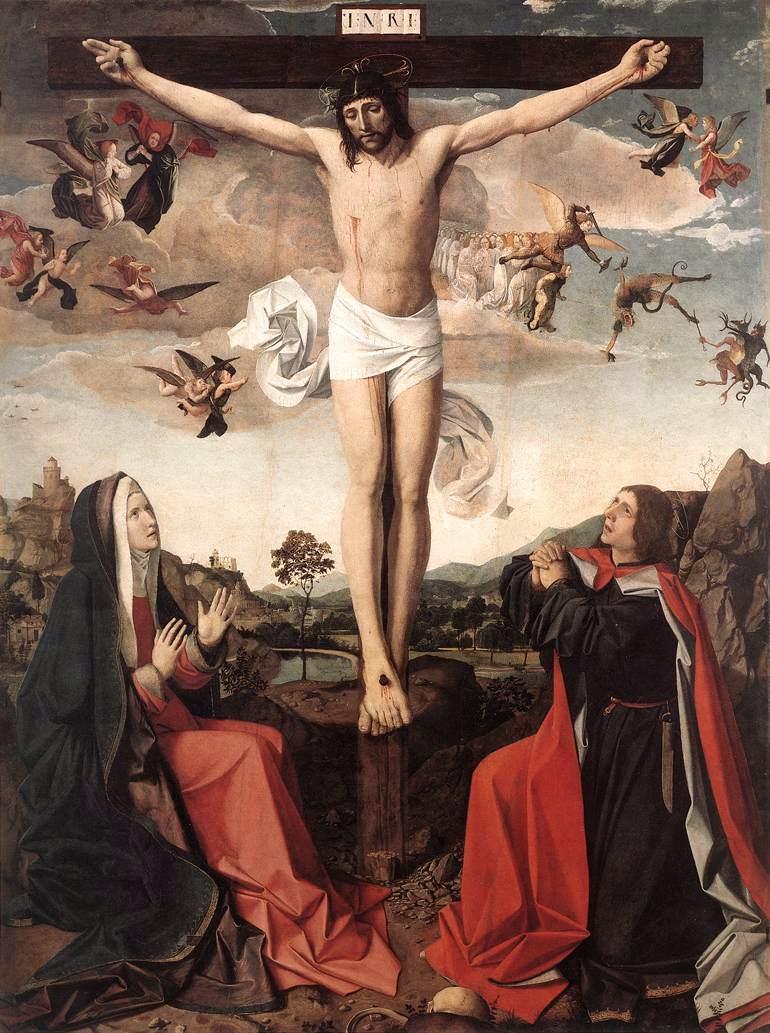
“Calvary” by Josse Lieferinxe, c. 1500
In the ancient world, crucifixions were a dime a dozen. Hardly a day passed without one. Consider these statistics:
- 519 BC: Darius I, king of Persia, crucifies 3,000 of the leading citizens of Babylon.
- 332 BC: Alexander the Great crucifies 2,000 people after invading the city of Tyre.
- 100 BC: Alexander Jannaeus, king of Judea, crucifies 800 Pharisees.
- 71 BC: A great uprising of slaves against the Roman Empire, led by the great gladiator Spartacus, leads to the crucifixion of 6,000 of his followers along a stretch of highway from Capua to Rome, totaling 120 miles.
- 4 BC: Varus, governor of Syria, crucifies 2,000 Jewish rebels who were leading a Messianic revolt.
- AD 70: The Roman general Titus sweeps into the city of Jerusalem, sacks it, and begins crucifying 500 people a day he runs out of wood to make crosses.
Crucifixions happened all the time. In fact, according to one estimate, as many as 30,000 people were crucified just in Israel by Jesus’ day.[1]
This Friday is Good Friday – a day when we commemorate a crucifixion. But with crucifixions being so commonplace in the ancient world, it’s worth it to ask: Why do we commemorate one particular crucifixion? Why don’t we commemorate the many crucifixions of the citizens of Babylon, or of Spartacus’ followers, or of the Jews under Titus’ reign of terror? Why do we commemorate only one crucifixion – Jesus’ crucifixion?
The Mishnah, an ancient compendium of Jewish rabbinical teaching, explains that if a criminal was condemned to execution, which would have included crucifixion, he was to say, “Let my death be atonement for all of my transgressions.”[2] The idea was that if a person’s crimes were so heinous that he was deserving of death, only death could save him from those crimes. Crucifixion, then, was connected not only to punitive punishment, but also to personal atonement.
Jesus’ crucifixion, however, was different. Rather than making recompense for His own sins by His death, Jesus asks for forgiveness for others’ sins: “Father, forgive them, for they do not know what they are doing” (Luke 23:34). And rather than seeking atonement for Himself by His execution, the apostle John says Jesus makes atonement for the world: “[Christ] is the atoning sacrifice for our sins, and not only for ours but also for the sins of the whole world” (1 John 2:2).
This is why we commemorate Jesus’ crucifixion. For we remember not only that Jesus was crucified, but why Jesus was crucified. He was crucified not for His own sins, but for ours. Jesus’ crucifixion did what no other crucifixion could do. It saved us. And that’s worth remembering…and celebrating. And that’s why this Friday is not just any Friday, but a Good Friday.
______________________________
[1] John MacArthur, The MacArthur New Testament Commentary: Matthew 24-28 (Chicago: The Moody Bible Institute, 1989), Matthew 27:27-37.
[2] m. Sanhedrin 6.2.
Luther on Christ’s Resurrection…And Ours
 On this Easter Monday, I thought I would share with you some words from a series of seventeen sermons preached by Martin Luther in 1533 on 1 Corinthians 15. In this chapter, the apostle Paul speaks of the resurrection of Christ and the hope and assurance that it gives us that we too will be raised on the Last Day:
Because Christ is risen and gives us His resurrection against our sin, death, and hell, we must advance to where we also learn to say: “O death, where is thy sting?” [1 Corinthians 15:55] although we at present see only the reverse, namely, that we have nothing but the perishable hanging about our neck, that we lead a wretched filthy life, that we are subject to all sorts of distress and danger, and that nothing but death awaits us in the end.
But the faith that clings to Christ is able to engender far different thoughts. It can envisage a new existence. It can form an image and gain sight of a condition where this perishable, wretched form is erased entirely and replaced by a pure and celestial essence. For since faith is certain of this doctrine that Christ’s resurrection is our resurrection, it must follow that this resurrection is just as effective in us as it was for Him – except that He is a different person, namely, true God. And faith must bring it about that this body’s frail and mortal being is discarded and removed and a different, immortal being is put on, with a body that can no longer be touched by filth, sickness, mishap, misery, or death but is perfectly pure, healthy, strong, and beautiful…
God did not create man that he should sin and die, but that he should live. But the devil inflicted so much shameful filth and so many blemishes on nature that man must bear so much sickness, stench, and misfortune about his neck because he sinned. But now that sin is removed through Christ, we shall be rid of all of that too. All will be pure, and nothing that is evil or loathsome will be felt any longer on earth. (AE 28:202-203)
Luther’s final words beautifully summarize the hope of Easter: “All will be pure, and nothing that is evil or loathsome will be felt any longer on the earth.” Because Christ is risen, the evils of sin and death will be destroyed. Or, in the words of the poet John Donne, because of Easter, “death, thou shalt die!”
Christ is risen! And this means you will too.
Resurrection, It Does a Body Good!
 In his book, The Historical Jesus, John Dominic Crossan says of Jesus’ resurrection, “Nobody knew what had happened to Jesus’ body.”[1] Crossan is well known for asserting that Jesus’ resurrection was not a bodily resurrection, but a series of mystical visions experienced by and subsequently promoted by early Christians. As for the fate of Jesus’ body after death, Crossan believes it was thrown in a shallow grave where it was quickly scavenged by wild animals.[2] And Crossan is not alone in his belief. Incredulous at the notion that a dead person can physically rise, many post-Enlightenment thinkers and theologians will speak of Christ’s resurrection as one that took place merely in the minds or hearts of His earliest followers.
The biblical account of Christ’s resurrection is not nearly so scientifically sterilized as Crossan and others make it out to be. Whatever these people may believe about Christ’s fate after His crucifixion, the biblical authors believed that Christ rose bodily. Indeed, this is Paul’s argument in 1 Corinthians 15:
Christ has indeed been raised from the dead, the firstfruits of those who have fallen asleep…So will it be with the resurrection of the dead. The body that is sown is perishable, it is raised imperishable; it is sown in dishonor, it is raised in glory; it is sown in weakness, it is raised in power. (1 Corinthians 15:20, 42-43)
Paul’s argues that Christ’s bodily resurrection is the first resurrection in a long line of bodily resurrections that will come on the Last Day. The bodies of believers, once perishable, will be raised imperishable. The bodies of believers, born into the dishonor of sin, will be raised into the glory of perfection. The bodies of believers, formerly weakened by the Fall, will be raised in eternal power. The resurrection, Paul says, is bodily. And not just Christ’s resurrection is bodily, our resurrections are too.
Jesus Himself speaks to the corporal nature of His resurrection when He appears to His disciples:
While they were still talking about this, Jesus Himself stood among them and said to them, “Peace be with you.” They were startled and frightened, thinking they saw a ghost. He said to them, “Why are you troubled, and why do doubts rise in your minds? Look at My hands and My feet. It is I Myself! Touch Me and see; a ghost does not have flesh and bones, as you see I have.” When He had said this, He showed them His hands and feet. And while they still did not believe it because of joy and amazement, He asked them, “Do you have anything here to eat?” They gave Him a piece of broiled fish, and He took it and ate it in their presence. (Luke 24:36-43)
Jesus will not have His resurrection mistaken by His disciples for a measly apparition. This is why He invites His disciples to look at and touch His hands and His feat. This is why He eats a piece of fish. Jesus has risen bodily.
So why is this even important? Why make such hay out of whether or not Jesus rose bodily? Three reasons come to mind. First, the bodily resurrection of Christ is the linchpin of our faith. To deny this is to lose everything. As the apostle Paul writes, “If Christ has not been raised, your faith is futile; you are still in your sins” (1 Corinthians 15:17). To deny the resurrection of Christ is to deny all of Christ and His work. There can be no compromise on His resurrection. Second, the bodily resurrection of Christ affirms the goodness of God’s creation. God created bodies. And He cares about bodies. Christ’s resurrection is proof of this. For God could not stand by to see His Son’s body wrecked and ruined by a cross. And God will not stand by to see our bodies and wrecked and ruined by sin. And this leads to the third reason Jesus’ bodily resurrection is so important. The bodily resurrection of Christ is a promise our bodily resurrections on the Last Day. The fact of the matter is this: our God is just getting going when it comes to resurrections. One day, graves will be emptied, death will be defeated, and the redeemed of the Lord will cry, “Where, O death, is your victory? Where, O death, is your sting” (1 Corinthians 15:55). What a glorious day this will be. And this is why I believe in the resurrection of Jesus’ body and in the resurrection of mine. For such a resurrection is the hope and promise of life everlasting.
Holy Week
 Every year, I receive many questions concerning the significance of Holy Week. Because Holy Week began yesterday, I want to share with you a brief overview I wrote a couple of years ago covering the biblical basis, historical underpinnings, and common customs of this most sacred time of year. May God bless you this week as you commemorate and celebrate Christ’s life, death, and ultimate, triumphant resurrection!
In retail, it’s the month between Thanksgiving and Christmas. In college basketball, it’s the month of March. For the IRS, it’s April 15. We all have months, days, and moments which are especially poignant to us and fill our hearts with anticipation and excitement. For Christians, Holy Week is just such a time.
“Holy Week” is a term used to denote the final week of Jesus’ life. It holds a special place in a Christian’s heart, especially since the New Testament gospels – Matthew, Mark, Luke, and John – devote more than one-third of their pages to this single week. Indeed, the gospels have sometimes been called “Passion stories with introductions.” Their focus is unmistakably on Jesus’ final week of life.
Holy Week began to occupy a prominent place in the Church’s life very early in history. The Apostolic Constitutions (a fourth century manual of church practice for pastors and bishops) calls Holy Week the “Great Week” and calls on Christians “to fast these six days”[1] in memory of Christ’s sufferings. The six days referred to here are Monday through Saturday of Holy Week.
Holy Week is highlighted by four high holy days: Palm Sunday, Maundy Thursday, Good Friday, and Easter Sunday. The Monday, Tuesday, and Saturday of Holy Week, though churches sometimes hold worship services on these days, are relatively minor in comparison to the others. Because of their significance in the life of Jesus, it is well worth it to consider each of the high holy days of this sacred week.
Palm Sunday
Palm Sunday recounts Jesus’ entry into Jerusalem as He is welcomed by adoring throngs:
The next day the great crowd that had come for the Feast heard that Jesus was on His way to Jerusalem. They took palm branches and went out to meet Him, shouting, “Hosanna!” “Blessed is He who comes in the name of the Lord!” “Blessed is the King of Israel!” Jesus found a young donkey and sat upon it, as it is written, “Do not be afraid, O Daughter of Zion; see, your king is coming, seated on a donkey’s colt.” (John 12:12-15)
Palms were a symbol of Jewish nationalistic pride. In 164 BC, after the Greek tyrant Antiochus IV Epiphanes, who had persecuted and murdered many Jews, was defeated, the Jews waved palms in celebration of their victory. A history book from that time recounts Antiochus IV Epiphanes’ demise: “Carrying ivy-wreathed wands and beautiful branches and also fronds of palm, they offered hymns of thanksgiving to him who had given success.”[2]
When Jesus comes riding into Jerusalem on a donkey, the Jews are again being oppressed – not by Greeks, but by Romans. And so, the Jews break out their palms once more in the hope that Jesus might be the One to deliver them. Even their cry of “Hosanna” betrays their strident nationalism. “Hosanna” is from two Hebrew words: hosha, meaning “to save,” and nah, meaning “please.” Thus, the Jews cry to Jesus: “Save us please from our Roman oppressors!”
This scene of adoring crowds singing “Hosannas” captured the imagination of those in the ancient church. Dramatic reenactments of this scene were introduced in Spain, Gaul, and England, in the fifth, seventh, and eighth centuries respectively. Such reenactments continue in churches today, where congregants wave palm branches and sing, “All glory, laud, and honor, to You, Redeemer King!”
Maundy Thursday
The crowds of Palm Sunday may have loved Jesus, but the members of the religious establishment hated Him. Already on Palm Sunday, the religious leaders were plotting how they might silence Jesus. When they saw the palms and heard the crowds, they sniveled: “See, this is getting us nowhere. Look how the whole world has gone after Him” (John 12:19)!
As the week progresses, the tension between Jesus and the religious leaders rises to a fever pitch. By Thursday, “Jesus knew that the time had come for Him to leave this world and go to the Father. Having loved His own who were in the world, He now showed them the full extent of His love”(John 13:1). Jesus, knowing that He would soon die, demonstrates His love for His disciples in two ways. First, Jesus washes His disciples’ feet in an act of service to them (cf. John 13:1-17). Second, Jesus shares with His disciples a final meal:
Jesus took bread, gave thanks and broke it, and gave it to them, saying, “This is My body given for you; do this in remembrance of Me.” In the same way, after the supper He took the cup, saying, “This cup is the new covenant in My blood, which is poured out for you.” (Luke 22:19-20)
On Maundy Thursday, churches throughout the world share Communion as a way of both remembering Jesus’ final meal with His disciples and solemnly rejoicing in how Christ comes to us modern-day disciples with His body and blood in, with, and under simple bread and wine for the forgiveness of our sins. As Jesus washed His disciples feet, some churches also include a foot-washing rite in their Maundy Thursday services as a reminder that our Lord “did not come to be served, but to serve, and to give His life as a ransom for many” (Mark 10:45).
As Jesus has shown us love through His service to us and through the sharing of His body and blood with us, we are to show God’s love to others, even as Jesus commands shortly after He washes His disciples’ feet: “A new command I give you: Love one another. As I have loved you, so you must love one another” (John 13:34). The Latin word for “command” is mandatum, from which the name “Maundy Thursday” is derived. Thus, Maundy Thursday is a day of love – the love that Christ has for us and the love in Christ that we have for each other.
Good Friday
The apostle Paul wrote, “For I resolved to know nothing while I was with you except Jesus Christ and Him crucified” (1 Corinthians 2:2). Paul says that Christ and His cross is the very center of the Christian message. Good Friday, then, the day on which Christ hung on a cross, is a most sacred day.
Because Good Friday is both sacred and solemn, it is traditionally a day of reflection. It is called “Good Friday” not because the suffering, scourging, ridiculing, and death which Christ endured was “good” in and of itself. These things were carried out by evil men. Rather, Good Friday is called “good” because of what these terrible things accomplished – the forgiveness of our sins. As Paul writes, “In Christ we have redemption through His blood, the forgiveness of sins” (Ephesians 1:7).
Good Friday worship services take several forms. A popular late-medieval devotion known as the Way of the Cross has fourteen stations in which the events of Christ’s Passion are acted out in the streets of local communities. Worshippers proceed from one station to the next and remember Christ’s sacrifice for them. In the seventeenth century, a service spanning from noon to 3 pm, the hours during which Jesus was on the cross, became popular. This service usually focuses on the so-called “seven last words” of Jesus and includes devotions on each word. Then, in an evening service called Tenebrae, a Latin word meaning “shadows,” worshippers quietly reflect as candles are extinguished and lights are lowered over the course of the service until the sanctuary is completely blackened in remembrance of the dark day of Jesus’ death.
As somber a day as Good Friday is, it is not without a glimmer of hope. For we know that the darkness of evil and even death cannot overcome the light of hope that Christ has come to bring (cf. John 1:5).
Easter Sunday
The word “Easter” was originally a pagan word, referring to Austron, the Saxon goddess of fertility and sunrise, whose festival was celebrated in the spring. The eighth century scholar Saint Bede the Venerable explains how Saxon Christians commandeered the pagan name “Easter” and used it to refer to their celebrations of Christ’s resurrection.[3] Blessedly, the Church’s use of the word “Easter” has remained, while its pagan use has long since faded into the recesses of history. It is no surprise that Christian Easter celebrations have stood the test of time. After all, the Easter story is unforgettable and gripping:
On the first day of the week, very early in the morning, the women took the spices they had prepared and went to the tomb. They found the stone rolled away from the tomb, but when they entered, they did not find the body of the Lord Jesus. While they were wondering about this, suddenly two men in clothes that gleamed like lightning stood beside them. In their fright the women bowed down with their faces to the ground, but the men said to them, “Why do you look for the living among the dead? He is not here; He has risen!” (Luke 24:1-6)
Luke captures the excitement and unexpectedness of the scene. The women, finding Jesus’ tomb empty, wonder what could have happened. Even though Jesus had foretold His resurrection on multiple occasions (cf. Luke 9:22, 13:32, 18:33, 24:7), the idea that a man could rise from the dead was so over-the-top, the women failed to call to mind our Lord’s words. Indeed, they thought His body had been stolen (cf. John 20:15). But then a question from two men dressed in white snaps their attention to the reality of what has happened: “Why do you look for the living among the dead?” The angels accuse the women of being walking oxymorons. Looking for the living among the dead? That’s like writing an obituary instead of a birth announcement when you have a healthy, happy child. That’s like taking your spouse to divorce court on your wedding day. It makes no sense!
The resurrection of Christ was central to early Christian preaching and teaching. The apostle Paul explains:
For what I received I passed on to you as of first importance: that Christ died for our sins according to the Scriptures, that He was buried, that He was raised on the third day according to the Scriptures. If Christ has not been raised, your faith is futile; you are still in your sins. Then those also who have fallen asleep in Christ are lost. If only for this life we have hope in Christ, we are to be pitied more than all men. (1 Corinthians 15:3-4, 17-19)
Paul is crystal clear in his estimation of Christ’s resurrection. It is “of first importance.” It is so important, that if it is not true, all of Christianity is a ruse and we have no hope for eternity. Thus, on Easter, the Church both defends the historicity of Christ’s resurrection and celebrates its significance. For Christ’s resurrection is an historical guarantee of the promise that when Christ returns, we too will rise from the dead to share in eternity with our Lord.
The Church, over the centuries, has gloriously celebrated Easter. Many churches hold “Easter sunrise services” commonly beginning shortly before sunrise at approximately the time the women would have come to Christ’s empty tomb. Although not practiced by the early church, a tradition developed called an “Easter Vigil service.” This service takes place Saturday night and anticipates the coming resurrection of Christ.[4]
Traditionally, the worship services for Easter are the largest and loudest of the year. This is surely appropriate. For “Christ has indeed been raised from the dead, the firstfruits of those who have fallen asleep…So in Christ all will be made alive” (1 Corinthians 15:20, 22). Christ’s resurrection is the hope of our resurrections!
Weekend Extra – The End?
 Mark’s account of Jesus’ resurrection is my favorite of all the Gospel accounts. I know that John’s account holds a special place in the hearts of many, perhaps because, at least in the many Easter services I’ve attended, it always seems to be the appointed Gospel lesson for the day. And no doubt the picture it paints of Peter running to the tomb and finding it empty and his companion John seeing and believing is gripping and exciting, but nevertheless, Mark’s account holds a special place in my heart, mainly because of how it ends: “Trembling and bewildered, the women went out and fled from the tomb. They said nothing to anyone, because they were afraid. The End” (Mark 16:8).
Well, “The End” is not actually in the Greek text, and that’s part of the problem. Because with an ending like this, many in the early church thought, “Surely there must be a better, more appropriate ending than three women, scared out of their wits, fleeing from an empty tomb where they have just encountered a young man dressed in white!” And so, in most Bibles, there is Mark 16:9-20, appropriately culminating with Jesus’ great commission in verse 16, His ascension into heaven in verse 19, and then a strange line about snake handling in between these verses. But don’t worry, that verse about snake handling probably wasn’t in the original, divinely inspired text. Whew! Am I a glad about that one!
If you’ll notice, after verse 8 in most Bibles, you’ll find a notation: “The earliest manuscripts and some other ancient witnesses do not have Mark 16:9–20.” In other words, even though Mark’s gospel wraps up nicely with Jesus’ great commission and ascension in verses 16 and 19 respectively, the earliest manuscripts of Mark end with wary women. This leads textual critical scholar Bruce Metzger to comment on verses 9-20, “The section was added by someone who knew a form of Mark that ended abruptly with verse 8 and who wished to supply a more appropriate conclusion” (Bruce Metzger, A Textual Commentary on the Greek New Testament, 105). It is important to note that Metzger also explains that verses 9-20 have a long storied history in the Church, first being attested to by Irenaeus and Tatian’s Diatessaron in the second century. Thus, though these verses were probably not written by the Evangelist himself, they did not come long after him.
But even with all this in mind, I kind of like that we seem to have nothing more of Mark’s Gospel after verse 8. After all, if I found a missing body and a supernatural looking guy in white hanging out in Jesus’ tomb, I think I’d be scared too! And yet, we all know that the women shouldn’t have been scared. After all, Jesus had foretold His death and resurrection time and time again (cf. Mark 8:31, 10:33-34). The women should have known better.
But then again, so should we. For we, like the women, have the promise – and the fulfillment – of a risen Savior! We, like the women, can say with the young man in the tomb, “Christ is risen!” And just as the young man told the women that Jesus was going ahead of them into Galilee where they would see Him (Mark 16:7), Jesus tells us that He goes ahead of us as our Good Shepherd, leading us through this life, and even into the next (cf. John 10:4). So why in the world do we worry? Why in the world do we fret? For what reason in the world do we have to be afraid?
Perhaps we are more like the women than we care to admit. For we have the same message as the women: “Christ is risen!” But we also have the same response: We are trembling, bewildered, and afraid.
But we don’t have to be. For Jesus, as our Good Shepherd, invites us, “Do not be afraid, little flock, for your Father has been pleased to give you the kingdom” (Luke 12:32). Fear may mark the end of Mark’s Gospel, but it does not have to mark the end of our lives. For Jesus’ gospel in and through our lives is still being written.
So, of what are you afraid? Your finances? Your future? A person? Perhaps even your eternity? Remember that the message of Easter is not only, “Christ is risen,” but also, “Do not be alarmed” (Mark 16:6). For we serve and follow a living Lord who can take care of and take away our fears. I hope you’ll let Him. Because although verse 8 may be a good place for a Gospel to end, it’s never a good place for a life to end.
Want to learn more on this passage? Go to
www.ConcordiaLutheranChurch.com
and check out audio and video from Pastor Tucker’s
message!
Resurrection! It’s Not Just for Jesus

One of my favorite parts of Holy Week is the music. Last night in Maundy Thursday worship, we sang of Christ’s body and blood, given for us sinners to eat and drink. I’ve been singing the words to this hymn this morning:
God’s Word proclaims and we believe
That in this Supper we receive
Christ’s very body, as He said,
His very blood for sinners shed.
Today, as we reflect upon the cross of Christ, we will sing another of my favorite songs:
Mighty, awesome, wonderful,
Is the holy cross.
Where the Lamb laid down His life
To lift us from the fall.
Mighty is the power of the cross.
And then, on Easter, will come this powerful anthem:
I know that my Redeemer lives;
What comfort this sweet sentence gives!
He lives, He lives, who once was dead;
He lives, my ever-living head.
The words of this final song, of course, are taken from the book of Job where, even after Job has lost everything, he declares his faith in God and his desire for an advocate to plead his case to God: “I know that my Redeemer lives, and at the last He will stand upon the earth. And after my skin has been thus destroyed, yet in my flesh I shall see God, whom I shall see for myself, and my eyes shall behold, and not another. My heart faints within me” (Job 19:25-27)! These words have long been taken by Christians as a foreshadowing of Christ’s resurrection. Hence, the reason we sing these words on Easter! Interestingly, however, it’s not just Christians who have found hints of a resurrection in Job’s story, the ancient Jews did too.
In the third century BC, a Greek translation of the Old Testament was commissioned. Because of the rampant Hellenization of the ancient world, many Jews could no longer read Hebrew, the language in which the Old Testament was originally written, and so this work of translating the Bible into Greek was undertaken so that people could read the Bible in their language. The Septuagintal translation of Job is especially interesting because whoever translated it seems to have a love for resurrection! Consider these passages:
- Job 14:14: Hebrew – “If a man dies, shall he live again?” Greek – “If a man dies, he shall live!”
- Job 19:26: Hebrew – “After my skin has been thus destroyed…” Greek – “And to resurrect my skin upon the earth that endures these sufferings…”
- Job 42:17: The Greek Septuagint adds a line to this verse not in the Hebrew text: “It is written of Job that he will rise again with those whom the Lord will raise.”
Clearly, the translator of Job believed in the resurrection! Thus, the book of Job not only foretells Jesus’ resurrection in that famous line from Job 19, it foretells the resurrection of Job and all the faithful as well. For because Christ has risen, we will rise! In the words of the prophet Daniel: “Many of those who sleep in the dust of the earth shall awake, some to everlasting life, and some to shame and everlasting contempt” (Daniel 12:2). For those who trust in Christ, we will be raised to everlasting life. Because Christ has risen, we will rise. The translator of Job knew and believed this. I hope you do too. For if you know and believe that your Redeemer lives, you can know and believe that you will live…forever.
Holy Week Sorrow and Celebration
 Right now in my personal devotions, I am reading through the book of Lamentations, a sorrowful song written by the prophet Jeremiah, which describes Israel’s defeat and exile at the hands of the Babylonians in 586 BC. Some of the language Jeremiah uses to describe Israel’s demise is grotesque and gut wrenching:
- The tongue of the nursing infant sticks to the roof of its mouth for thirst. (Lamentations 4:4)
- Their skin has shriveled on their bones; it has become dry as wood. (Lamentations 4:8)
- The hands of compassionate women have boiled their own children; they became their food during the destruction of the daughter of my people. (Lamentations 4:10)
Clearly, this is a tragic, despairing time. Indeed, even for a professional prophet such as Jeremiah, who has seen much sin and tragedy, the despair of the exile seems overwhelming. And Jeremiah places the blame for this despair squarely at the feet of God.
In chapter 3, Jeremiah laments his plight:
I am the man who has seen affliction under the rod of His wrath; He has driven and brought me into darkness without any light; surely against me He turns His hand again and again the whole day long. He has made my flesh and my skin waste away; He has broken my bones; He has besieged and enveloped me with bitterness and tribulation; He has made me dwell in darkness like the dead of long ago. He has walled me about so that I cannot escape; He has made my chains heavy; though I call and cry for help, He shuts out my prayer; He has blocked my ways with blocks of stones; He has made my paths crooked. He is a bear lying in wait for me, a lion in hiding; He turned aside my steps and tore me to pieces; He has made me desolate; He bent His bow and set me as a target for His arrow. He drove into my kidneys the arrows of his quiver; I have become the laughingstock of all peoples, the object of their taunts all day long. He has filled me with bitterness; He has sated me with wormwood. He has made my teeth grind on gravel, and made me cower in ashes. (Lamentations 3:1-16)
Notice the pronoun Jeremiah employs again and again to describe who is responsible for his misery: “He.” “He” has brought Jeremiah misery, trouble, pain, and despair. It’s “His” fault that Jeremiah’s plight is what it is. Who is this “He”? None other than God, of course. God has afflicted Jeremiah in the most miserable of ways.
And yet, even in his misery, Jeremiah has not lost all hope: “But this I call to mind, and therefore I have hope: The steadfast love of the LORD never ceases; His mercies never come to an end; they are new every morning; great is Your faithfulness” (Lamentations 3:21-23). Jeremiah believes that finally, ultimately, God’s steadfast love will prevail. Indeed, it’s interesting the way Jeremiah describes this steadfast love just verses later: “Though He cause grief, He will have compassion according to the abundance of His steadfast love; for He does not willingly afflict or grieve the children of men” (Lamentations 3:32-33). Though God does afflict and grieve people because of their sin, Jeremiah says, He does not willingly do so. God’s will is not to pour out His hot wrath, but His steadfast love. The Hebrew word for “willingly” is milibo, a word meaning, “from His heart.” Thus, Jeremiah is saying that from God’s heart does not come affliction. Rather, from God’s heart comes His steadfast love. God’s will is wrapped in love.
Luther describes God’s wrath at sin and God’s will of love by making a distinction between the “alien” and the “proper” work of God:
We must know what is meant by the work of God. It is nothing else but to create righteousness, peace, mercy, truth, patience, kindness, joy, and health, inasmuch as the righteous, truthful, peaceful, kind, joyful, healthy, patient, merciful cannot do otherwise than act according to His nature. Therefore God creates righteous, peaceful, patient, merciful, truthful, kind, joyful, wise, healthy men…But He cannot come to this His proper work unless He undertakes a work that is alien and contrary to Himself…Therefore, since He can make just only those who are not just, He is compelled to perform an alien work in order to make them sinners, before He performs His proper work of justification. Thus He says, “I kill and I make alive; I wound and I heal.” (AE 51:18-19)
God must judge us before He can justify us, Luther says. His alien and His proper work go hand in hand. Thus, both God’s alien work of judgment and God’s proper work of love are needed in Jeremiah’s life. And both God’s alien work of judgment and God’s proper work of love are needed in our lives too. But lest we forget, through faith in Christ, God’s proper work prevails!
The alien and the proper work of God meet most clearly in the death and resurrection of Christ, which we remember during this Holy Week. Luther explains:
God’s alien work is the suffering of Christ and sufferings in Christ, the crucifixion of the old man and the mortification of Adam. God’s proper work, however, is the resurrection of Christ, justification in the Spirit, and the vivification of the new man, as Romans 4:25 says: “Christ died for our sins and was raised for our justification.” (AE 51:19)
God judges His Son on the cross, killing Him for the sins of the world. This was not something He delighted in doing – it was alien to Him – but it was necessary. For Christ’s crucifixion satisfied God’s righteous wrath at sinners…sinners like you and me (cf. Romans 3:25-26). And with God’s wrath satisfied through Christ’s suffering and death on the cross, God could now move to His proper work: Giving to His children His steadfast love which never ceases.
This Holy Week, spend some time meditating on both the alien and the proper work of God. For both are needed. But finally, one prevails! For God’s work does not end in an alien way. Rather, it ends in its proper way. It ends in our salvation through faith in Christ. Praise be to God!


 Pastor Zach's Blog