Posts tagged ‘Donald Trump’
Michael Flynn, Intelligence Leaks, and Ethical Questions

Credit: Carolyn Kaster/AP
When Michael Flynn tendered his resignation as National Security Advisor last week after only 24 days on the job, it marked the predictable outcome of what had become deepening concerns over some dishonest statements he made to the vice-president about the nature of a December conversation he had with the Russian ambassador to the United States and the potential his conversation created for his blackmail by Russian authorities. In a political climate where dishonesty is often dismissed out-of-hand as part of the job, Mr. Flynn’s forced resignation is a sobering reminder that character still counts.
Of course, in this story, there are not only ethical questions raised by Mr. Flynn’s clandestine conversation, there are also critical ethical questions that must be asked about the leaking of his conversation by shadowy intelligence officials to the news media. After all, unethically leaking the fact the National Security Advisor unethically lied to vice-president seems, well, just all-around unethical.
Sadly, in our hyper-politicized climate, it is difficult not to filter this story through anything other than a political lens. President Trump certainly filtered it this way, at least in part, when he complained on Twitter:
The real scandal here is that classified information is illegally given out by “intelligence” like candy. Very un-American!
— Donald J. Trump (@realDonaldTrump) February 15, 2017
Yes, intelligence leaks are indeed scandalous – and dangerously so. But dishonesty by the National Security Advisor with the vice-president is also scandalous. Both sides of this scandal need to be addressed. Sadly, most politicians only see fit to address whichever side furthers their own political purposes.
The problem with politicizing scandals like these is that we often overlook the sins of one side conveniently while decrying the sins of the other side forcefully. Our argument becomes not that one side is truly good, but that the other side is really bad. In this way, we justify one side’s sins by the sins the other side. But when we address ethical scandals like this, we only wind up creating a circular firing squad, with everyone squarely aiming their barrels at everyone else. We settle for hurting whoever happens to be our political enemy rather than holding onto what is actually right.
Jonathan Bethune, in an article for The Federalist, captures and summarizes our political zeitgeist well when he explains:
There can be no meaningful dialogue premised upon shared values if both sides only apply those values when it lets them score points. The class of moderately intelligent politically aware people are those most affected by this trend. They have become partisan ideologues.
An ideologue is at least consistent in his belief in specific policies. A partisan openly supports his gang above all else. But a partisan ideologue is worse than both. He is a Machiavellian creature: a supporter of “ends justify the means” approaches to pushing an agenda. The gang must be defended that the agenda might be defended, even when the gang violates core tenets of the agenda. Partisan ideologues are dishonest by nature. Worse still, they often cannot even tell when they are being dishonest.
Mr. Bethune is onto something here. He understands that a politics that is more partisan than it is principled can only become pathological. And when this happens, politics becomes a sinister force for moral decay rather than what Aristotle envisioned politics at its best to be – a guardian of societal good. Such pathology in our politics not only points to a problem with Mr. Flynn and with dangerous intelligence leaks, it points to a problem with us.
Perhaps it is time, then, to look not only at the news, but in the mirror.
An Executive Order and an Immigration Debate
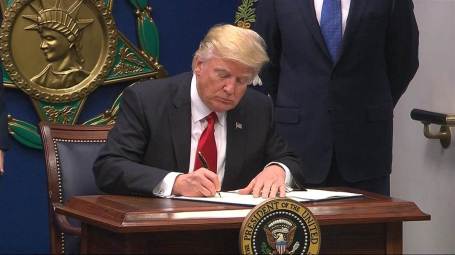
When President Trump issued an executive order two Saturdays ago putting a 90-day moratorium on all foreigners entering the United States from Iraq, Syria, Iran, Libya, Somalia, Sudan, and Yemen and a 120-day ban on all refugee admissions, the reaction was swift and splenetic. Protests erupted at airports across the country. Democratic politicians decried – and, quite literally, cried at – Mr. Trump’s executive order. And now, a federal judge in Washington has temporarily blocked enforcement of the president’s immigration stay.
Though much could be said – and has been said – from a policy standpoint about the president’s executive order and the heated debates that have ensued, it is worth it for us, as Christians, to use this moment as an opportunity step back and consider how Scripture frames the broader issues involved. After all, long after the embers of the fight over this particular executive order have cooled, the contentious disagreements that have bubbled to the top in this debate will remain. So here are a few things to keep in mind.
Safety and Sojourners
One of the roles of any government is to protect its people by punishing wrong and standing up for what is right. This is part of the reason Joshua led a conquest through the land of Canaan. This is also why the apostle Paul writes:
For the one in authority is God’s servant for your good. But if you do wrong, be afraid, for rulers do not bear the sword for no reason. They are God’s servants, agents of wrath to bring punishment on the wrongdoer. (Romans 3:4)
The preamble to our Constitution echoes this sentiment when it explains the very need for such a document thusly:
We the people of the United States, in order to form a more perfect union, establish justice, insure domestic tranquility, provide for the common defense, promote the general welfare, and secure the blessings of liberty to ourselves and our posterity, do ordain and establish this Constitution for the United States of America.
Likewise, President Trump, when his executive order was met with fiery backlash, defended it by saying that his order was about “terror and keeping our country safe.”
Safety is indeed a noble goal. But Scripture also has much to say about welcoming and helping sojourners. God commands the Israelites:
When a foreigner resides among you in your land, do not mistreat them. The foreigner residing among you must be treated as your native-born. Love them as yourself, for you were foreigners in Egypt. I am the LORD your God. (Leviticus 19:33-34)
One of Jesus’ most famous stories – the Parable of the Good Samaritan – has as its centerpiece a call to be kind to foreigners. In this day, for a Jew to talk about a “good Samaritan” would have sounded oxymoronic. The Samaritans, after all, were the ones who broke into the Jewish temple during Passover and desecrated it by scattering human bones through it. Jews did not consider Samaritans “safe.” But in Jesus’ story, a Samaritan ends up saving the life of a Jew.
As Christians, then, we are called to be concerned both with the safety and security of our families and nation as well as with the plights of others, such as Syrian refugees, doing whatever we can to welcome and care for those who need our help. A concern for safety and a love for sojourners are to go hand in hand.
Local and Global
Donald Trump’s short tenure as president has been marked by the theme of putting America first. In what was perhaps the most memorable line of his inauguration address, the president declared, “From this day forward, a new vision will govern our land. From this day forward, it’s going to be only America first, America first.”
Addressing concerns and challenges close to home is important. Charity, the old saw says, begins at home. Scripture echoes this theme when the apostle Paul encourages believers to take care of those closest to them: “Anyone who does not provide for their relatives, and especially for their own household, has denied the faith and is worse than an unbeliever” (1 Timothy 5:8). In this same letter, Paul also wonders out loud how a pastor who “does not know how to manage his own family…can…take care of God’s church” (1 Timothy 3:5). At issue here is a principle of subsidiarity, which encourages a focus on local affairs first.
But once again, as important as local affairs are, they are not the only concerns we should have. President Trump’s call of “America first” must never become that of “America only.”
Rodney Stark, in his seminal work The Triumph of Christianity, notes that Christianity is unique not only because it is:
…the largest religion in the world, [but because] it also is the least regionalized. There are only trivial numbers of Muslims in the Western Hemisphere and in Eastern Asia, but there is no region without significant numbers of Christians – even in the Arab region of North Africa.[1]
Christianity is decentralized because the faith’s founder gave His disciples a global mission: “Go and make disciples of all nations, baptizing them in the name of the Father and of the Son and of the Holy Spirit, and teaching them to obey everything I have commanded you” (Matthew 28:19-20). In the book of Acts, Christ encourages the Church to have both a local and a global vision for mission: “You will be My witnesses in Jerusalem, and in all Judea and Samaria, and to the ends of the earth” (Acts 1:8).
As Christians, then, though we are to tend to the affairs of our families, communities, and country, these cannot be our sole concerns. A world that is hurting is a world that needs our compassion, interest, and engagement. We are called to have eyes for both that which is local and for things which are global.
Government and Church
As Christians, we must remember that the affairs of the government are not always coterminous with the mission of the Church. Governments have a specific role to play. They are God’s servants, on a civic level, to promote and defend that which is right and to dissuade and punish that which is wrong. Likewise, the Church has a specific mission to carry out – to reach the world, in both word and deed, with the gospel on a personal level. Thus, while a government may seek to protect a nation, the Church continues to go forth to reach the nations.
As Christians, then, we live in two worlds. We are both members of Christ’s body, the Church, and citizens of an earthly nation. In such a politically-heated environment, however, it can be tempting to exalt the partisanship of politics over the community of the congregation. Indeed, one of the saddest aspects of our current crisis is that the millions of Syrian refugees who have been displaced from their homes and families have become, in the words of Pete Spiliakos:
…footballs in our partisan scrimmages. We insist on certain standards of hospitality to refugees, making those standards a test of “who we are,” opportunistically – when it is useful to our side.
In other words, we do not charitably welcome refugees while carefully stewarding our own national interests because it is right thing to do, we pick either the reasonable concerns of our nation or the sad plight of international refugees and turn one into a cause célèbre at the expense of the other because it is politically expedient. This is wrong both civically and ecclesiologically because it reduces people to pawns in a game of thrones. We are less concerned with doing justice and more concerned with wielding power.
In a debate that has become increasingly either/or, we, as Christians, have a message that is both/and. We can both seek the safety of our nation and be hospitable to sojourners. We can both address our local contexts and keep an eye on global crises. We can both live as responsible citizens and work as members of Christ’s body. One thing does not need to trump the other thing because, ultimately, over everything is Christ. He is the One who ultimately both keeps us safe and welcomes us into His kingdom as sojourners from this corrupt age. He is the One who both loves each of us locally and dies for the world globally. He is the One who both rules all rulers and is the head of His body, the Church. He is the One in whom “all things hold together” (Colossians 1:17).
As we seek to process today’s troubles, then, let us never forget who we are. We are not merely useful political plodders. We are the children of God in Christ, which means that we trust in Him, live with Him, and love like Him – both those who are near and those who are halfway across the world.
___________________________
[1] Rodney Stark, The Triumph of Christianity (New York: HarperCollins Publishers, 2011), 392.
The Inauguration of Donald J. Trump

Credit: Mario Tama/Getty Images
It’s official. As of last Friday, just after noon Eastern Standard Time, Donald J. Trump became the 45th President of the United States.
Though our nation has a new president, old partisan divides and rancor remain. Representative John Lewis, an icon of the civil rights movement, questioned the legitimacy of Mr. Trump’s election and promised to boycott his inauguration, which prompted a fiery response from the president via his Twitter account. Project Veritas uncovered the aspirations of a radical protest organization to detonate a butyric acid bomb at the inaugural ball. And then there were the protests just blocks away from the inauguration parade that erupted into riots. Indeed, there is no shortage of division in our society.
At this watershed moment in American history, it is worth it to take a moment and remind ourselves how we, as Christians, are to conduct ourselves in a world full of violence, threats, political infighting, and social media rants. So, as a new man settles into the world’s most powerful position, here are a few things to keep in mind.
Rulers come and rulers go.
Last week, a friend sent me a picture of the “Donald Trump Out of Office Countdown Wall Calendar.” It extends to 2021. Apparently, the calendar is not only counting down Mr. Trump’s term in office, but making a prediction about the next presidential election. Whatever you may think of the new president, and regardless of whether or not you hope he is elected to another term, this wall calendar provides an important reminder: Mr. Trump’s presidency will not last forever, just like all the presidencies before his did not last forever. Indeed, it is always interesting to hear discussions of how “history is being made” every time a new president is elected and inaugurated. We seem to know, even if only intuitively, that the present is only the present for a split second. It quickly becomes history – a past that is no longer pressing.
If you are concerned about Mr. Trump’s presidency, then, remember: it will not last forever. And if you are ecstatic about Mr. Trump’s presidency, remember: it will not last forever. This is why the Psalmist instructs us not to put our “trust in princes, in human beings, who cannot save. When their spirit departs, they return to the ground; on that very day their plans come to nothing” (Psalm 146:3-4). The reign of any earthly ruler never lasts. Every reign ends; every ruler dies – that is, except for One.
Rulers have limited authority.
No matter who resides at 1600 Pennsylvania avenue, a contingent of the electorate is always apoplectic, convinced that whoever happens to be president at the time will surely spell the end of American democracy, if not world order, as we know it. The reality of a president’s – or any ruler’s – authority is much less impressive. Scripture reminds us that every human authority is under God’s authority. The prophet Daniel declares that God “deposes kings and raises up others” (Daniel 2:21). The apostle Paul tells masters of slaves in the ancient world that One “who is both [your slave’s] Master and yours is in heaven, and there is no favoritism with Him” (Ephesians 6:9). No matter how much authority one person may have, no human authority can match God’s ultimate authority.
This should bring us peace and give us perspective. Leaders, ultimately, do not control the world. Instead, they simply steward, whether faithfully or poorly, whatever little corner of the world God has happened to give to them for a brief moment in time. It is never wise, therefore, to put too much faith in leaders we like or to have too much fear of leaders we don’t. Their power is not ultimate power.
Rulers need our prayers.
When we no longer put too much faith in our leaders or have too much fear of them, this frees us up to pray for them according to Scripture’s admonition: “I urge, then, first of all, that petitions, prayers, intercession and thanksgiving be made for all people – for kings and all those in authority, that we may live peaceful and quiet lives in all godliness and holiness” (1 Timothy 2:1-2). I find it especially striking that making it a common practice to pray for our leaders – no matter who they might be – is commanded by Paul not only because of the effects these prayers have on our leaders, but because of the effects these prayers have on us! When we pray for our leaders, Paul says, this leads us to peaceful and quiet lives even when the world around us feels troubled, and godly and holy lives even when the world around us seems to be careening into moral rot. When we pray for others, God strengthens us.
As Donald Trump assumes the responsibilities of the President of the United States, he needs our prayers. So keep President Trump and his family in your prayers. And while you’re at it, keep other leaders, be they on the national, statewide, or local levels, in your prayers as well. As a practical admonition, perhaps consider writing a note to one of your public servants asking how you can pray for them. Your note just might be a big blessing to them and encourage them to become a better leader. And that’s something our nation can always use.
President-Elect Donald J. Trump

Credit: Pablo Martinez Monsivais/AP Photo
Whether you love him, despise him, believe in him, are distasteful of him, are worried about him, or are indifferent to him, Donald J. Trump is the President-Elect of the United States. Regardless of which one of these categories you may occupy (or, perhaps, you’re in another category I missed), as Christians, there are a few things we are called to be during the transition from the end of Barack Obama’s presidency to the beginning of Donald Trump’s presidency. Perhaps you already know these things, but a little reminder never hurts.
Be prayerful.
The apostle Paul writes to Timothy:
I urge, then, first of all, that petitions, prayers, intercession and thanksgiving be made for all people – for kings and all those in authority, that we may live peaceful and quiet lives in all godliness and holiness. (1 Timothy 2:1-2)
Paul is clear that we, as Christians, ought to pray for our leaders. But there is something I think we often miss in this passage. Before Paul exhorts Timothy to pray “for kings and all those in authority,” he urges Timothy to pray “for all people.” The category of “leaders” is a subset of the category of “people.”
Though this may seem painfully obvious, it is important to remember that our leaders are, in fact, actual people. I say this because sometimes it can become far too easy for us to paint the leaders we don’t care for as soulless cartoonish villains, not worthy of even basic respect.
Regardless of what you think of President-Elect Trump, he is a person, made in the image of God and loved by God. He is also a husband, a father, and a grandfather. We should pray for him not only as a politician, but also as a person.
Be supportive.
Every person is sinful. And yet, as Jesus puts it, even evil people “know how to give good gifts to [their] children” (Matthew 7:11). In other words, just because no one is perfect doesn’t mean that everyone does everything wrong. Instead, we are all mixed bags. We do some things right and some things wrong. We do some things that are good and some things that are evil. Donald Trump, no doubt, will do some good things for America. For instance, his promise to support the cause of life and minimize the scourge of abortion is vital not only to our national wellbeing, but to our human decency as well. In cases such as this, Christians ought to graciously, thoughtfully, and humbly support that which is good and just.
Be skeptical.
Even as sinful people can do good things for which they should be commended, they can also, obviously, do sinful things for which they must be confronted. Christians should be willing to call sin for what it is regardless of the political party out of which it comes. Certainly, President-Elect Trump has said some things that are not only not befitting of the office of President of the United States, but also defy basic decorum, decency, and truthfulness. The warning of Jesus’ brother should ring in our minds: “The tongue also is a fire, a world of evil among the parts of the body. It corrupts the whole body, sets the whole course of one’s life on fire, and is itself set on fire by hell” (James 3:6). Reckless words may be legal in a society that has enshrined free speech, but legality does not equal morality. Christians should continue to call President-Elect Trump, and all of our public officials, to account when their behavior turns ugly.
Especially because of the rancorous nature of this year’s election cycle, I would add that we should be careful not to allow a healthy skepticism to turn into a bitter cynicism. Skepticism is honest that sin is constantly afoot and must be confronted. Cynicism, on the other hand, finds a certain schadenfreude in another’s sin because it can sanctimoniously condemn it and boast over it. Skepticism is wise. Cynicism is hateful. Let us not fall prey to the latter.
Be faith-filled.
Our nation is deeply divided, as even the statistical outcome of this election demonstrates. Donald Trump won in the electoral college and, hence, has secured the presidency, while Hillary Clinton bested Mr. Trump in the popular vote. As Christians, we have a uniquely unifying message because, in the midst of a division as deep as ours, we can point to a God who made us all and to His Son who sacrificed Himself for us all. Christ is the One who can break down what separates us. Now is the time to share Him.
Ultimately, whether you are satisfied with the outcome of this election or fearful because of it, remember to guard your faith. Fear can lead us to lash out in anger as we try to forcefully and artificially rectify something we think is wrong. Satisfaction can lead to gloating and glibness as we trust in a set of comfortable circumstances that will, finally, prove to be fleeting. Both of these reactions can lead us away from Christ rather than toward Him. A reaction of fear can refuse to trust in the peace Christ wants to give as it stews in its own self-righteous anger. An enshrinement of comfort can minimize the provision Christ wants of offer as it lounges in its own self-sufficiency.
Thus, what we need now as the presidency of the United States shifts parties and hands is what we have always needed and will always need:
Faith.
Do not put your trust in princes, in human beings, who cannot save. When their spirit departs, they return to the ground; on that very day their plans come to nothing. Blessed are those whose help is the God of Jacob, whose hope is in the LORD their God. (Psalm 146:3-5)
Who’s Afraid of Election Day?
Credit: Darren McCollester / Getty Images
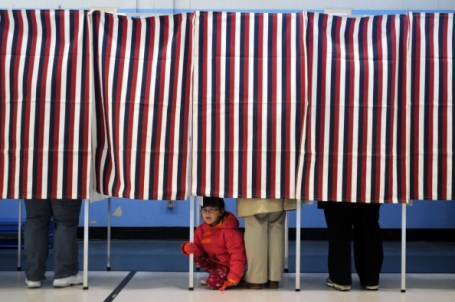
Tomorrow is the big day. Tomorrow, we the people turn out to vote for the next President of the United States. Though literally thousands of other politicians will be on the ballots that are cast tomorrow, the presidential election is the one that looms largest in the minds and hearts of most people. Indeed, I’ve heard it repeated over and over again throughout the course of this political season that “this is the most important presidential election of our lifetimes.” I honestly do not know whether or not it is. I do know that Walter Mondale told a crowd in 1984, “This is the most important election of our lives.” I would argue that history has probably proven him wrong. And history, eventually, may prove today’s claim about the importance of this election wrong – or, perhaps, right. We’ll just have to wait and see.
But whether or not voters and pundits prove to be historically correct in their estimation of the weightiness of this election, I do know that the immediate perceived importance of this election is enormous and is engendering deep fear in the minds and hearts of many. I have had conversation after conversation with people who are scared of what has happened and what will happen to our political system and to our nation.
This past weekend, I listened to a sermon on the topic of this year’s election. The pastor who preached this sermon argued forcefully, powerfully, and, at times, eloquently for what he believed about this election and even for whom he believed we, as Christians, should vote in this election. But what struck me most about this pastor’s sermon was its closing. He ended by talking about two fears that he has for the future of this nation. First, he explained his fear that there may be too many of “them” and too few of “us.” He sees postmodern secularism winning over the masses and driving Christianity to the fringes and he is worried that there is nothing we can do politically to beat it back. Second, he expressed his worry that we may simply be too late to make any difference. He thinks too many Christians have been too silent for too long, and now a day of reckoning has come.
Politically, this pastor seemed very knowledgeable. Theologically, however, if I can be so bold to say this, as I listened to his sermon, I became more and more convinced that he missed something very important. Here’s why I say that.
First, if anyone thinks that there are too many of “them” and too few of “us,” I would encourage that person to read the story of Gideon. When God takes the army Gideon has mustered to fight the Midianites and reduces it in force from 32,000 men to 300 men – a reduction of over 99 percent – it looks like there is no way Gideon and his tiny army can defeat the massive army of a whole tribe of people. But God specializes in doing great things when there are too many of “them” and too few of “us.” God made a whole nation out of one man Abraham. God redeemed a whole people from slavery through one man Moses. God changed the whole course of human history through twelve men He deemed “apostles.” And God brought salvation to our whole world in one man He calls His Son. God can do a lot with a little.
Second, if anyone thinks it is simply too late, I would point that person to the story of Jesus’ friend Lazarus. When Jesus learns that His friend has fallen ill, rather than rushing to see him, He waits for him to die. Why? Because, as Jesus says to Martha, He is “the resurrection and the life” (John 11:25). Even death is not too late for Jesus because He can snatch life from the jaws of death. When the hour on our clock strikes eleven and we begin to struggle and scramble, Jesus can bring forth a new dawn that we never saw coming.
What struck me most about this pastor’s sermon is that although he issued a clear call to his congregation to get out and vote, he never explicitly reminded his congregation to have faith – to trust in the One who holds everything from your house to the White House in His hands.
Politics has a bias toward action. Legislation gets passed when deals get made. Public officials are elected when votes are cast. Social change can be engineered when Supreme Court verdicts are rendered. Action is important to politics. But as Christians, we must remember that the centerpiece of who we are is not in what we do, but in whom we believe. “Believe in the Lord Jesus, and you will be saved” (Acts 16:31). Faith is the centerpiece of our life in Christ.
I think it’s this that gets to the root of our fear. Because if we get so stuck on the action of our vote and the action of our legislators and the action of some guy or gal who sits in an office that is shaped like an oval that we forget that our hope is nothing that we have done, are doing, will do, or can do, then we’ve missed what’s most important. Because we’ve missed Jesus. And you don’t get Jesus by action. You only get Jesus through faith. There’s a reason the Psalmist says, “When I am afraid, I put my trust in You” (Psalm 56:3).
So, if you are afraid of the outcome of this election and the future of this country, go ahead and vote, but don’t expect your vote to calm your fears. Because your fears cannot be calmed by electoral majority. Your fears can only be calmed by a Savior who died for you and me.
Trust in Him.
Election Day Fear

Credit: CNN
Last week, I was driving back to my office after teaching a Bible study at a local business. I happened to be listening to a radio talk show when a lady called who took my breath away. She was nearly in tears. She had just seen a movie forecasting what would happen if a particular candidate was elected President of the United States. She told the talk show host:
I am scared to death. I don’t sleep. I’m an absolute basket case. I want what’s good for my children, my grandchildren, my family. It’s all going down the tubes because, after watching that movie last night, all I saw was what’s coming down, what’s next, what they have planned.
Wow. What palpable fear. What genuine terror. What a heartbreaking phone call. Fear can wreak a lot of havoc in a person’s heart and life.
I know this caller is not the only one frightened right now. It seems as though every time a presidential election comes around, people’s fear becomes more and more acute. So here’s a gentle reminder: fear is not helpful. There is a reason why the most common command in the Bible is, “Do not be afraid.” There is a reason Jesus says, “Do not worry about tomorrow, for tomorrow will worry about itself” (Matthew 6:34). Fear is like an infection. Left unchecked, it can destroy people spiritually, emotionally, and relationally. So if you’re tempted toward fear, especially as it pertains to this upcoming election, here are a few things to keep in mind.
Fear tends toward hyperbole.
Every four years, I hear the same refrain from candidates and political pundits alike: “This is the most important election of our lifetimes.” Of course it is. That is, until the next election comes along. This claim, of course, is usually accompanied with dire predictions of what will happen if the wrong candidates get into political office. Of course factually, this claim cannot stand up under scrutiny because logically, this claim cannot be true more than once in a generation. And yet, it is assumed as true every four years. How can we believe a claim that is so logically ludicrous? Because we are afraid. And fear tends to look toward a certain point in time, such as an election, and wonder with worry: Is this the moment that will serve as the linchpin for the rest of history? Is this the moment when everything changes?
Christians have a confident answer to these questions. And our answer is “no.” We know that history’s linchpin moment has already come with Christ. No moment or election can even come close to comparing with Him. Indeed, I find it interesting that the primary way we know about political figures from the first century such as Pontius Pilate, Herod the Great, and even Caesar Augustus is through Scripture. But all of these men serve as paltry footnotes to the story of Jesus. It turns out they weren’t as important as everyone thought they were back then. Perhaps our leaders won’t be as important as we think they are right now. So why are we afraid?
Fear fosters self-righteousness.
It was Reinhold Niebuhr who wrote:
Political controversies are always conflicts between sinners and not between righteous men and sinners. It ought to mitigate the self-righteousness which is an inevitable concomitant of all human conflict.[1]
Niebuhr notes that, in politics, no party is completely right because no person is completely righteous. So we ought to be humbly honest about our sins rather arrogantly defensive in a smug self-righteousness. The problem with fear is that it tempts us to overlook the sins of ourselves and our party while gleefully pointing out the sins of the other party. Or worse, fear will justify the sins of our party by pointing to the purportedly worse sins of the other party. In this way, fear surrenders moral credibility because it puts itself through all sorts of intellectual and ethical contortions to make that which is self-evidentially wrong look right. This, by definition, is self-righteousness – something that Jesus unequivocally condemns. If Jesus condemns it, we should stay away from it. So do not let fear lead you into it.
Fear clouds decision-making.
Psychologists have long noted that fear is a great motivator. But fear has a funny way of impairing judgment. Just ask any deer who has been paralyzed by the two big lights that are barrelling toward him at a rapid rate of speed. Fear may promise to lead to rescue and safety, but, in the end, it leads to death. So why would we settle for election cycles that are continuously driven by fear?
Decisions made out of fear tend to be Consequentialist in nature. Consequentialism is a theory of ethics that says an act is good if it brings the least harm to the most people. The problem with Consequentialism, however, is twofold. First, because no one can fully predict the future, decisions based on future predictions, including the future predictions fueled by fear, usually have unintended – and often undesirable – consequences. Second, Consequentialism tends to degenerate into deep sinfulness as people become willing to excuse increasingly terrible acts to achieve some desired result. Consequentialism, then, may go after one good thing, but, in the process, it surrenders to and sanctions a bunch of bad things.
Decisions are much better made on principle rather than out of fear. Decisions made on principle allow the one making them to look at all facets of a decision rather than just an end result. They also place a high value on integrity rather than wantonly sacrificing that which is right for that which is expedient. Decisions made on principle are, ultimately, better decisions.
I know that eschewing fearfulness is much easier said than done. But fear must be fought – especially as it pertains to this upcoming election. Fear about this election and about the future solves nothing. It only manages to make the present miserable. So take heart and remember:
The LORD is with me; I will not be afraid.
What can mere mortals do to me? (Psalm 118:6)
Mortals cannot do nearly as much as we sometimes think they can, even if one of them becomes President of the United States. Things really will be okay, even if sinfulness does its worst.
Do not be afraid.
______________________
[1] Reinhold Niebuhr, Reinhold Niebuhr: Theologian of Public Life, Larry Rasmussen, ed. (Minneapolis: Fortress Press, 1991), 248.
Politics, Power, and Sacrifice
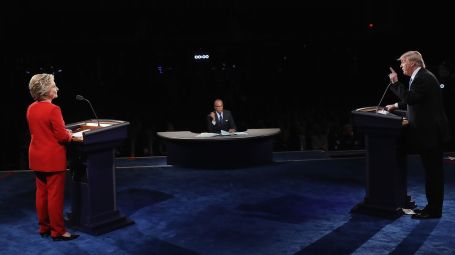
Originally, I wasn’t sure whether or not I was going to watch last Monday’s presidential debate. But my curiosity got the best of me, so I turned on the TV. I have seen many on social media bemoan the state of our politics in this presidential election and, I suppose, I would sympathize with their chorus. The tone of this election is grating. The discussion about this election often borders on and even ventures into the banal. And the goal of this election appears to be little more than an undisguised race for power. People across all points on our political spectrum are desperate to see their person in power so their interests can be furthered while others’ interests are overlooked, or, in some instances, even crushed.
Power is a funny thing, in part because it is such a dangerous thing. In the famous dictum of Lord Acton: “Power tends to corrupt, and absolute power corrupts absolutely. Great men are almost always bad men.” Power ought to come with a warning label: “Handle with care.”
Power, of course, isn’t always bad. God has plenty of power – indeed, He ultimately has all power – and is quite adept at using it. But it is also important to point out that God’s power always comes with a purpose. He uses His power in order to sustain the world. He uses His power in order to constrain evil. He uses His power in order to rescue us from hell. Power, for God, is a means to some very good ends.
The concern I have with so many in our political system is that power has become the means and the end. Politicians want power because, well, they want power! And this means that when they get power, they often use it in a most detrimental way – not to help others, but to help themselves.
Yoni Appelbaum discusses this reality in an article for The Atlantic titled, “America’s First Post-Christian Debate.” The way he describes America’s situation is jarring:
Civil religion died on Monday night.
For more than 90 minutes, two presidential candidates traded charges on stage. The bitterness and solipsism of their debate offered an unnerving glimpse of American politics in a post-Christian age, devoid of the framework that has long bound the nation together.[1]
He goes on to describe how traditionally Christian-esque values were not only not extolled in the first of our presidential debates, they were proudly repudiated. Virtues, Appelbaum says, were reframed as vices. Altruism was painted as a sucker’s game and sacrifice was left for those who are losers. “The Clinton-Trump debate,” he concludes, “was decidedly Marxian in its assumptions – all about material concerns, with little regard for higher purpose.” Yikes. I hope he’s wrong. But I couldn’t help but notice that not one transcendent concern made an appearance during the debate. We, as a nation, have become so obsessed with the exercise of power in the material realm that we pay little regard to the transcendent One who gives power as a gift to be stewarded rather than as a weapon to be wielded.
When the high priest of political pragmatism sirens us into trading cherished values like altruism and sacrifice for the formidable forces of power and control, something has gone terribly wrong. Such a trade fundamentally undermines the very purpose of power – at least in any Christian or morally traditional sense – in the first place. Power is to be used for the sake of altruism, not to dispense with it. Power is to be used in concert with sacrifice, not to insulate oneself from sacrifice. Any of the men and women in our nation’s Armed Forces can tell you that. Jesus certainly expressed His power in sacrifice. The cross was a place of no power and great power all at the same time. On the cross, Jesus gave up all power, even power over His very life, as “He gave up His spirit” (John 19:30). But through the cross, Jesus exercised great power, conquering sin, death, and the devil. Jesus’ power, to borrow a concept from the apostle Paul, came through weakness (cf. 2 Corinthians 12:10).
Political power might not involve dying on a cross, but it sure would be nice if it involved taking one up. It sure would be nice if politicians used their power to do the right thing, even if it involved some measure of sacrifice. It sure would be nice if politicians fashioned themselves more as public servants and less as demiurge saviors. It sure would be nice if voters stopped cynically leveraging the power-obsessed sins of an opposing candidate to minimize and rationalize the power-obsessed sins of their own candidate. A willingness to see sin as sin, even if it’s sin in the politician you happen to be voting for, is a first step to an honest and healthy analysis of our problems politically.
I understand that politicians are not always Christian, and I understand that non-Christians can be competent politicians. I am also not so naïve as to think that every politician will see his or her elected office as a cross to bear rather than as a career to manage, even if they should. I furthermore understand that the civil religion of which Appelbaum speaks in his article is not coterminous with – and in many ways is not compatible with – Christianity. But the virtues of Christianity it promotes – charity, selflessness, and humility, among others – are good for our world even as they are good in the Church. We need them. We need them because, to quote another proverb from Lord Acton, “Despotic power is always accompanied by corruption of morality.” The curbing of despotic power may not be the ultimate reason to foster and preserve Christian virtue in our political system, but it sure is a good reason.
We the people should expect of our politicians – and of ourselves – something more than a blunt exercise of power, even if that power happens to promote our interests. We the people should expect real virtue, both in the people we elect as well as in ourselves. Do we? If we don’t, there’s no better time than the present to change our expectations. Remember, the people we elect to public office are not just products of a corrupt political system, they are reflections of the values we celebrate and the vices we tolerate.
Perhaps it’s time for us to take a good, long look in the mirror.
__________________________
[1] Yoni Appelbaum, “America’s First Post-Christian Debate,” The Atlantic (9.27.2016).
Do Muslims and Christians Worship the Same God?

Dr. Larycia Hawkins
Last week on this blog, I discussed the danger of trading theological integrity for political expediency in the wake of Donald Trump’s proposed ban on all non-resident Muslims entering our country. As I explained, Mr. Trump’s claim that his ban is “not about religion,” though politically palatable, cannot be factually truthful. His ban, I argued, is necessarily about religion because it affects a whole group of thoroughgoingly religious people.
I also argued that it is important for us, as Christians, to have honest theological conversations with our Muslim friends. We may disagree on a great number of things, but at least we agree that theology matters. Categories like orthodoxy and heresy, truth and deity are important to us. In a culture that is far too dismissing of theology, Muslims and Christians should be enthusiastically engaging in theology.
This is what I argued for last week. And now this week, almost providentially, I have an opportunity to practice what I blog.
One of America’s premier evangelical institutions, Wheaton College, is embroiled in an imbroglio after one of its professors, Dr. Larycia Hawkins, claimed that Muslims and Christians worship the same God. Wheaton placed Dr. Hawkins on paid administrative leave, explaining in a press release:
As a Christian liberal arts institution, Wheaton College embodies a distinctive Protestant evangelical identity, represented in our Statement of Faith, which guides the leadership, faculty and students of Wheaton at the core of our institution’s identity. Upon entering into a contractual employment agreement, each of our faculty and staff members voluntarily commits to accept and model the Statement of Faith with integrity, compassion and theological clarity … Dr. Hawkins’ administrative leave resulted from theological statements that seemed inconsistent with Wheaton College’s doctrinal convictions.[1]
Dr. Hawkins’ assertion is well worth our time and attention because it is an example of precisely the kind of theological discussions I would argue Christians and Muslims ought to be having. Do Christians and Muslims worship the same God? Is Dr. Hawkins correct?
As a Christian, I would answer the question of a shared deity among Christians and Muslims in two ways: “No, but…” The answer “no” is necessary for theological honesty. The answer “but” is crucial to Christian hospitality. Let me briefly explain both answers.
“No”
It is very difficult to assert, at least in any way that demands a nuanced theology of divinity, that Muslims and Christians worship the same God. In defending her assertion on social media, Dr. Hawkins cited theologian Miroslav Volf, who, in an interview for Christianity Today, explained:
I think that Muslims and Christians who embrace the normative traditions of their faith refer to the same object, to the same Being, when they pray, when they worship, when they talk about God. The referent is the same …
God is one in both traditions. That’s very important. Two, God is merciful. Also, God is just. God’s oneness, God’s mercy, and God’s justice are significant commonalities. We have different understandings of each of these, but the overlaps are really impressive.[2]
Volf argues that Christians and Muslims worship the same God based on a list of divine attributes that happen to be the same between the two faiths. His list of divine attributes, however, strikes me as ad hoc. What about the Christian contention that God is one, yet also three persons? Muslims do not believe this (cf. Surah 4:171). What about God’s humanity? At the heart and soul of a Christian’s faith is the God-man Jesus Christ. Muslims flatly reject this (cf. Surah 10:68). What about God’s greatest attribute – that He is love (cf. 1 John 4:8)? Though one of the 99 names Muslims have for God is “the Loving One,” that God is love seems to be a bridge too far for Islamic theology.
Volf acknowledges such differences, but then moves quickly to downplay them:
There are significant differences that are the subject of strenuous debates. Some differences really are foundational to the faith, like the doctrine of the Trinity. At the same time, there’s this amazing overlap and similarity. We need to build on what is similar rather than simply bemoan what’s different.
Volf’s assertion that Muslims and Christians worship the same God in spite of significant differences in their respective conceptions of Him begs a question: where would Volf draw his line? When do differences in theology become profound enough for there to be a difference of divinities?
If somebody postulates the existence of more than one God, I would have to say we don’t worship the same God. If somebody says that God is basically one with the world, I would also have to say we don’t worship the same God.
Again, all of this seems very ad hoc to me. For Volf, the attributes of God’s oneness and His distinction from creation are vital. The attribute of God as three persons is not. Why? Simply because Volf says so?
Jesus is quite clear that, in order to be a true worshiper, a person must worship “in the Spirit and in truth” (John 4:23-24). It is quite difficult to worship “in the Spirit” while denying the Spirit’s personhood, as do Muslims, and it is impossible to worship “in truth” while denying at least parts of what Scripture says is true about God. It is important to note that the issue here is not whether a person has a complete understanding of God. Jesus affirms that a person can worship the true God while not having a complete understanding of Him when He says of the Samaritans, “You Samaritans worship what you do not know” (John 4:22). Worship does not require perfect knowledge. True worship does, however, require faith.
But the Scriptures are also very clear that if a person perverts what can be known about God from biblical revelation, he has moved from worship to idolatry. This is why the apostle Paul, when he was in Athens, was “greatly distressed to see that the city was full of idols” (Acts 17:16), but was also willing to engage the Athenians in a theological conversation around the altar the they had built “TO AN UKNOWN GOD” (Acts 17:23). The Athenians’ altar stemmed from ignorance. Their idols were built on false and dangerous ideas about divinity. The altar propelled Paul to further conversation. The idols incited his unapologetic condemnation.
Considering that Islam does not claim to be ignorant of God, but rather claims that God is widely different from whom Christians claim He is, it is difficult to see how either a Christian or a Muslim can honestly say that both faiths worship the same God. Just because two divinities share a short list of attributes does not mean they are the same God any more than a mother and a daughter who share some genes are the same person. This is why I must answer “No” to the question, “Do Christians and Muslims worship the same God?” If this is all I was to say, however, I would not be saying enough.
“But”
I firmly believe that Christians and Muslims do not worship the same God. This is not to say that I think Muslims have no knowledge of what I as a Christian would confess to be the true God or that the God of Muhammad does not reflect in certain ways the God of the Bible. In Romans 1, Paul reminds us that “since the creation of the world God’s invisible qualities – His eternal power and divine nature – have been clearly seen, being understood from what has been made” (Romans 1:20). It is no surprise, then, from a Christian standpoint, that the God of Muhammad would have attributes that are influenced and informed by the God of the Bible, for the God of the Bible is not only particularly revealed in Scripture, but generally, though not salvifically, knowable through creation.
Ultimately, even if someone believes that Christians and Muslims do indeed worship the same God, this still does not settle the question of what is true about God, how one is to approach God, and how one receives eternal life with God. The Quran, for instance, speaks of Jesus, but rejects His death for sinners (cf. Surah 4:157-158). The Bible makes Jesus’ death for sinners the very locus of His identity (cf. 1 Corinthians 2:2). Thus, when Muslims and Christians talk about Jesus, the question should not be, “Do the Bible and the Quran talk about the same Jesus?” Even if they do, this is finally of little consequence. A better question would be, “Does the Bible or the Quran authoritatively reveal the true Jesus?” After all, who Jesus is matters just as much as that He exists.
What is true of Jesus specifically is true of God generally. We need to be asking, “Does the Bible or the Quran authoritatively reveal the true God?” Who has the true and supreme revelation about God from God? As a Christian, my answer must be that the Bible has the true and supreme revelation about God from God. My guess is a Muslim would beg to differ. But this is why a willingness to have hospitable theological discussions is so important. And this is why, if a Muslim friend would like to offer his or her thoughtful and respective perspective on the God of Muhammad and the God of the Bible, I would love to hear it. Understanding may not always lead to agreement, but it does generally lead to charity. And that’s a virtue both our religions share.
_________________________
[1] “Wheaton College Statement Regarding Dr. Larycia Hawkins,” Wheaton College (12.16.2015).
[2] Mark Galli, “Do Muslims and Christians Worship the Same God?” Christianity Today (4.15.2011).
Donald Trump’s Sandbox
Credit: Huffington Post
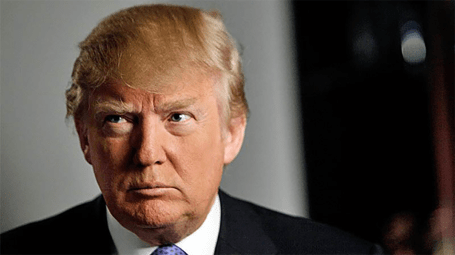
I decided it would be best to wait for a while to write on what has become Donald Trump’s now infamous proposal that there should be “a total and complete shutdown of Muslims entering the United States until our country’s representatives can figure out what is going on” for a couple of reasons. First, the outrage, predictably, over Mr. Trump’s ban was fierce and fast and I wanted to allow some time for it to cool. Reacting to the hottest thing is not always the wisest thing. Second, I wanted to take some time to gather my thoughts on what has transpired. It is a tricky thing for a pastor to write about a politician and I never do so lightly. This is why I also feel compelled to state upfront, lest there be any confusion, that, though I do reference certain political realities, the primary purpose of this blog is not to analyze Mr. Trump’s politics or campaign. There are others who are far more adept at these types of analyses than I. I do believe, however, that Mr. Trump’s ban on Muslims has worldview and theological implications that are important for Christians to recognize and to address. Indeed, what fascinates me most about Mr. Trump’s ban is not so much what he proposed at first, but how he has continued to defend his proposal. In an interview on Live with Kelly and Michael, the presidential candidate argued, “It’s not about religion. This is about safety.”
Mr. Trump’s claim that his ban on non-resident Muslims entering the country is not about religion, though it may be in some sense politically palatable, cannot be factually truthful. He is, after all, singling out adherents of a religion – not citizens of a nation or members of a political party – in his ban. This is about religion because it affects a whole group of thoroughgoingly religious people.
There is no doubt, as we continue to deal with the fallout from the terror attacks in Paris and San Bernardino, that the threat of radical Islamist terrorism is real and that national security should be a top priority. But what often gets overshadowed in so many of our frenetic discussions concerning radical Islamist terrorism is Islam itself and the people who practice it devotedly on a daily basis. Islam, before it is anything else, is a religion with a developed theological system. It makes claims about what is true and what is false, what is orthodox and what is heretical. This is why I am sympathetic to the many Muslims who have claimed that the people who carry out terror attacks are not true Muslims. In the eyes of these Muslims, radical Islamist terrorists have said things and done things that have placed them so far outside the pale of orthodox Islamic theology that they cannot be called Muslim, at least in any theologically responsible sense. I would argue in like manner that what members of the Westboro Baptist Church have said and done has placed them so far outside of the pale of orthodox Christian theology that we cannot consider them to be Christian in any theologically responsible sense no matter what the marquis on their “church” may claim. But it is only through explicitly religious and theological analyses of these groups that we can arrive at such conclusions. Thus, a theological understanding of and, I would hasten to add, a theological repudiation of what has happened in these terrorist attacks is inescapable.
Though he probably does not realize it, Mr. Trump’s assertion that his ban on Muslims entering the country can be made without thinking through the religious implications could only be taken seriously in a secular liberal society like ours. In a recent column for The New York Times, Ross Douthat explains how secular liberalism views Islam:
Secular liberal Westerners … take a more benign view of Islam mostly because they assume that all religious ideas are arbitrary, that it doesn’t matter what Muhammad said or did because tomorrow’s Muslims can just reinterpret the Prophet’s life story and read the appropriate liberal values in …
Instead of a life-changing, obedience-demanding revelation of the Absolute, its modernized Islam would be Unitarianism with prayer rugs and Middle Eastern kitsch – one more sigil in the COEXIST bumper sticker, one more office in the multicultural student center, one more client group in the left-wing coalition.[1]
The secular liberal view of religion is one where orthodoxy always takes a back seat to pluralism and transcendent ethics must eventually bow the knee to today’s contingent truths. Theological claims must ultimately give way to political and cultural concerns. Whether knowingly or unknowingly, this is precisely what Donald Trump assumes when he claims his ban on Muslims is “not about religion.” He assumes the long-standing theological heritage of Islam can be quickly and easily ushered aside to make way for a security-driven ban on Muslims in the same way some progressives presume the theological distinctives of Islam can be breezily brushed off in favor of a Western-style spirituality that calls for no real doctrinal fidelity from its adherents. In Mr. Trump’s case, the politics of security have, excuse the pun, “trumped” any real discussion of theology. What other name can there be for this kind of prioritization but secular liberalism?
One need to look no further than to the middle part of the previous century to see what happens when secular liberalism gets what it wants. Mainstream Christian Protestantism now lies in ruins because it bartered away its classical theology for a bourgeois intellectuality acceptable to a politically-minded modernity.
Confessional Christians are in a unique position to discuss with Muslims potential solutions to the crisis posed by radical Islamist terrorists because, for all we disagree on, we at least agree that theology matters and ought to be taken seriously. It is a particular theology, after all, that, no matter how grotesquely perverted and morally repugnant it may be, drives, at least in part, the aspirations of ISIS. Such a theology needs to be confronted, deconstructed, and condemned, which, thankfully, is precisely what some Muslim theologians are doing. An appreciation for theology can also lead us to question whether or not a whole religious group should be summarily and indiscriminately dismissed with the wave of a hand and a flip explanation that a ban on this group is not about religion. If a group defines itself religiously, as do Muslims, it probably behooves us to respect, study, and take this group’s theology seriously.
Certainly, there would be challenges in any honest theological discussions between Christians and Muslims. I am no Islamic theologian, but as far as I can tell, Islamic theology does not conceive of an Augustinian distinction between a City of God and a City of Man like Christian theology does. It is this distinction, outlined for us beautifully in Romans 12 and 13, that has allowed Christians to work comfortably and conscientiously in all sorts of governmental systems, including in American democracy, because they understand that no matter what the system of government, the City of Man that is human government is ultimately, even if hiddenly, under God’s control. The Christian’s call, then, is not to try to create a Christian government, but to be the Christian Church. In Islamic theology, such a distinction between the City of God and the City of Man does not feature nearly so prominently, if, some might argue, at all. Mosque and government go hand in hand. Even so, many Muslim majority countries have figured out ways to create at least some distance between their religion and their rulers. In this way, then, Christians and Muslims have plenty to talk about, for we both struggle with how to live out our respective faiths in our societies, even if our theologies of how our religions relate to our rulers differ. Furthermore, we agree that traditional religious categories like orthodoxy, heresy, truth, revelation, prophecy, and deity are important, even if we disagree on how each of these categories, right down to the category of deity, should be filled. But at least we agree that questions about theology are more important and, ultimately, more enduring than questions of politics and power. This is more than can be said for some in the secular left.
I do not think that Mr. Trump has rigorously thought through the logical and theological inconsistencies of his statements about Muslims. I suspect he offered his ban to score political points with his base while also tweaking the milquetoast de rigueur of many of the political elites. I also have a feeling that Mr. Trump might take issue with me claiming that his ban on Muslims “is not about religion” actually shares with secular liberals an assumption about the nature and importance of theology. But even if he’s doing so naïvely, his comments betray that Mr. Trump is still playing in the secular liberals’ sandbox. And the consequences of such a foray, to use Mr. Trump’s own phrasing, are “yuge.”
_____________________________
[1] Ross Douthat, “The Islamic Dilemma,” The New York Times (12.12.2015).


 Pastor Zach's Blog