Posts tagged ‘Christianity’
ABC Extra – You Need A Break!
 Yes, this is a picture of me. This is when we were at the rodeo in January, seeing MercyMe in concert. Well, our friends and my wife were seeing MercyMe. I, on the other hand, was a little tired that evening. So I took a little nap in the middle of a big concert.
I am one of those people who can sleep anytime and anywhere. If I’m tired, my eyes begin to close and my head begins to nod. It doesn’t matter if it is at night or during the day, at a public place or when I’m at home. I can even doze at a rodeo. My wife, on the other hand, needs everything to be just right before she can fall asleep. The room must be pitch black. The ambience must be dead quiet. Even the slightest noise in the middle of the night can startle her awake.
This past weekend in worship and ABC, we talked about gift and glory of rest. But in a world full of appointments, tasks, meetings, and errands, rest can be hard to come by. Especially during this holiday season, when we have parties to host and presents to buy and relatives to visit, the specter of a restful Christmas can seem to be nothing but a cruel illusion.
So how do we get the rest we need when the world around us never seems to slow down? First, to rest, we must intentionally slow ourselves down. I shared this quote in ABC, but it is so insightful, I want to share it here again. It concerns the biblical day of rest, otherwise known as the Sabbath:
Most people mistakenly believe that all you have to do to stop working [and rest] is not work. The inventors of the Sabbath understood that it was a much more complicated undertaking. You cannot downshift casually and easily, the way you might slip into bed at the end of a long day. As the Cat in the Hat says, “It is fun to have fun but you have to know how.” This is why the Puritan and Jewish Sabbaths were so exactingly intentional, requiring extensive advance preparation – at the very least a scrubbed house, a full larder and a bath. The rules did not exist to torture the faithful. They were meant to communicate the insight that interrupting the ceaseless round of striving requires a surprisingly strenuous act of will.[1]
Resting “requires a surprisingly strenuous act of will.” In other words, rest isn’t easy! It must be intentional. You must schedule rest, prepare for rest, and then stubbornly take a rest, even if it spites a calendar which clamors for your every waking moment.
Second, to rest, we must examine our hearts. The apostle John writes, “We set our hearts at rest in God’s presence whenever our hearts condemn us. For God is greater than our hearts, and He knows everything” (1 John 3:19-20). Rest, John reminds us, goes deeper than just how many appointments we have scheduled. It goes down to the state of our hearts. Thus, even when our schedules are packed full and our lives are running at high speed, our hearts can be at rest because our hearts are held by the Lord. The stress our world does not have to ruin the rest of our hearts. Thus, even when we feel as though our hearts are overwhelmed by this world’s demands, we can cling to this promise: “God is greater than our hearts.” God’s power and grace far outweigh, outlast, and outdo the anxiety and unrest we can harbor in our hearts. So find your rest in Him. He’s just the break you need.
Want to learn more? Go to
www.ConcordiaLutheranChurch.com
and check out audio and video from Pastor Tucker’s
message or Pastor Zach’s ABC!
[1] Judith Shulevitz, “Bring Back the Sabbath,” The New York Times (3.2.2003).
ABC Extra – “Jesus was born of a…”
 When trying to understand a particularly puzzling or perplexing passage of Scripture, it is helpful to turn to other interpreters and study how they have interpreted the passage. This is especially helpful in the case of Isaiah 7:14, a famous prophecy about the birth of Jesus: “Therefore the Lord Himself will give you a sign: The virgin will be with child and will give birth to a son, and will call Him Immanuel.” This passage became a source of heated debate and disagreement when the Revised Standard Version of 1952 famously translated, “Therefore the Lord Himself will give you a sign. Behold, a young woman shall conceive and bear a son, and shall call His name Immanuel.” Traditionally, this verse has been taken as a prophecy of the miraculous conception of Christ as one who was born of a virgin girl named Mary: “This is how the birth of Jesus Christ came about: His mother Mary was pledged to be married to Joseph, but before they came together, she was found to be with child through the Holy Spirit” (Matthew 1:18). It was the Holy Spirit, Matthew says, who planted the Christ child in Mary’s womb. Mary, therefore, was still a virgin when she had Jesus. But the RSV changed the traditional translation of Isaiah 7:14 from “virgin” to “young woman.” Why the change?
The crux of the debate centers on the Hebrew word for “virgin,” or, as the RSV translates, “young woman.” The word is almah. And although almah does generally refer to a young woman who is a virgin, there are limited instances where it may refer to a young woman not in a virginal state, the most famous being Proverbs 30:18-19: “There are three things that are too amazing for me, four that I do not understand: the way of an eagle in the sky, the way of a snake on a rock, the way of a ship on the high seas, and the way of a man with a maiden.” The Hebrew word for “maiden” is almah. In this instance, the word seems to be referring to a woman already married and, hence, no longer in a virginal state. This is why the translators of the RSV opted for a more general translation of almah – “young woman” – rather than a more specific one – “virgin” – in Isaiah 7:14. The difficulty with this translation, however, is that Christianity’s critics have quickly pounced on this translation to undermine the Christological implications of this prophecy. Rather than foretelling the virgin birth of Christ, these critics maintain that this prophecy points only to events in the Isaiah’s own day.
This debate, then, leads us to this important question: Which translation of almah is correct? “Virgin” or “young woman”? And make no mistake about it: At stake here is far more than trifling lexical nuances. At stake here is a prophecy which the gospel writer Matthew says is fulfilled finally and fully in Jesus Christ! Indeed, Matthew cites this prophecy in his birth narrative: “All this took place to fulfill what the Lord had said through the prophet: ‘The virgin will be with child and will give birth to a son, and they will call him Immanuel’—which means, ‘God with us’” (Matthew 1:22-23). Did Matthew misquote, misunderstand, or, worse yet, purposefully misuse this passage from Isaiah 7:14 when he applied it to the virgin birth of Jesus?
It is here that it is helpful to turn to other interpreters and see how they have understood this particularly puzzling and perplexing passage of Scripture. One of the oldest interpretations of this passage comes to us via an ancient translation of the Bible called the Septuagint. The Septuagint is a Greek translation of the Old Testament, commissioned in the third and second centuries as more and more Jews, after Alexander the Great undertook his project of radically Hellenizing the whole world, were no longer able to speak and understand Hebrew fluently. This Septuagint was a way for the Jews to maintain their religious Scriptural heritage in a language they could read and understand. And in Isaiah 7:14, the Hebrew word almah is translated as the Greek word parthenos. And although there may some limited linguistic ambiguity in the meaning of the word almah, there is no such ambiguity in the word parthenos. It means “virgin.” Thus, ancient Jewish translators, living before the birth of Christ, interpreted this prophecy Messianically, referring to a miraculously virgin born Messiah. And Matthew, in his account of Jesus’ birth, picks up on the Seputagintal translation of this prophecy and too uses the word parthenos. Interestingly, later Jewish Greek translations of this verse from the second century AD translate almah as neanis, meaning “young woman,” no doubt in an attempt the mute the Christian interpretation of this passage. But before the birth of Christ, the Jews were expecting nothing less than a miraculously born Messiah – a virgin born Messiah.
Thus, this particularly puzzling and perplexing prophecy stands as it has traditionally been interpreted. And this particularly puzzling and perplexing prophecy is puzzling and perplexing no more. For it has been fulfilled in Jesus.
Want to learn more? Go to
www.ConcordiaLutheranChurch.com
and check out audio and video from Pastor Tucker’s
message or Pastor Zach’s ABC!
ABC Extra – “Rejoice…Always!”
 “Rejoice in the Lord always. I will say it again: Rejoice” (Philippians 4:4)! This verse has always frustrated me. Not because I think it is somehow incorrect. Quite the contrary, I believe the command to rejoice is a divine and a good command. No, this verse has always frustrated me because I’m no good at it. The command is clear: I am to rejoice in the Lord always. I, however, seem to manage to rejoice in the Lord only sometimes. There are plenty of moments when I either find my joy in something other than the Lord or I lose my sense of joy altogether. I fail miserably at following this command.
It’s far too easy, when reading a verse like this, to chalk up Paul’s language here to a bit of hyperbole – a bit of overstatement just to make his point. “Surely Paul wasn’t being rigidly literal!” we might whisper to ourselves. “As long as I rejoice in the Lord sometimes, or even most of the time, I’m sure the Lord will be content with my best efforts.” But when our God gives commands, He does not hand out “A’s” for effort. He actually expects us to follow His mandates. And this mandate is clear: We are to rejoice in the Lord always.
But how can this happen? On the one hand, we must confess that it doesn’t happen – at least on this side of heaven. As I admitted above, I certainly fall short in the joy department. But I can rejoice that God forgives me through Christ for my lack of rejoicing. As with every other command of God, this is a command which we do not – and, because of our sinful natures, cannot – follow. On the other hand, it is important to note that Paul does not give this command to rejoice without offering us a roadmap to joy when he writes, “Do not be anxious about anything, but in everything, by prayer and petition, with thanksgiving, present your requests to God” (Philippians 4:6). In verse 4, when Paul exhorts us to rejoice in the Lord always, the Greek word for always is pas. In verse 6, when Paul tells us address everything with prayer and petition, the Greek word for “everything” is pas. Here, then, is how we are to rejoice in the Lord during everything – we are to encounter everything with Him through prayer and petition. That trial that we face – we are to face it with the Lord. That triumph that we enjoy – we are to enjoy it with the Lord. That question that we have – we are to ask it to the Lord. We are to live our lives with a keen awareness that we live with the Lord. For as long as we are with the Lord, we always have reason to rejoice. This is why Paul says, “Rejoice in the Lord always!”
Rejoicing, then, begins not with an effort to conjure up joy, but with an awareness of God’s continual presence. It begins with an awareness that, as Paul states, “The Lord is near” (Philippians 4:5). He is near in time – for His second coming is imminent. And He is near in space – for He promises to always be with us. And when you are aware of God’s presence and closeness, which is an indication of His care, concern, and compassion for us, it’s hard to anything but rejoice…always.
Want to learn more? Go to www.ConcordiaLutheranChurch.com and check out audio and video from Pastor Tucker’s message or Pastor Krueger’s ABC!
ABC Extra – Let Slavery Ring!
 “Men desire above all things to be free and say that freedom is the greatest of blessings, while slavery is the most shameful and wretched of states.”[1] So said the first century Roman philosopher, Dio Chrysostom. Although philosophers are known for writing convoluted and delicate treatises, there is no convolution or delicacy here. Freedom is great. Slavery is wretched. The end. Dio could not be clearer.
The reason Dio does not need to speak of slavery delicately is because, in ancient Rome, slavery truly was a wretched state. Consider this description of slaves from Apuleius, a Roman author from the second century:
What scrawny little slaves there were! Their skin was everywhere embroidered with purple welts from their many beatings. Their backs, scarred from floggings, were shaded, as it were, rather than actually covered by their torn patchwork garments. Some wore only flimsy loincloths. All of them, decked out in these rags, carried brands on their foreheads, had their heads half-shaved, and wore chains around their ankles. Their complexions were an ugly yellow; their eyes were so inflamed by thick dark smoke and the steamy vapor they could barely see.[2]
According to Apuleius, slavery was so intolerable that he could not bear even to look at slaves without gasping. Seutonius, in his history of the Roman emperors, describes Augustine’s policy of, with few exceptions, allowing only free men to serve in his army:
Except as a fire-brigade at Rome, and when there was fear of riots in times of scarcity, [Augustus] employed freedmen as soldiers only twice: once as a guard for the colonies in the vicinity of Illyricum, and again to the defend the bank of the river Rhine; even these he levied, when they were slaves, from men and women of means, and at once gave them freedom; and he kept them under their original standard, not mingling them with the soldiers of free birth or arming them in the same fashion.[3]
No one wanted to be a slave. Everyone wanted to be free. And this is what makes Paul’s words in Philippians 2 so striking.
“Your attitude should be the same as that of Christ Jesus: Who, being in very nature God, did not consider equality with God something to be grasped, but made Himself nothing, taking the very nature of a servant” (Philippians 2:5-7). The Greek word for “servant” here is doulos, meaning not only a servant, but a slave. Jesus, being in very nature God, became a slave! And He did so willingly. No one coerced, cajoled, or compelled Jesus into slavery.
Jesus’ willingness to become a slave is especially gripping when one considers that Philippi was a town filled with veterans and soldiers. Thus, those who lived there prided themselves on being free men, for, as Seutonius explains, only free men could serve in the Roman army. So Paul writes to a town full of people who prided themselves on being free about a man who willingly let go of His freedom to become, of all things, a slave.
Jesus’ willingness to let go of His freedom for the state of slavery can serve us a model for us. After all, Paul regularly identifies himself as a doulos of Christ (e.g., Romans 1:1, Philippians 1:1). Like his Lord, Paul is happy to be a doulos to his Lord.
How about you? Do you pride yourself so much in your freedom that you forget that you are called to be a slave to Christ? Slavery, when it is to the things of this world, is indeed wretched. But slavery to Christ is glorious. For serving Christ is hopeful and heartening. In a world that is obsessed with freedom, we rejoice that we are slaves to our Savior!
Want to learn more? Go to
www.ConcordiaLutheranChurch.com
and check out audio and video from Pastor Tucker’s
message or Pastor Zach’s ABC!
ABC – Pain, Suffering, and the Gospel

"The Apostle Paul" by Rembrandt
As a pastor, I have been at the bedside of more than one person nearing the end of their life. And it always breaks my heart to see how much pain they must often endure as their body slowly shuts down and the sickness they have been valiantly fighting slowly takes over. This kind of suffering is truly sad. But suffering is not only physical. Just as heartbreaking for me to watch is the woman who is being emotionally abused by her spouse or the young boy who is made an outcast by his peers. Emotional, psychological, and spiritual suffering can leave very real scars on a human heart, soul, and life just as physical suffering can.
In our text from this past weekend, we read how the apostle Paul was a man who, like Jesus, was “familiar with suffering” (Isaiah 53:3). As he preached the gospel, he encountered persecution after persecution and pain after pain. In Philippians 1, we learn that Paul is encountering physical suffering. He is imprisoned in Rome for preaching the gospel, awaiting a hearing before the Roman emperor Nero, who is not exactly a friend and fan of Christians. And yet, even in the midst of this suffering, and his impending martyrdom at the hands of a ruthless emperor, Paul has hope and joy. He writes to the Philippians: “Now I want you to know, brothers, that what has happened to me has really served to advance the gospel” (Philippians 1:12). Paul says his suffering advances the gospel. And it does! He goes on, “It has become clear throughout the whole palace guard and to everyone else that I am in chains for Christ” (Philippians 1:13). As I mentioned in ABC, the “whole palace guard” could have numbered between 13,000 and 14,000 men. That’s a lot of men who have become aware of Paul’s suffering “in chains for Christ!” Apparently, Paul is sharing the gospel with the very men who are presiding over his suffering in chains. He is sharing the gospel with the guards.
Much like our suffering, Paul’s suffering is not merely physical. Paul goes on to speak of those who add to his suffering: “It is true that some preach Christ out of envy and rivalry…supposing that they can stir up trouble for me while I am in chains” (Philippians 1:15, 17). Paul has such vehement detractors of his ministry that they want to kick him while he’s down – they want to cause him trouble while he is in prison, as if being in prison isn’t trouble enough. Thus, through their envy and rivalry, they add to Paul’s physical suffering emotional suffering as well by preaching Christ for all the wrong, selfish reasons. And yet, even as Paul suffers, the gospel continues to spread.
The gospel has a funny – and even miraculous – way of spreading in and in spite of adversity and suffering. In Paul’s case, the gospel continued to spread thanks to his witness to the palace guard. Even today, adversity often serves as an unwilling and unwitting catalyst for the truth of the gospel to reach ears it might not otherwise tickle. I think of the Dan Brown’s The Da Vinci Code, which was so popular and controversial when it first hit store shelves in 2003. Rife with ecclesiastical conspiracy theories, it became a flashpoint around which detractors of the Church and her message could rally. But its shoddy history, theology, and ecclesiology was made quick work of by the brightest and best Christian scholars who knew the theories put forth in this book were utterly unsubstantiated. It was only titillating conspiracy coupled with fantasy. However, because of the big questions this book raised, many people began to study Christianity – its history, theology, and ecclesiology – and found its teachings and truths to be on much more solid ground than they might have previously expected. Thus, the faith of many in Christ was strengthened and bolstered – and all this through a book antagonistic to Christianity.
What trials are you currently encountering? What suffering are you currently bearing? Is it physical, emotional, spiritual, or psychological? Whatever form your trials and suffering may take, pray to God – that He might give you strength to endure and that He might strengthen your faith in and through your suffering.
Want to learn more? Go to
www.ConcordiaLutheranChurch.com
and check out audio and video from Pastor Tucker’s
message or Pastor Zach’s ABC!
A Pastoral Response to Mormonism in the Public and Political Square
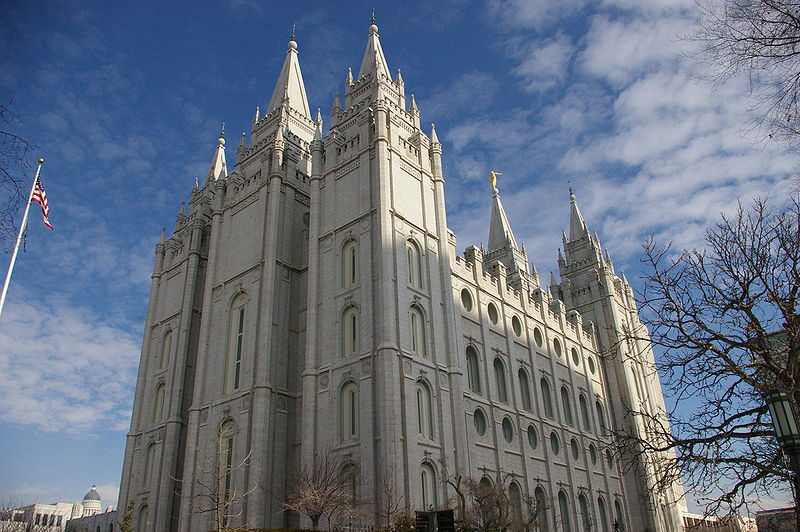 With the election cycle kicking into full gear, politicians, pastors, and pundits are beginning to offer endorsements with regard to who they would like to see elected President of the United States. At the Values Voter Summit, in an endorsement for Rick Perry, a Republican candidate for president, Robert Jeffress, Senior Pastor of First Baptist Church in Dallas, asked, “Do we want a candidate who is a good, moral person, or do we want a candidate who is a born-again follower of the Lord Jesus Christ?”[1] Following his remarks, Pastor Jeffress was asked to clarify his comments and explain specifically what he thought of Rick Perry over and against another frontrunner candidate, Mitt Romney, to whom he seemed to allude when he spoke of a “good, moral person.” The pastor replied, “Rick Perry’s a Christian. He’s an evangelical Christian, a follower of Jesus Christ. Mitt Romney’s a good, moral person, but he’s not a Christian. Mormonism is not Christianity. It has always been considered a cult by the mainstream of Christianity.”[2] These remarks sparked a firestorm, with many voters and reporters alike indignant that the pastor would designate Mormonism as a “cult.”
Because of the attention and ire that Pastor Jeffress’ comments have drawn, we have received many questions concerning the Mormon Church[3] and its relationship to mainstream Christianity. In light of these questions, we thought it would be appropriate to briefly address the teachings of Mormonism theologically, the status of Mormonism religiously, and the duty Christians have as voting citizens vocationally. Here is a broad overview of what is to follow.
First, we will discuss how Mormonism cannot be considered a part of historic, orthodox Christianity. Its teachings concerning the Trinity, the nature of God the Father and His Son, Jesus Christ, are far removed from biblical and historical Christian teaching. Mormonism does not confess the Trinity nor does it believe that a person is saved by God’s grace through faith in Christ alone. Rather, Mormons believe they are saved by grace and their works.
Next, we will tackle the question du jour, “Is Mormonism a cult?” Theologically, we can say that Mormonism is a cult, for it claims new, advanced, divine revelation in addition to the Bible. Psychologically and sociologically, the validity of calling Mormonism a cult becomes less clear. A cult, as the word is used in its secular sense, denotes a body which is explicitly psychologically and sociologically subversive. Mormonism does not necessarily bear this hallmark of a cult. Thus, when we call Mormonism a “cult,” it is important that we define the term.
Finally, we will ask the question, “May Christians vote for a candidate who is not a Christian?” In this section, we will discuss how because those in political offices rule in the kingdom of the world and not in the Kingdom of God, they can be competent to rule even if they are not Christian. Christians are free to pick the most competent candidate, even if he is not a Christian candidate, for political office.
With this overview, we now move to discuss each of the above points in more depth.
The Teachings of Mormonism
First, we turn to the teachings of Mormonism from a theological perspective. As stated previously, theologically, we must understand that Mormonism cannot be considered a part of historic, orthodox Christianity. Indeed, Mormonism explicitly rejects claims that it is part of the Christian tradition. Mormonism teaches that before May 15, 1829, there was no true Church on earth. It was on this day that John the Baptist allegedly visited Joseph Smith and conferred upon him and his friend, Oliver Cowdery, the Aaronic priesthood. Before this prophetic encounter with John the Baptist, Mormons claim, “There was no one living in mortality who held the keys to this Priesthood.”[4] In other words, before this time, Mormons teach that no one had the priestly pedigree to be a part of true Christianity. It had been completely lost from the days of the apostles. Thus, according to their own statements, Mormons claim to be the restoration and repristination of Christianity and not a part of the history or orthodoxy of the Church over the past two thousand years. Therefore, we should take Mormons at their word and not call them “Christians” in any historic or orthodox sense.
A brief survey of Mormon beliefs reveals that Mormons are indeed far removed from traditional and foundational Christian doctrines.
The Trinity
To begin with, Mormons reject the doctrine of the Trinity which states that there is one God, consisting of three co-equal and co-eternal persons: “Latter-Day Saints reject the doctrines of the Trinity as taught by most Christian churches today.”[5] Mormons also have beliefs about the individual persons of the Godhead, Father, Son, and Holy Spirit, that are at wide variance with traditional Christianity. For instance, they teach, “The Father has a body of flesh and bones as tangible as man’s.”[6] It should be noted that this flatly contradicts the Scriptural witness that “God is spirit” (John 4:24)[7] and “a spirit does not have flesh and bones” (Luke 24:39). Moreover, Mormons teach that God was once a man: “God himself was once as we are now, and is an exalted man, and sits enthroned in yonder heavens!”[8] This, of course, denies the immutability and the eternality of God (cf. Malachi 3:6, Psalm 90:2).
Christology
As for Christ, Mormonism teaches that Jesus is the spirit brother of Lucifer. Mormons espouse that when the world was in need of a Savior, both Jesus and Satan presented their cases before the Father as to who would make the better Redeemer. Then, “after hearing both sons speak, Heavenly Father said, ‘I will send the first.’ Jesus Christ was chosen and ordained to be our Savior.”[9] Certainly this fanciful meeting between the Father, Son, and Satan is far outside the pale of biblical Christianity. Jesus is consistently referred to as God’s “only Son” (John 1:14, 3:16, 18, 1 John 4:9) and, as such, was not chosen to be the Savior over any other Messianic contenders, especially Satan. Instead, God planned our salvation in Christ from “before the foundation of the world” (Ephesians 1:4). Salvation in Christ was God’s original and eternal plan.
Salvation
With such a skewed Trinitarian theology and Christology, it is no surprise that the Mormon gospel of salvation is really no gospel at all. For Mormons, salvation is two-fold. First, salvation is a person’s personal progression to divinity. That is, Mormons believe humans can become gods. Joseph Smith explains: “Here, then, is eternal life – to know the only wise and true God; and you have got to learn how to be Gods yourselves…To inherit the same power, the same glory and the same exaltation, until you arrive at the station of God, and ascend the throne of eternal power.”[10] This is not only an untrue statement, but resonates all the way back to the Garden of Eden where Satan tempted Adam and Eve to believe they could usurp God’s position and prerogative. This is why he says to Adam and Eve, when he is trying to entice them to eat God’s forbidden fruit, “You will be like God” (Genesis 3:5). Mormons jettison a fundamental distinction of Christian theology: the distinction between the created and the Creator. They imagine that creatures can become like the Creator. This is flatly false.
Second, Mormons teach that salvation is ultimately a product of a person’s moral progression. Though Mormons believe that humans are saved by grace, they do not believe they are saved by grace alone. A famous and oft-quoted passage from the Book of Mormon makes this clear enough: “For we know that it is by grace that we are saved, after all we can do.”[11] Contrast this with the apostle Paul’s famous words concerning God’s grace: “For by grace you have been saved through faith. And this isnot your own doing; it is the gift of God, not a result of works, so that no one may boast” (Ephesians 2:8-9). Jesus’ work on the cross for our salvation is complete. There is no work we can do to contribute to our salvation.
This is only a small sampling of the false teachings promulgated by The Church of Jesus Christ of Latter-Day Saints. Other teachings, as well as the historical and moral veracity of Mormonism’s sacred writings, are highly suspect as well.[12] Therefore, whatever one may believe about Mormonism’s moral value or theological worth, it cannot be said that Mormonism is “Christian” in any traditional sense of the term. Albert Mohler summarizes the problem with Mormon theology well:
Mormonism borrows Christian themes, personalities, and narratives. Nevertheless, it rejects what orthodox Christianity affirms and it affirms what orthodox Christianity rejects. It is not orthodox Christianity in a new form or another branch of the Christian tradition. By its own teachings and claims, it rejects any claim of continuity with orthodox Christianity. Insofar as an individual Mormon holds to the teachings of the Latter-Day Saints, he or she repudiates biblical Christianity.[13]
In short, Mormonism is not Christianity, nor is it a branch or part of Christianity. If you’d like to learn more about Mormonism and its theological teachings, you can find a wealth of resources at http://www.evidenceministries.org.[14]
The Status of Mormonism
Having addressed the teachings of Mormonism theologically, we now move to discuss the status of Mormonism religiously. Pastor Jeffress called the religion a “cult.” Is it?
In its original context, the word “cult” did not carry with it the negative connotations it has today. The word comes from the Latin cultus, originally describing merely the worship of a deity. Today, however, this word carries with it a wide variety of definitions, many of them sounding sinister. For the sake of brevity, we will examine two definitions of this word – the first being theological in nature and the second being psychological and sociological in nature – and evaluate the status of Mormonism as a cult accordingly.
Theologically, a good definition of a “cult” can be found in the book, The Future of Religion: Secularization, Revival, and Cult Formation. In this work, sociologists Rodney Stark and William Sims Bainbridge define a “cult” thusly: “The cult is something new vis-à-vis the other religious bodies of the society…The cult adds to that culture a new revelation or insight justifying the claim that it is different, new, ‘more advanced.’”[15] According to this definition, Mormonism clearly qualifies as a cult. It is a new revelation and religion which objects to the historic, orthodox Christian position as something corrupt and apostate. Indeed, the very byline of The Book of Mormon, “Another Testament of Jesus Christ,” is a claim of additional, peculiar, and advanced revelation. In this sense, then, Pastor Jeffress is correct. Mormonism is considered to be a cult by most major evangelical denominations and is often called a cult within our own church body, The Lutheran Church – Missouri Synod.[16]
Psychologically and sociologically, we can use a definition of a “cult” from Louis Joylon West:
A cult is a group or movement exhibiting a great or excessive devotion or dedication to some person, idea or thing and employing unethically manipulative techniques of persuasion and control (e.g. isolation from former friends and family, debilitation, use of special methods to heighten suggestibility and subservience, powerful group pressures, information management, suspension of individuality or critical judgment, promotion of total dependency on the group and fear of leaving it, etc.) designed to advance the goals of the group’s leaders.[17]
According to West, a cult is that which is explicitly psychologically and sociologically subversive. It brings to mind people such as Jim Jones and David Koresh and their movements rather than The Church of Jesus Christ of Latter-Day Saints.[18] Much of the outrage in the media over Pastor Jeffress’ words calling Mormonism a cult would seem to stem from defining the word “cult” psychologically and sociologically rather than theologically.
As Christians, who are called to think theologically about issues such as this, we can indeed call Mormonism a “cult” because of its claim to additional revelation apart from and outside of Holy Scripture which results in the maligning of Christian theology. This designation, however, does not necessarily imply that Mormonism has all the psychological and sociological hallmarks of a cult. A Christian’s designation of Mormonism as a cult is primarily a theological rather than a psychological and sociological one.
Our Duty as Christians
Lastly, we move to consider how we, as Christian citizens, can respond to this controversy vocationally. The word “vocation” is from the Latin vocatio and means “calling.” The doctrine of vocation states that all Christians have been called by God to serve in different stations in life – whether that be the station of an employee, an employer, a husband, a wife, a mother, a father, a child, a volunteer, etc.[19] One of the vocations, or callings, God has given to Christians is that of “citizen.” On the one hand, we are citizens of God’s Kingdom by faith in Jesus Christ (Ephesians 2:19). On the other hand, we are also citizens, either by birth or by naturalization, of a particular country. This earthly vocation of citizen, in turn, comes with both duties (e.g., Luke 20:21-25) and privileges (e.g., Acts 22:25) as determined by governing authorities which are themselves instituted by God.[20] One of the duties and privileges United States citizens carry is that of voting for the country’s president. As Christians, the question arises: “How can I vote in a way that is faithful to God while also seeking to elect a person who will do the best job leading the country?”
It must be noted that there is no easy – or singular – answer to this question. Nevertheless, there are some guiding principles which can help us cast an informed vote.
First, it is important to understand that, while we, as Christians, live in two kingdoms – the Kingdom of God and the kingdom of man – the leaders we elect rule over only one kingdom – the kingdom of man. Thus, our primary concern should be with their competence to lead in this kingdom. This means that when we vote, we should consider a candidate’s familiarity with our Constitution and laws and his ability to navigate the intricacies of our legislative process. If he is inept in either of these areas, this should give us pause. A public official’s inability to operate effectively inside our nation’s governmental system can spell disaster for our public policy and welfare, for the official will be unable to execute the demands of his office. Competence is key.
Second, we must also understand that some of the spiritual concerns of the Kingdom of God are part of the natural, moral law which God has placed in this world and thus pertain to the political and public policy making of the kingdom of man.[21] Issues such as abortion, which pertains to the natural, moral duty we have to uphold human life (cf. Exodus 20:13),[22] homosexuality, which goes against the natural design of creation (cf. Romans 1:26-27), and care for those who cannot care for themselves, to which we are naturally inclined despite our depravity (cf. Matthew 7:9-11), ought to be taken into consideration as we decide for whom we will vote. If a candidate runs a platform contrary to natural, moral law, this too should give us pause, for this candidate can potentially do harm to our nation’s citizens.
With these two criteria in mind, then, we have a Christian duty to vote for candidates who, on the one hand, are capable and competent to rule in the kingdom of man, for this is what they are called to do, while, on the other hand, are at the same time aligned with those concerns of the natural, moral law of God which pertain to the political and public policy making in the kingdom of man.
All of this is to say that a candidate does not have to be Christian to be a suitable candidate for public office, though we can certainly be thankful that there are Christians in public and political offices. Ultimately, Luther would advise us to vote for a competent candidate, even if he is not personally moral or Christian:
The reasonable question has been put whether it is better to have a good but imprudent ruler…or a prudent but personally bad one. Moses here certainly calls for both [ref. Deuteronomy 1:13-16]: a good and prudent ruler. However, if both qualifications cannot be had, a prudent ruler who is not personally good is better than a good one who is not prudent, because a good one rules nothing but is only ruled – and only by the worst of people. Even though a prudent but personally bad ruler may harm the good people, he nevertheless rules the evil ones at the same time; and this is more necessary and proper for the world, since the world is nothing but a mass of evil people.[23]
Because a politician rules in the kingdom of man, his competence to do so should be the primary criterion used in discerning his fitness for office. If he is a Christian, great! If not, it is better to have a competent ruler who is not a Christian than an incompetent ruler who is a Christian.
Finally, Christians, out of theological conviction and consecrated consciences, can and do vote for different candidates. Because we live in a sinful and fallen world and, as such, we vote for sinful and fallen candidates, Christians come to differing conclusions as to which candidate would best serve in a particular public office. Christians’ consciences need not be unduly bound in such decisions. The pastors of Concordia believe that, given the choice between two candidates of equal competence, if one is a Christian and the other is not, wisdom instructs us to vote for the Christian candidate because he will not only serve his country skillfully as a politician, but faithfully as a Christian as he seeks God’s guidance. This guidance will make his leadership in public office all the more effective.
Pastor Jeffress has endorsed Rick Perry for President of the United States. As a citizen, he is certainly free to make this endorsement. As a pastor, however, he must be careful speaking on behalf of a political candidate in a public forum such as the Values Voter Summit. For his primary vocation as a pastor is the faithful stewardship of the gospel. Anything that jeopardizes this stewardship is to be rejected. The Commission on Theology and Church Relations of the Lutheran Church – Missouri Synod explains: “The church is a precious institution for us, which dare not be jeopardized by immersion in secular politics.”[24] We, as Christian citizens of this country, are also free to endorse and vote for our preferred candidates. However, our preferred candidates need not be the same as Pastor Jeffress’. Each Christian can come to his own conclusions concerning for whom he will vote.
As citizens of this country, we are free to vote for whomever we want. As citizens of the Kingdom of God, we are free to vote in accordance with our consecrated consciences. Thank God for both freedoms.
[1] Robert Jeffress at the Values Voter Summit, October 7, 2011, http://www.deseretnews.com/article/700186158/Video-of-Pastor-Robert-Jeffress-at-Values-Voters-Summit.html.
[2] Associated Press, “Perry Backer: Romney in a ‘Cult,’ Not a Christian,” http://www.foxnews.com/politics/2011/10/07/perry-backer-romney-in-cult-not-christian/.
[3] “The Church of Jesus Christ of Latter-Day Saints” is the official and legal name of what is colloquially called “the Mormon Church.” Both names are used interchangeably throughout this statement.
[4] Joseph Fielding Smith, Essentials in Church History (Salt Lake City: Deseret News Press, 1922) 68.
[5] Daniel Peterson and Stephen Ricks, “Comparing LDS Beliefs with First-Century Christianity” (March 1988) http://lds.org/ensign/1988/03/comparing-lds-beliefs-with-first-century-christianity?lang=eng.
[6] Doctrine and Covenants, 130.22, http://lds.org/scriptures/dc-testament/dc/130?lang=eng.
[7] Scriptural citations are taken from The Holy Bible, English Standard Version (Wheaton: Crossway Bibles, 2001).
[8] Achieving a Celestial Marriage: Student Manual (Salt Lake City: The Church of Jesus Christ of Latter-Day Saints, 1992) 129.
[9] Gospel Principles, Chapter 3, http://lds.org/library/display/0,4945,11-1-13-6,00.html.
[10] Joseph Smith cited in R. Philip Roberts, Mormonism Unmasked (Nashville: Broadman and Holman Publishers, 1998) 55.
[11] The Book of Mormon (Salt Lake City: The Church of Jesus Christ of Latter-Day Saints, 1981) 2 Nephi 25:23.
[12] For instance, The Book of Mormon makes an inaccurate historical claim that Jesus was born in Jerusalem (Alma 7:10). He was born in Bethlehem. The Book of Mormon becomes morally suspect when one realizes that Joseph Smith plagiarized large portions of the King James Version of the Bible and inserted them wholesale into his work (e.g., compare Moroni 10 with 1 Corinthians 12:1-11, 2 Nephi 14 with Isaiah 4, and 2 Nephi 12 with Isaiah 2). Moreover, Joseph Smith claimed to have translated The Pearl of Great Price, part of the Mormon canon of scriptures, from Egyptian scrolls which he explained, “Contained the writings of Abraham, another the writings of Joseph of Egypt, etc.” (History of the Church 2:236). Egyptologists have since found that these papyri are nothing more than standard Egyptian funereal documents, speaking of Egyptian gods and goddesses (http://en.wikipedia.org/wiki/Book_of_Abraham). Richard John Neuhaus says of Mormonism, “There is…the surpassingly awkward fact that not a single person, place, or event that is unique to the Book of Mormon has ever been proven to exist. Outside the fanum of true believers, these tales cannot help but appear to be the product of fantasy and fabrication” (http://www.irr.org/mit/neuhaus.html).
[13] Albert Mohler, “Mormonism, Democracy, and the Urgent Need for Evangelical Thinking” (October 10, 2011) http://www.albertmohler.com/2011/10/10/mormonism-democracy-and-the-urgent-need-for-evangelical-thinking/.
[14] If you would like to know more about the religious worldview of the Mormon Church, click the third slide on the Evidence Ministries home page. This article was written by the Mormon Church and appears in one of their official teaching manuals. In the opinion of Evidence Ministries, it is the best thing a Christian can read in order to understand the clearly non-Christian nature of Mormonism.
[15] Rodney Stark & William Sims Bainbridge, The Future of Religion: Secularization, Revival, and Cult Formation (Berkeley: University of California Press, 1985) 25-26. Surprisingly, the authors later assert that Mormonism is not a cult, even though they admit that, according their own definition, Mormonism qualifies to be classified as such: “The Church of Jesus Christ of Latter-Day Saints presents problems of classification. Clearly it is not just another protestant sect….The Mormon Church has added so much novel doctrine to the Christian-Judaic tradition that it represents a new religious tradition in its own right, and there can be no doubt that this tradition is deviant….Clearly, Mormonism fits our definition of a cult. However, because the Mormons succeeded in building their Zion in the empty deserts of the West, most Mormons do not experience life as members of a religious minority. In Utah, Mormonism is the dominant religious tradition, and this feeling sustains Mormons in nearby states as well. For this reason…we classified schismatic Mormon groups in Utah as sects, coding such groups as cults only if they developed outside of Utah” (245). Stark and Bainbridge do not classify Mormonism as a cult simply because of the number of Mormons in some western parts of the country.
[16] For instance, Edgar P. Kaiser’s short book, How To Respond to the Latter-Day Saints, is filed under “Cults” in Concordia Publishing House’s cataloging system.
[17] L.J. West & M.D. Langone, “Cultism: A conference for scholars and policy makers. Summary of proceedings of the Wingspread conference on cultism, 9-11 September” (Weston: American Family Foundation, 1985).
[18] It should be noted that Joseph Smith was known to be quite coercive, threatening damnation on young ladies so that he could procure them as his wives (http://www.irr.org/mit/neuhaus.html). In this sense, Mormonism, during its formative stage, displayed some cult-like tendencies as they are defined above.
[19] For more on vocation, see Gene Veith, God at Work: Your Christian Vocation in all of Life (Wheaton: Crossway, 2002).
[20] Lutherans have always affirmed a legitimate role for government in the kingdom of this world. Accordingly, we ought to pray “for kings and all who are in high positions, that we may lead a peaceful and quiet life, godly and dignified in every way” (1 Timothy 2:2). For a good discussion on the government’s role in the Christian’s life, see Render Unto Caesar…A Lutheran View of Church and State, A Report of the Commission on Theology and Church Relations of The Lutheran Church – Missouri Synod (September 1995) http://www.lcms.org/page.aspx?pid=465.
[21] Whether or not a person is a Christian, the Bible reminds us that God has instilled in each human being a natural, moral compass: “For when Gentiles [i.e., pagans], who do not have the law [of God], by nature do what the law requires, they are a law to themselves even though they do not have the law. They show that the work of the law is written on their hearts, while their conscience also bears witness, and their conflicting thoughts accuse or even excuse them” (Romans 2:14-15). These verses remind us that there are basic moral strictures incumbent on every human being whether or not they are Christians.
[22] Exodus 20:13, “You shall not murder,” is one of the Ten Commandments. Lutherans have classically understood the Ten Commandments to be an expression of natural, moral law. “The Ten Commandments had spread over the whole world not only before Moses but even before Abraham and all the patriarchs” (Martin Luther, Luther’s Works, vol. 47, J. J. Pelikan, H. C. Oswald & H. T. Lehmann, eds. [Philadelphia: Fortress Press, 1999] 89). “In some way human reason naturally understands the [Ten Commandments] (for it has the same judgment divinely written in the mind)” (Concordia: The Lutheran Confessions, Paul McCain et al, eds. [St. Louis: Concordia Publishing House, 2005] Ap IV 7).
[23] Martin Luther, What Luther Says, Ewald Plass, ed. (St. Louis: Concordia Publishing House, 1959) 582.
[24] Render Unto Caesar…A Lutheran View of Church and State, 91.


 Pastor Zach's Blog