Posts filed under ‘Uncategorized’
Divorce, Remarriage, Communion, and the Catholic Church’s Existential Crisis

Credit: Wikipedia
I have to admit, I’d be in awe if I got the phone call Jaqui Lisbona did. On a Monday, a couple of weeks ago, Jaqui’s phone rang. Her husband picked it up and was greeted by a man who introduced himself as Father Bergoglio. You may know him better as Pope Francis. He asked to speak with Jaqui. Apparently, several months back, she had written a letter to the pontiff asking him if she could take Communion even though she was divorced. Apparently, her priest had been refusing her Communion for some time now according to the provisions of the Catechism of the Catholic Church:
Today there are numerous Catholics in many countries who have recourse to civil divorce and contract new civil unions … The Church maintains that a new union cannot be recognized as valid, if the first marriage was. If the divorced are remarried civilly, they find themselves in a situation that objectively contravenes God’s law. Consequently, they cannot receive Eucharistic Communion as long as this situation persists.[1]
In contradistinction to her priest’s ban, The Washington Post reports that the Pope told Jaqui “‘there was no problem’ with her taking Communion, and that he was ‘dealing with the issue’ of remarried divorcees.”[2] Predictably, this set off a firestorm of controversy with the Vatican ultimately having to respond:
Several telephone calls have taken place in the context of Pope Francis’ personal pastoral relationships. Since they do not in any way form part of the Pope’s public activities, no information or comments are to be expected from the Holy See Press Office. That which has been communicated in relation to this matter, outside the scope of personal relationships, and the consequent media amplification, cannot be confirmed as reliable, and is a source of misunderstanding and confusion. Therefore, consequences relating to the teaching of the Church are not to be inferred from these occurrences.
I like Ross Douthat’s analysis of this response: “This formulation may be technically correct, but it’s also a little bit absurd. Even in ‘private’ conversation, the Pope is, well, the Pope.”[3] Exactly. You can’t claim the Pope is the vicar of Christ on the one hand while having him contradict what other vicars of Christ before him have taught on the other.
With that being said, there is something to be commended in the stance that The Catechism of the Catholic Church, and even this woman’s priest, has taken with regard to remarried divorcees and Communion. In a world that all too readily sanctions divorce and remarriage for reasons as debase and selfish as “I’m in love with someone else and I want to marry them,” The Catechism of the Catholic Church helps to remind us of the gravity of divorce as a sin in God’s eyes.
Still, it has been interesting to watch Catholics struggle to respond to this situation. They are struggling with how to make a proper distinction between, oddly enough, the Law and the Gospel! Consider this by Pascal-Emmanuel Gobry:
The question of the divorced-remarried and the sacraments is taking up a lot of our time. How should we look at this?
One of the many confounding things about the Jesus of the Gospels is that He fulfills the law, even strengthens the law, and yet extends mercy to literally anyone who wants it, no matter how deep their transgressions, and adopts a resolutely passionate attitude with sinners. This is encapsulated by His words to the adulterous woman: “I do not condemn you. Go and sin no more.”
As with all aspects of our faith, structured with paradox as it is, the temptation is always to strengthen one side of the “equation” too much at the expense of the other … Jesus says, “I do not condemn you. Go and sin no more.” One camp will say, “He said ‘I do not condemn you’!!!!!” One camp will say, “He said ‘Go and sin no more’!!!!!” …
It seems to me that the excesses go in these ways. The progressive excess is to use mercy as a (however well-intentioned) pretext to amend the law. The conservative excess is to use the law as a (however well-intentioned pretext) to refuse mercy.
Yes, God lays down the law. But God provides infinite mercy.[4]
It sounds to me like Gobry is having the existential crisis of a Lutheran and he doesn’t even know it! He is taking seriously the full weight of God’s law against divorce on the one hand while leaning on His sweet mercy for divorcées on the other.
Gobry even seems to suspect that the partaking of Communion to a divorcée’s blessing and benefit is not as simple as a humanly contrived promise to sin no more based squarely in a person’s will:
The juridical Gordian knot here is the necessary “firm resolve” not to commit the sin again. But it is not licentious to note that for all of us this firm resolve will be imperfect. Obviously, we don’t want to throw out the baby with the bathwater. But if we search our hearts, do we not find that “firm resolve” is drawn in shades of gray, rather than black or white? …
God’s law is as hard as His mercy is infinite. And none of us are righteous under the law. And none of us, if we are honest, can even be said to want to be righteous under the law, in every single dimension of our life. But, particularly in these delicate and demanding aspects of sexual life and life situations, the grace of wanting to want God’s will is already very precious and important. And is it not in those phases, where we are broken down, and all we can muster the strength to pray for is to want to want, or even to want to want to want, that the Church should be most present with the succor of her sacraments?
Gobry knows that rooting anything salvific and divinely beneficial in our actions or will is a fool’s errand. It’s not just that we aren’t righteous, it’s that we don’t even want to be righteous. Indeed, any righteous desire in our will is doomed to an infinite regress, rendered impotent because of sin. We only want to want to be righteous, or even want to want to want to be righteous. And even this is giving us too much credit.
So, what is the way out of this morass over who may worthily partake of Communion? Martin Luther would say, “That person is truly worthy and well prepared who has faith in these words: ‘Given and shed for you for the forgiveness of sins.’”[5] Our worthiness to partake of Communion is not and cannot be based in our freedom from sin, our reparations for sin, or the fullness and genuineness of a promise not to commit more sin. With regard to the Catholic Church’s current quandary over divorce and remarriage specifically, worthiness for Communion cannot be the result of trying to fix the sin of divorce by, after remarrying, getting another divorce, for this is also a sin. No, our worthiness to partake on Communion can only be based on faith in the One who gives us His body and blood to remedy our unworthiness. Our worthiness must be based in Jesus because our worthiness is Jesus.
Existential crisis…remedied.
______________________________
[1] The Catechism of the Catholic Church (Collegeville, MN: The Liturgical Press, 1994), § 1650.
[2] Terrence McCoy, “Did Pope Francis just call and say divorced Catholics can take Communion?” The Washington Post (4.24.2014).
[3] Ross Douthat, “The Pope’s Phone Call,” The New York Times (4.26.2014).
[4] Pascal-Emmanuel Gobry, “On Divine Mercy Sunday, Some Thoughts On Communion And Divorced-Remarried,” patheos.com (4.27.2014).
[5] Martin Luther, Large Catechism, “The Sacrament of the Altar,” Section 1.
For Fathers Only
 “Fathers, do not exasperate your children; instead, bring them up in the training and instruction of the Lord” (Ephesians 6:4).
These famous words from the apostle Paul are meant to call fathers to Godliness as they raise their children. Negatively, fathers are not to “exasperate,” or anger, their children needlessly or vindictively. Positively, they are to “bring them up,” or rear them, in the Lord. The Greek word for “bring them up” is ektrepho, meaning, “to feed.” Fathers are to feed their children. But this means much more than simply “bringing home the bacon,” as it were. This also means feeding children’s souls with time, affection, discipline, and grace.
Sadly, this call to fatherhood is lost on far too many men in our society. And the effects are devastating.
Kay Hymowitz, writing for the City Journal, a quarterly affairs journal for Manhattan, recently published an article titled “Boy Trouble”[1] in which she attributes much of the dismal performance in school, in jobs, and in life of a great number of boys to absentee fathers. In other words, fathers who fail to bring their children up in the training and instruction of the Lord because of their non-presence have a profoundly negative impact on their children. Hymowitz expounds:
By the 1970s and eighties, family researchers following the children of the divorce revolution noticed that, while both girls and boys showed distress when their parents split up, they had different ways of showing it. Girls tended to “internalize” their unhappiness: they became depressed and anxious, and many cut themselves, or got into drugs or alcohol. Boys, on the other hand, “externalized” or “acted out”: they became more impulsive, aggressive, and “antisocial.” Both reactions were worrisome, but boys’ behavior had the disadvantage of annoying and even frightening classmates, teachers, and neighbors. Boys from broken homes were more likely than their peers to get suspended and arrested. Girls’ unhappiness also seemed to ease within a year or two after their parents’ divorce; boys’ didn’t.
Since then, externalizing by boys has been a persistent finding in the literature about the children of single-parent families. In one well-known longitudinal study of children of teen mothers (almost all of them unmarried), University of Pennsylvania sociologist Frank Furstenberg, a dean of family research, found “alarmingly high levels of pathology among the males.” They had more substance abuse, criminal activity, and prison time than the few boys in the study who had grown up in married-couple families.
Hymowitz goes on to consider some of the ways in which societies have sought to compensate for absentee fathers. Some societies have tried to provide robust social support programs, ensuring single mothers have all the financial resources they need to give their sons opportunities that will serve them well. But these social support programs have not stemmed the tide of troubled, fatherless boys. Others have tried to encourage male role modeling in the form of coaches, teachers, and even stepfathers. But the problem remains. Indeed, Hymowitz cites one study done on boys who were raised by their stepfathers and notes that these boys were “even more at risk of incarceration than the single-mom cohort.”
Finally, Hymowitz reaches an inevitable, even if unsurprising, conclusion: “Girls and boys have a better chance at thriving when their own father lives with them and their mother throughout their childhood—and for boys, this is especially the case.” A household needs a father.
Please understand that I do not mean to belittle or disparage the contributions that mothers – and especially single mothers – make to a household. Indeed, I know and have known many faithful single mothers who do all they can to raise their children faithfully, compassionately, and evangelically with great success. To them, I say, “Thank you.” I am saying to men, however: You are needed. The stakes are high. You cannot afford you to be derelict in your duties toward your families.
So get with it. Heed the call of the apostle Paul. You have more influence than you may ever know. Which means you have more responsibility than you could ever dream. Take that responsibility seriously. Little eyes are watching.
[1] Kay Hymowitz, “Boy Trouble,” City Journal 23, no. 4 (Autumn 2013).
An Important Note on Children’s Safety

This note went out from Concordia’s Senior Pastor, Bill Tucker, to all of Concordia’s day school and child care parents. Whether or not you have a child in one of our ministries, please take a moment to read this note and consider what conversations you may need to have with your children, especially if you live in the San Antonio area.
Dear Concordia Parents,
Yesterday morning in the Hollywood Park neighborhood, a young boy was waiting for a bus when a man in a white cargo-type van without side windows pulled up to the boy’s bus stop and tried to lure him inside. When the boy ran to tell his father, the van sped away. One of our own member’s children was similarly approached by a man in a white van, but when this child’s mother saw what was happening and began to move toward the van, it again sped off.
Instances like these are certainly disturbing. This is why I wanted to send you a note so that you could, first, be aware of this urgent news story and, second, take a moment to talk to your children about how strangers can mean danger.
If you would, allow me to share a few thoughts on talking to your children about staying safe outside while waiting for a bus, playing, or any other scenario where you, as parents, may not be immediately present. You can remind your children:
- Never to go anywhere without consulting you first.
- That dangerous people do not always look mean or scary.
- Never to get close to a stranger and to make sure they have plenty of room to run from a stranger.
- Never to help a stranger look for a lost pet or play a game.
- Never to get into a vehicle with someone they do not know.
- Never to share their name or address with someone they do not know.
- About “safe places” such as police and fire stations, the library, a store, or a friend’s house. These are places kids can go for help!
- That if a stranger grabs them, they need to yell loudly and shout, “I don’t know you!”
- That they can call 911 in case of an emergency.
I share these thoughts with you not to alarm you, but to remind you of all the different things you can do to help keep your children safe. You can find additional resources on keeping your kids safe at take25.org and safelyeverafter.com. Please be assured that, when your children are on Concordia’s campus, we do everything in our power to try to ensure your children’s safety and well-being. Your children’s safety is our number one priority.
If you have any information on the news story cited above, please contact the Hollywood Park Police at (210) 494-3575, extension 236. Remember that in an uncertain and sometimes frightening world, our God promises that He “is our refuge and strength, a very present help in trouble” (Psalm 46:1).
God bless you!

Bill Tucker
Senior Pastor, Concordia Lutheran Church
friartuc@concordia-satx.com
When Darkness Closes In: Processing a Tragedy
 The tragedy at Sandy Hook Elementary School in Newtown, Connecticut has touched – and shattered – many lives. Last weekend in worship and ABC, the pastors of Concordia offered some thoughts on this tragedy in light of God’s Word and promises. You can check out Pastor Tucker’s message and my Adult Bible Class below.
We pray that God would comfort and keep all those devastated by this terrible travesty. And may the families find their solace and hope in God’s promise of the resurrection of the dead to eternal life!
The Blood Drive Is On Its Way!
Next Sunday, September 30, is the final blood drive of 2012. We will have two buses available all morning long in the circle drive by the flags so you can donate blood as you are able. If you want to see who your donation of blood will benefit, just watch the video below. You’re sure to be inspired!
Why Heaven Matters
This weekend, we kicked off a new series on heaven at Concordia. Here’s a clip from last weekend’s message. Join us Saturday at 6 pm, or Sunday at 8, 9:30, or 11 am for worship and to learn more about this important Christian teaching!
ABC Extra – Jesus Isn’t Gentle (At Least Not All The Time)
 Even if you’ve never specifically articulated it, you have at least a general impression of Jesus. “Jesus is loving.” “Jesus was a good man.” “Jesus accepts all people no matter where they’re from or what they’ve done.” These are but a few of the most common impressions of Jesus. Even our hymnody seems to endorse these types of impressions. As a child, I learned to sing: “Gentle Jesus, meek and mild, look upon a little child. Pity my simplicity, suffer me to come to Thee.” Yep, this is Jesus: He’s meek and mild.
As I’ve grown older and have spent more time reading the Scriptures, the impression of Jesus as meek and mild that I had as a child has been challenged. More often than not, in the Scriptures, Jesus doesn’t seem all that meek and mild. In fact, in some instances, Jesus doesn’t even seem nice! Indeed, we encountered one of these instances in this past weekend’s ABC.
In Mark 4:1-20, Jesus shares with His disciples what I like to call “The Parable of the Parable.” He tells His disciples a parable which describes what happens when He tells a parable! “A farmer goes out to sow some seed,” Jesus begins. “Some falls on a hard path, some falls on rocky soil, and some lands in the nearby thorn bushes. And none of these seeds last. They either do not sprout at all or they sprout and quickly wither. But there is some seed that falls on soft soil. And this seed germinates and grows up to be healthy, full, and whole.” As I mentioned, this parable describes what happens when Jesus tells a parable! There are some people who out and out reject His teaching while others get carried away by the rocks and thorny trials of this world. Some, however, not only hear and understand Jesus’ parables, but believe them. They are the soft soiled ones who take Jesus’ parables to heart.
Sadly, Jesus warns that many will not take His parables to heart: “To those on the outside everything is said in parables so that, ‘they may be ever seeing but never perceiving, and ever hearing but never understanding; otherwise they might turn and be forgiven’” (Mark 4:11-12). These are some biting words! Jesus says that to those on the outside, He intentionally speaks in coded parables, lest these outsiders actually understand Jesus’ message and believe in His mission! This certainly doesn’t sound nice. This doesn’t sound like a gentle Jesus, meek and mild!
In His words, Jesus quotes Isaiah 6:9-10, where God gives the prophet a similar mission of veiling God’s Word and message, lest people understand and believe: “Go and tell this people: ‘Be ever hearing, but never understanding; be ever seeing, but never perceiving.’ Make the heart of this people calloused; make their ears dull and close their eyes. Otherwise they might see with their eyes, hear with their ears, understand with their hearts, and turn and be healed.” There is no ambiguity in God’s commission to Isaiah. Isaiah is to specifically and deliberately “make the heart of the people calloused.” That is, he is to turn people away from God. What a strange – and harsh – mission for a prophet!
The Septuagint, a Greek translation of the Old Testament from the third century BC, translates Isaiah 6:9-10 like this: “You will be ever hearing, but never understanding; you will be ever seeing, but never perceiving. This people’s heart has become calloused; they hardly hear with their ears, and they have closed their eyes.” Take careful note of the difference between the two versions. In the Hebrew text of Isaiah 6, Isaiah is specifically charged with hardening the hearts of the people. But in the Greek translation of this text, the hearts of the people are already calloused long before Isaiah begins his ministry. So which one is it? Is it Isaiah who callousing the hearts of the people? Or do the people who hear Isaiah come with already calloused hearts, ready to reject his message?
Actually, it’s both. Long before Isaiah arrives on the scene, the people of Israel have been busy callousing their hearts through their rebellion and carousing. Isaiah paints a bleak picture of Israel’s spiritual condition in his opening chapter: “Ah, sinful nation, a people loaded with guilt, a brood of evildoers, children given to corruption! They have forsaken the LORD; they have spurned the Holy One of Israel and turned their backs on Him” (Isaiah 1:4). Israel is already calloused. Thus, Isaiah is called only to callous hearts through his preaching which are have already been calloused by sin. This, then, is God’s warning to sinners: “If you callous your hearts by sin, I will callous your hearts in judgment of that sin.”
This, therefore, is finally what Jesus is doing in His parables. He speaks of hiding the meaning of His parables from “those on the outside” not because He hates these people or wants to see them consigned to damnation, but because they have already chosen to be on the outside, apart from Jesus. And so now, Jesus is simply giving these sinners what they want – what they demand. He is callousing their hearts through His parables.
The portrait of Jesus as purely meek and mild is surely inaccurate. In Jesus’ “Parable of the Parable,” we learn that Jesus most certainly allows people to fall under the judgment they deserve and desire. And yet, this is not Jesus’ final will. His will is that these people would indeed “turn and be forgiven,” even though He knows that some will not.
This, then, is Jesus’ invitation to you: Do not be calloused! By the Spirit’s strength, instead, be soft soil. Have a tender heart! Receive and believe God’s Word…and watch it grow in you – even unto salvation.
Want to learn more on this passage? Go to
www.ConcordiaLutheranChurch.com
and check out audio and video from Pastor Tucker’s
message or Pastor Zach’s ABC!
“There’s Truth In That Thar Text”
 This past Wednesday, I had the pleasure of leading our terrific Concordia youth in a discussion on Philosophical Relativism using Focus on the Family’s “The Truth Project.” Philosophical Relativism is the skeptical stance that the truth of a proposition lies only in that proposition’s interpreter. In other words, “Truth,” with its offensively bombastic capital “T,” is not and cannot be external to an interpreter. It resides only within the individual.
The ascendency of philosophical relativism has birthed many a methodological cousin, one of which is the unfortunate “Reader Response Criticism,” still practiced in English classes across this country and trumpeted by some teachers and professors as if it’s the Holy Grail of hermeneutics. Reader Response Criticism focuses on the reader of a text and his or her response to that text rather than the text itself, stridently eschewing any notion that the text itself could contain or, in its more radical forms, would even bother to try to communicate, meaning to its reader.
Sadly, this kind of methodology has been used not just on standard fare English class texts like Moby Dick or Catcher in the Rye, it has also been used on the Holy Scriptures. Indeed, the proliferation of downright weird readings and interpretations of Biblical texts which have long since drifted away from their socio-historical and theological moorings find their moorings, at least in part, in the Reader Response methodology. This is dangerous both because it fails to take God’s Word seriously as divinely revealed Truth and because it leads us astray from the Gospel, the very message our salvation. That is, such a methodology not only leads us down the path to interpretive idiosyncrasy and “weirdness,” it leads us down a path to damnation because it makes us, rather than God, Truth’s creator and arbitrator. This is serious business.
It is with this in mind that I wanted to share with you a quote from Francis Watson. In his book Text and Truth: Redefining Biblical Theology, he offers a trenchant rebuke of Philosophical Relativism in general and Reader Response Criticism in specific:
A Christian faith concerned to retain its own coherence cannot for a moment accept that the biblical texts (individually and as a whole) lack a single determinant meaning, that their meanings are created by their readers, or that theological interpretations must see themselves as non-privileged participants in an open-ended, pluralistic conversation. Such a hermeneutic assumes that those texts are like any other “classic” texts: self-contained artifacts, handed down to us through the somewhat haphazard process of tradition, bearing with them a cultural authority that has now lost much of its normative force, yet challenging the interpreter to help ensure that they will at least remain readable, and continue to be read. (97)
According to Watson, the problem with Reader Response Criticism is that it calls us to “save the Bible,” as it were, making it relevant by means of our own responses to it, lest it quickly fade into the recesses of history as some antiquated and rotting curious cultural artifact. The difficulty with such a stance is that the Bible is in no need of saving. Rather, the Bible is inspired of God so that we might be saved.
In the 1840’s, M.F. Stevenson, then the assayer of the Dahlonega Mint in Dahlonega, Georgia, was working hard to keep his boom town from going bust as more and more people were moving west to join in the California Gold Rush of 1849. He sought to persuade his town’s residents that Georgia still had its own share of gold to be mined. “There’s gold in them thar hills,” he told his miners.
Like in the hills of Georgia, we, as Christians, ought to believe, “There’s Truth in that thar text.” The Bible contains and reveals its Truth apart from any single reader, though it must be believed by its readers to be efficacious for their salvation. The Truth of Scripture is not dependent on its readers. As readers of Scripture, then, it is our calling to responsibly and carefully mine Scripture’s Truth and rejoice that God has pleasured to reveal to us His Truth.
“There’s Truth in that thar text.” I hope you’ll read and believe that Truth today. After all, it’s God’s Truth of eternal life for you.

CHRIST.ology – Part 2
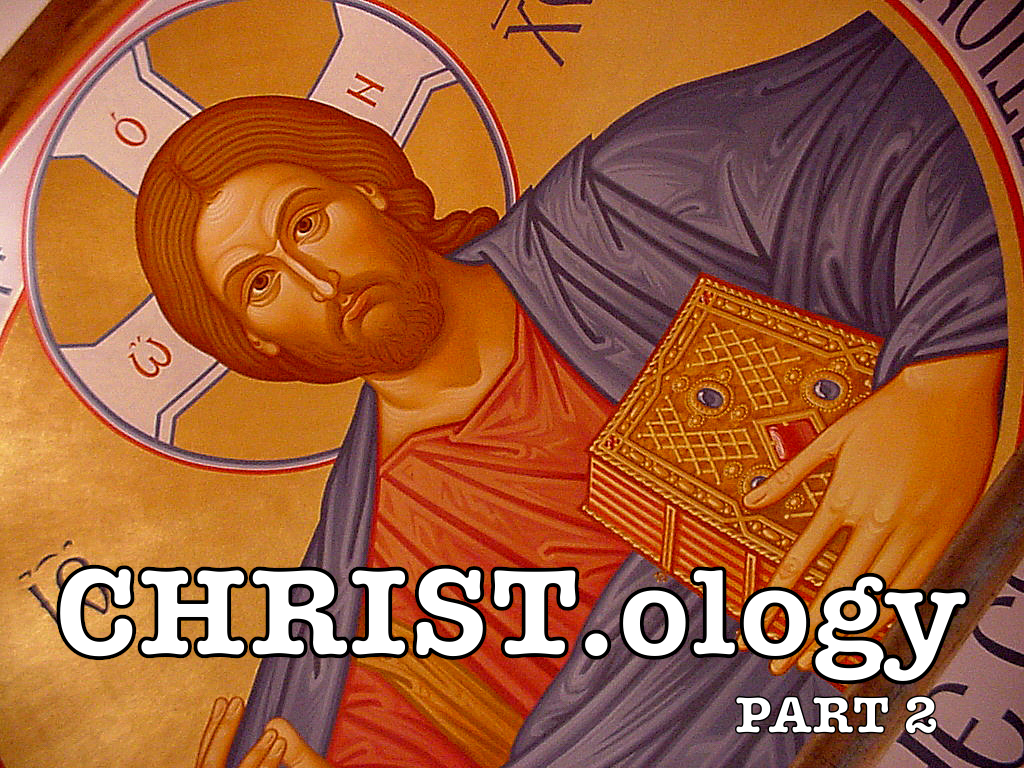 This blog is part two of a three part series I am writing on Christology, based on the Tuesday morning Men’s Bible Breakfast series I am teaching at Concordia. In part one, I spoke of Christ’s two natures as truly God and truly man. Sadly, over the centuries, these two natures have regularly been disparaged and misrepresented by heretics. So that we do not make the same mistakes as these heretics of old, it is worth surveying some of the historical mistakes made concerning Christ’s two natures.
Broadly speaking, Christological heresies have fallen into one of two categories: those which deny Christ’s two natures on the one hand, and those which confuse Christ’s two natures on the other. Let’s look at some examples of each.
Heresies which deny Christ’s two natures…
Arianism
Arianism rose to ascendancy in the third and fourth centuries. This heresy taught that though Jesus was a god, he was not the God. That is, Jesus was indeed divine, but he was not “of one substance with the Father,” as the Nicene Creed confesses. A letter that Arius wrote to Eusebius of Nicodemia, the bishop who baptized Constantine, succinctly states the Arian position: “Before Christ was begotten, he was not…The Son has a beginning, but God is without beginning.” The Arians taught that Jesus’ was God’s first creation and not eternal. John 1:1 firmly refutes such a notion: “In the beginning was the Word and the Word was with God and the Word was God.” Jesus, the Word, was in the beginning. He is uncreated and without beginning because he is in the beginning. Thus, he is not a god, he is the God.
Adoptionism
The heresy of Adoptionism surfaced at the turn of the second century. The Adoptionists taught that Jesus was not just declared God’s Son at his baptism, he was made God’s Son (cf. Luke 3:21-22). To back up this claim, the Adoptionists used Psalm 2:7: “You are my Son; today I have become your Father.” According to Acts 13:33, this Psalm is fulfilled in Jesus. The Adoptionists pointed to God “becoming” Jesus’ father as proof that he was adopted. However, their reading of this passage is woefully mistaken.
The Hebrew word for “become” in Psalm 2:7 is yalad, a word classically translated as “beget.” This word can either denote cause or relationship, depending on what Hebrew mood is used. That is, sometimes this verb can denote cause – one generation giving rise to another through procreation. Other times, however, this verb is used to denote relationship, describing the love and affection that two people have for each other. In Psalm 2:7, this verb, according to its Hebrew mood, is used to denote relationship and not cause. That is, this verb is used to speak of the Father’s loving relationship with the Son and not the Father’s causation of the Son. Thus, Psalm 2:7 is not meant to say that the Father adopted to Jesus to make him his Son, but that the Father loves his Son, even as many fathers love their sons.
Docetism
The name “Docetism” comes from the Greek word dokeo, meaning, “to seem.” The Docetists taught that though Jesus looked, or seemed, human, it was merely an illusion. He did not truly become a man and he did not truly die on a cross. The Docetists based their position on the philosophy of the Gnostics who taught that the spiritual was inherently good while the physical was inherently evil. Therefore, the Docetists taught that God, who is spiritual, would never become a man because a man is physical and the physical is evil! John refutes this heresy again and again. For instance, the evangelist writes in 2 John 7: “Many deceivers, who do not acknowledge Jesus Christ as coming in the flesh, have gone out into the world. Any such person is the deceiver and the antichrist.” John is unequivocally clear: If a person does not acknowledge that Jesus became true man, he is a deceiver.
Heresies which confuse Christ’s two natures…
Even as Arianism and Adoptionism denied Christ’s nature as God and Docetism denied Christ’s nature as a man, there were other heresies which affirmed both natures, yet confused them. To these we now turn.
Nestorianism
Nestorianism became especially prevalent in the fifth century and taught not only that there were two natures contained in the one person of Christ, but that there were actually two Christs! That is, although Christ may have looked like one person, he was actually two persons. Thus, there were some things which the human Christ did which the divine Christ did not participate in and vice versa. For instance, the Nestorians taught that only the human Christ died on the cross, for God cannot die. This is in direct contradiction to Philippians 2:6, 8 which teaches: “Christ, being in very nature God…and being found in appearance as a man, humbled himself and became obedient unto death – even death on a cross.” Paul clearly teaches that Christ, who was in his very nature God, died on the cross. Thus, God died on the cross contra Nestorianism. Christ is one person with two natures, both of which participate in everything Christ, the one man, does, including his life, miracles, ministry, death, and resurrection.
Monophysitism
In reaction to Nestorianism, there arose yet another heresy called Monophysitism. Monophysitism taught that Christ was one person with only one nature. That is, Monophysitism so desired to keep the two natures of Christ unified rather than radically separating them into two Christs as did Nestorianism that it melded Christ’s two natures into one hybrid nature. Eutyches explains Monophysite theology thusly: “Christ’s human nature was dissolved like a drop of honey in the sea.” Thus, Christ’s human nature, though still theoretically present, is not in any way distinct from his divine nature. Biblically, this is problematic because Scripture speaks of Jesus’ two natures as distinct, though not separate. For instance, in the Garden of Gethsemane, Jesus prays, “My Father, if it is possible, may this cup be taken from me. Yet not as I will, but as you will” (Matthew 26:39). Here we see both Jesus’ human and divine natures. As a human, Jesus does not want to die. As God, he surrenders himself to his Father’s will.
Pope Leo the Great wrote against Monophysitism in a declaration known as The Tome of Leo:
The proper character of both natures was maintained and came together in a single person…The birth of flesh reveals human nature; birth from a virgin is a proof of divine power. A lowly cradle manifests the infancy of the child; angels’ voices announce the greatness of the Most High. Herod evilly strives to kill one who was like a human being at the earliest stage the Magi rejoice to adore on bended knee one who is the Lord of all. And when he came to be baptized by his precursor John, the Father’s voice spoke thunder from heaven, to ensure that he did not go unnoticed because the divinity was concealed by the veil of flesh: “This is my beloved Son, in whom I am well pleased.” Accordingly, the same one whom the devil craftily tempts as a man, the angels dutifully wait on as God. Hunger, thirst, weariness, sleep are patently human. But to satisfy five thousand people with five loaves; to dispense living water to the Samaritan woman, a drink of which will stop her being thirsty ever again; to walk on the surface of the sea with feet that do not sink; to rebuke the storm and level the mounting waves; there can be no doubt these are divine.
There is hardly a finer confession, explication, and affirmation of Christ’s two natures than the one penned above. Pope Leo clearly confesses that Christ has two natures, yet he is only one person. And indeed, this confession of Christ is sorely needed – not just because it is good Christology, but because it is good soteriology, a word which refers to the doctrine of our salvation. Christ must be human so that he can identify with us in our struggles, temptations, and sin. He must be human so that he can die. But he must also be God so that he can lead us, guide us, and redeem us. He must be God so that not only does he die, but he also rises again.
Truly man. Truly God. Truly Jesus. Truly our hope and salvation. Don’t settle for anything or anyone less than him.


 Pastor Zach's Blog