Posts filed under ‘ABC Extra’
ABC Extra – The Real Thing – 1 Corinthians 6:12-20
 In 1969, the Coca Cola Company came out with one of their most memorable slogans: “Coke. It’s the real thing.” This slogan was meant to distinguish Coca Cola from all those other “phony colas” out there which were not the real thing, but only discount knock-offs. There’s only one real cola and these advertisers wanted us to know that it was Coke.
Of course, the great philosopher Plato would disagree with Coke’s slogan. Plato distinguished between two worlds: the material world which he described as a world of incidental, outward forms and the non-material world which he maintained was the world of true and universal Forms. Thus, a physical object like, let’s say, a bottle of Coca Cola, was only an incidental form and shadow of a larger, true, grander Form in a spiritual world of Forms. A physical bottle of Coca Cola, then, would quite literally not be the real thing. No, the real Coca Cola resided somewhere in an inaccessible spiritual world of true Forms.
Plato’s distinction between the true spiritual world of Forms and the illusionary physical world of forms has profoundly influenced nearly every philosophical system. It especially held sway over the philosophical systems of the first century. The Epicureans believed, for instance, that since everything in this physical world was only a shadow of the true spiritual world of Forms, everyone was free to live how they wanted, doing with their bodies as they wanted. After all, our physical, bodily forms did not really matter. It was our spiritual Forms that really counted.
Enter the Corinthian Christians. This congregation had apparently bought into Platonic and Epicurean philosophies and found it acceptable and even admirable to live hedonistic lives, apart from any ethical scruples. Indeed, they had a slogan to summarize their philosophical sensibilities: “All things are lawful for me” (1 Corinthians 6:12). The Corinthians believed that whatever they wanted, desired, or thought they needed, they could obtain without regard to moral law. Were they hungry? They could gorge themselves. Were they lusty? They could engage in promiscuity without so much as a second thought. After all, this physical world is only a place full of shadows and our physical bodies are only shells. The real spiritual Form of us resides somewhere else.
The apostle Paul, when addressing the Corinthians, has a somewhat different estimation of this physical world and our physical bodies. He writes, “The body is meant…for the Lord, and the Lord for the body” (1 Corinthians 6:13). Paul’s argument is simply this: what you do with your body counts. Your body is not just a shifting shadow of a greater spiritual reality in some non-descript world of Forms. Indeed, the body is so precious that the Lord is “for the body.” In other words, God thinks your body is a good thing! Tall, short, fat, skinny, black, white, Hispanic, male, female, old, young, or middle aged, God is for your body! He cares about your body! Indeed, he cares about it so much that he promises to raise it imperishably from the dead on the Last Day (cf. 1 Corinthians 15:42).
Paul finally describes the value of our physical bodies thusly: “Do you not know that your body is a temple of the Holy Spirit within you, whom you have from God? You are not your own, for you were bought with a price. So glorify God in your body” (1 Corinthians 6:19-20). There is an interesting textual variant at the end of verse 20. Some ancient manuscripts add another line to this verse. They add, “And in your spirit, which is God’s.”
This final line is probably a liturgical gloss. In other words, whenever a letter like Paul’s would be read out loud to an ancient Christian congregation, the congregation would know the letter so well that they would respond at certain strategic points in the reading. And so, much like when a pastor today says, “The peace of the Lord be with you all,” the congregation will respond, “And also with you,” when the pastor of one of these ancient congregations would read, “So glorify God in your body,” the congregation would respond, “And in your spirit, which is God’s.” These words seem to have become so commonplace, that they made it into some copies of the actual biblical text!
Although these words were almost certainly not in Paul’s original letter to the Corinthians, they do provide us with some interesting insight into how Christians viewed their bodies. The body, it seems, was so important to the early Christians that they came up with a responsive liturgy just to extol the value of our bodies along with our spirits: “Glorify God in your body. And in your spirit, which is God’s.” Thus, whether in our physical bodies or in our incorporeal spirits, we are to glorify God with everything in us. What you do with your body matters. It is not just a reflection of some spiritual reality, it is spiritual reality because in your body resides your spirit. So, in both your body and your spirit, live well and so glorify God with everything in you.
Want to learn more on this passage? Go to
www.ConcordiaLutheranChurch.com
and check out audio and video from Pastor Josh’s
message or Dr. Player’s ABC!

ABC Extra – Darkness to Light – John 3:1-16
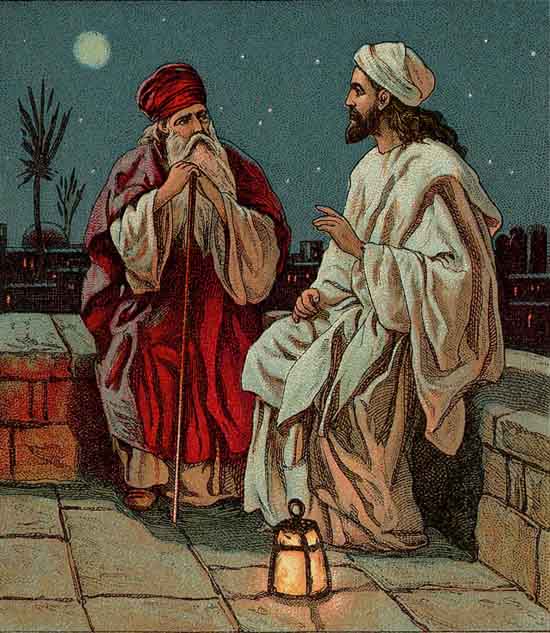 Fitness. According to the Bible, it’s not just a diet program or an exercise regimen, it involves everything we are. For God desires us to be fit in every aspect of our lives, be that physically, emotionally, spiritually, relationally, or otherwise. Indeed, Jesus describes his mission thusly: “I have come that they may have life, and have it to the full” (John 10:10). Jesus desires not only that we have life, but that we have it to the full. And a full life can be found only in him.
Ultimately, a perfectly full life can never be had in this life, for this life will end. Thus, a full life, given by Jesus, involves a promise of a new life beyond this one – a new, eternal life beyond this one. This new, eternal life is the topic of conversation between Jesus and a Pharisee named Nicodemus in John 3. The chapter opens:
Now there was a man of the Pharisees named Nicodemus, a member of the Jewish ruling council. He came to Jesus at night and said, “Rabbi, we know you are a teacher who has come from God. For no one could perform the miraculous signs you are doing if God were not with him.” (John 3:1-2)
Especially notable in these verses is the timing of this conversation between Nicodemus and Jesus. It is “at night” (John 3:2). On the one hand, as I mentioned in Adult Bible Class, John’s gospel regularly uses the image of darkness to express not only physical darkness, but spiritual darkness. As Jesus later says in this same chapter: “This is the verdict: Light has come into the world, but men loved darkness instead of light because their deeds were evil” (John 3:19). Thus, Nicodemus’ timing in his visit to Jesus seems to express something concerning his spiritual state: he is in darkness.
But at the same time the setting of this encounter alludes to Nicodemus’ spiritual darkness, it alludes to something else: his faithfulness. According to ancient traditions, religious communities, such as the community of the Pharisees, were to study Scripture late into the night. We read in the Dead Sea Scrolls: “The general membership [of a religious community] will be diligent together for the first third of every night of the year, reading aloud from the Book, interpreting Scripture, and praying together” (1QS 6:7-8). Thus, at night, as during the day, Nicodemus was to study Scripture with his fellow Pharisees. So when Nicodemus comes to Jesus, he probably does so right after he has studied the Scriptures.
Eventually, Nicodemus comes to faith in Jesus. We read near the end of John’s gospel:
Later, Joseph of Arimathea asked Pilate for the body of Jesus. Now Joseph was a disciple of Jesus, but secretly because he feared the Jews. With Pilate’s permission, he came and took the body away. He was accompanied by Nicodemus, the man who earlier had visited Jesus at night. Nicodemus brought a mixture of myrrh and aloes, about seventy-five pounds. Taking Jesus’ body, the two of them wrapped it, with the spices, in strips of linen. This was in accordance with Jewish burial customs. At the place where Jesus was crucified, there was a garden, and in the garden a new tomb, in which no one had ever been laid. Because it was the Jewish day of Preparation and since the tomb was nearby, they laid Jesus there. (John 19:38-42)
Interestingly, by this time, Nicodemus does not seem to be nearly so shy concerning his commitment to Jesus as he was in John 3. He accompanies Joseph of Arimathea to Pontius Pilate, the very prefect of Judah. Mark records that such an act “took courage” (Mark 15:43), for Pilate could have easily condemned the two men.
Not only does Nicodemus boldly approach Pilate with Joseph, he also embalms Jesus’ body on “the Jewish day of Preparation” (John 19:42), that is, the day before the Sabbath. Jewish days were reckoned from sundown to sundown. This means that Nicodemus would have to tend to the details of Jesus’ burial before sundown – while it was still daylight.
Nicodemus’ first encounter with Jesus was under the cover of night. Nicodemus’ final encounter with Jesus was in broad daylight. Perhaps all those late night study sessions of the Scriptures helped Nicodemus after all. For hours upon hours of studying the light of God’s Word eventually led him to faith in God’s Light of the world.
Before you go to bed tonight, after it becomes dark, take a cue from Nicodemus: take a few brief moments to read and ponder the light of God’s Word, thanking God for his Light of the world.
Want to learn more on this passage? Go to
www.ConcordiaLutheranChurch.com
and check out audio and video from Pastor Tucker’s
message or Pastor Zach’s ABC!
Sermon Extra – The Good Shepherd’s Voice – John 10:1-11
 This past weekend at Concordia, we kicked off a new series titled “Fit for Life” where, for the next few weeks, we are discussing how Jesus can bring health and wholeness to every area of our lives. Indeed, in my sermon this weekend, I began by talking about how the ancient Israelites had a word that they used to describe this kind of holistic health: shalom. This word, most often translated as “peace,” was used to describe a person’s overall well-being, wholeness, health, and even the promise that God would one day come and set the brokenness of this sinful world right. And then, one lonely night in Bethlehem, angels appear to a group of shepherds announcing the birth of a Savior named Jesus and singing: “Glory to God in the highest, and on earth peace to men on whom his favor rests” (Luke 2:14). In Christ, God had fulfilled his promise to bring shalom to this earth.
As God’s shalom incarnate, Jesus brings health to a broken world. He gives sight to the blind, he makes the lame walk, he cures those who are sick, he makes the deaf hear, he raises the dead, and he preaches good news (cf. Matthew 11:5). One such instance of Jesus preaching good news comes in John 10, where Jesus calls himself “the Good Shepherd” (verse 11) who comes “so that we may have life, and have it to the full” (verse 10). How does the Good Shepherd accomplish such a feat? By “laying down his life for the sheep” (verse 11).
In my sermon, I spoke of two different words that Jesus uses for “life” in verses 10 and 11 respectively. When Jesus describes our life in verse 10, he uses the word zoe, describing normal, everyday life. When Jesus talks about laying down his life in verse 11, however, he uses the word psyche, meaning “soul.” Thus, Jesus lays down his very soul at Calvary so that we can have not just normal, everyday life, but full, eternal life. Jesus’ call, then, is to build your zoe on what he did on the cross with his psyche.
One of the things that Jesus promises as our Good Shepherd is this: “His sheep follow him because they know his voice” (verse 4). I find it interesting that Jesus’ sheep do not just hear his voice, or even listen to his voice. No. Instead, they know his voice. They know its tone and tenor. Indeed, they know his voice so well that “they will never follow a stranger; in fact, they will run away from him because they do not recognize a stranger’s voice” (verse 5).
In our world, there are many voices that clamor for our attention and allegiance. The voices of politicians try to steer us to vote Republican or Democrat. The voices of financial gurus try to get us to invest with them, promising exceptional returns on our portfolios. There are even voices of differing and competing spiritualities, all trying to get us to believe their claims. “It’s all karma. You only get what you got coming to you.” “There is no God but Allah, and Mohammed is his prophet.” “All roads lead to God. Just be sincere in what you believe.” “Salvation is found in no one else but Jesus, for there is no other name under heaven given to men by which we must be saved” (Acts 4:12). Which of these voices do you believe?
The invitation of our Good Shepherd is to trust in his voice and his voice alone. For all other voices of this world – be they political or financial or spiritual – lead to an empty life and, finally, to an eternal death. But listening – and knowing – the Good Shepherd’s voice leads to a life that is full and, finally, to a life that is eternal.
This week, get to now the Good Shepherd’s voice a little better. Read his sure and certain voice in his Word. Listen for the whisper and prompting of his Spirit. Wait for the Good Shepherd to respond to your prayers. For when you know the Good Shepherd’s voice you also know shalom. And there is no better thing than shalom for a full life – and for an eternal one.
Want to learn more on this passage? Go to
www.ConcordiaLutheranChurch.com
and check out audio and video from Pastor Zach’s
message or Pastor Nordlie’s ABC!
ABC Extra – The Cup of James and John – Mark 10:35-45
 “For even the Son of Man did not come to be served, but to serve, and to give his life as a ransom for many” (Mark 10:45). These words constitute the heart and soul of service. For service begins with Jesus and his service to us on the cross.
In worship and Adult Bible Class this past weekend, we talked about service and how Christ served us in an utterly unique way which can never repeated or recapitulated: he suffered God’s wrath at our sin in our place on the cross so that we wouldn’t have suffer God’s wrath at our sin for ourselves in hell. This is known as the doctrine of propitiation – that Christ turned back God’s wrath through his suffering and death. And only Christ can suffer in this propitiatory manner. This is why when Jesus asks James and John in Mark 10:38, “Can you drink the cup I drink or be baptized with the baptism I am baptized with?” their answer should have been, “No.” For Jesus is speaking figuratively of his impending death, even as he spoke of it explicitly just verses earlier: “The Son of Man will be betrayed to the chief priests and teachers of the law. They will condemn him to death and will hand him over to the Gentiles, who will mock him and spit on him, flog him and kill him. Three days later he will rise” (Mark 10:33-35). James and John cannot fulfill this mission of suffering, dying, and rising. Thus, they should not presume to be able to drink Jesus’ cup of the cross.
And yet, James and John respond to Jesus’ question with shocking egotism. “We can,” they boisterously announce (Mark 10:39)! “We can drink your cup of the cross!” James and John declare themselves to be saviors! But even in the face of such distasteful egotism, Jesus responds with grace and love: “You will drink the cup I drink and be baptized with the baptism I am baptized with” (Mark 10:39). To what is Jesus referring? After all, James and John certainly cannot die the propitiatory death that Jesus dies! They cannot turn back God’s wrath from humanity!
Jesus is referring to the suffering that James and John will soon have to endure for the sake of their faith in Christ. And although their deaths cannot do what Jesus’ death for humanity, their deaths can mirror how Jesus died. And indeed their deaths do just this. James, we are told in Acts 12:1-2, is arrested by Herod who puts him to death by the sword. John, history tells us, is thrown into the cauldron of boiling oil by Emperor Domitian. But when John miraculously escapes, the emperor opts to exile him to the Aegean island of Patmos. And John and James are not the only ones who suffer for the cause of Christ. Thousands of Christians in the first century suffered at and were martyred by enemies of the faith. Indeed, even a secular historian of Rome from the first century named Tacitus is called to recount some of the horrors to which these early Christians were subjected at the hand of the emperor Nero:
Nero fastened the guilt and inflicted the most exquisite tortures on a class hated for their abominations, called Christians by the populace. Christus, from whom the name had its origin, suffered the extreme penalty during the reign of Tiberius at the hands of one of our procurators, Pontius Pilatus, and a most mischievous superstition, thus checked for the moment, again broke out not only in Judea, the first source of the evil, but even in Rome, where all things hideous and shameful from every part of the world find their center and become popular. Accordingly, an arrest was first made of all who pleaded guilty; then, upon their information, an immense multitude was convicted…of hatred against mankind. Mockery of every sort was added to their deaths. Covered with the skins of beasts, they were torn by dogs and perished, or were nailed to crosses, or were doomed to the flames and burnt, to serve as a nightly illumination, when daylight had expired. Nero offered his gardens for the spectacle, and was exhibiting a show in the circus, while he mingled with the people in the dress of a charioteer or stood aloft on a car. Hence, even for criminals who deserved extreme and exemplary punishment, there arose a feeling of compassion; for it was not, as it seemed, for the public good, but to glut one man’s cruelty, that they were being destroyed. (Tacitus, Annals XV)
A couple of things are especially notable about Nero’s passage. First, Tacitus believes that the Christians were guilty of “hatred against mankind.” That is, he asserts that the Christian faith is so foreign and ridiculous that it as a grave peril to the social order. Thus, he seems to support a punishment and even the death penalty against Christians. However, Nero’s treatment of these “criminals,” as Tacitus calls the Christians, is so brutal that it turns even the Roman historian’s stomach. “There arose a feeling of compassion,” Tacitus says. And indeed there did, even as the apostle Peter tells us:
But in your hearts set apart Christ as Lord. Always be prepared to give an answer to everyone who asks you to give the reason for the hope that you have. But do this with gentleness and respect, keeping a clear conscience, so that those who speak maliciously against your good behavior in Christ may be ashamed of their slander. It is better, if it is God’s will, to suffer for doing good than for doing evil. (1 Peter 3:15-17)
Peter says that those who brutally persecute Christians are eventually ashamed of their senseless acts of violence. And thus, the public’s compassion is aroused.
Though we may never be called to suffer under the deranged delusions of an insane despot as so many of the early Christians were called to do under Nero, we are still persecuted for our faith. People still speak ill of us. They still try to discount or disparage our beliefs. Suffering for faith is alive and well. And we drink the cup of wrath: not the cup of God’s wrath against man, but the cup of man’s wrath against God and his followers. And yet, because Jesus drank the propitiatory cup of salvation, even in the midst of our suffering, we can still “rejoice and be glad, because great is our reward in heaven” (Matthew 5:12).
So this week, don’t be surprised if the world hands you a cup of suffering for the cause of Christ. But if you do suffer, remember the one who has suffered in your place. For with him, there is no suffering you can’t face.
Want to learn more on this passage? Go to
www.ConcordiaLutheranChurch.com
and check out audio and video from Pastor Tucker’s
message or Pastor Zach’s ABC!
ABC Extra – Matthew 5:13-16
 The Roman philosopher Pliny wrote, “Nothing is more useful than salt or sunshine” (Natural History, 31.102). This past weekend in worship and Adult Bible Class, we reflected on the truth of those words as we discussed Jesus’ mission for us, using his metaphor of salt and light:
You are the salt of the earth. But if the salt loses its saltiness, how can it be made salty again? It is no longer good for anything, except to be thrown out and trampled by men. You are the light of the world. A city on a hill cannot be hidden. Neither do people light a lamp and put it under a bowl. Instead they put it on its stand, and it gives light to everyone in the house. In the same way, let your light shine before men, that they may see your good deeds and praise your Father in heaven. (Matthew 5:13-16)
Part of what makes these metaphors so powerful is that they are multifaceted and therefore rich in their applications of who we are called to be as Christ’s witnesses. Salt, for instance, had nearly limitless uses in the ancient world. From a seasoning to a preservative to a sign of friendship to an element in sacrifices to a symbol for the Word, salt was used in and for nearly anything and everything. As such, salt was considered a precious commodity. In fact, spilling salt was thought to invoke a curse. In order to break this curse, a person was to take some of the spilled salt and throw it over his shoulder. From this, we get the tradition of tossing salt over one’s shoulder for good luck.
Interestingly, in Leonardo da Vinci’s famed fresco of the Last Supper, in front of Judas is a spilled shaker of salt. Da Vinci used this well-known image of spilled sodium chloride and the superstition connected to it to poetically portray Judas’ deep and dire betrayal of his Lord and Master.
Salt’s value in the ancient world adds yet another facet to Jesus’ commission, “You are the salt of the earth.” Not only are we to spice up the world with the message of Christ, preserve the world with the true doctrine of Christ, be a friend to the friendless in the name of Christ, be willing to sacrifice for the cause of Christ, and preach the Gospel boldly according to the Word of Christ, this metaphor of salt also reminds us that we are considered precious in the sight of Christ. As God reminds us through his prophet Isaiah, “Since you are precious and honored in my sight, and because I love you, I will give men in exchange for you, and people in exchange for your life” (Isaiah 43:4). Finally, God gave not men, but a man named Jesus, in exchange for us. We are so precious in God’s sight that he gave his Son for us. Thus, when Jesus says, “You are the salt of the earth,” among other things, Jesus is reminding us of how infinitely valuable we are to him.
As for Jesus’ metaphor of light, we learned not only that are we called to be light for Christ in a dark, crooked, and depraved generation, we also learned that Christ is our light, just as he tells us: “I am the light of the world” (John 8:12). Interestingly, Jesus’ identity as the Light is intimately connected to Jesus’ identity as the Messiah. In the Old Testament, a king was called a mashiach, or messiah, a Hebrew word meaning, “anointed one.” A king would be anointed with oil as a sign of his fitness to rule and reign over Israel. Oil, of course, was used not only for anointing kings, but for a whole plethora of purposes, including that of lighting lamps. Thus, in Psalm 132:17 we find that the oil of anointing is connected to the oil which lights a lamp as the Psalmist prophecies that God will “set up a lamp for his anointed one.” The two pictures come together. The oil with which God’s Messiah is anointed becomes the very oil with which he lights a dark world. And so, when Jesus says, “I am the light of the world,” his claim is none other than a Messianic one.
Finally, these metaphors of salt and light are not only Christ’s mission for us, they are a description of Christ himself. Salt describes Christ’s love and care for us as his precious children. Light describes Christ’s identity as the world’s Messiah and Savior. In other words, we cannot be salt and light without Christ being Salt and Light first. So this week, go forth as salt and light in the name of the One who is Salt and Light.
Want to learn more on this passage? Go to
www.ConcordiaLutheranChurch.com
and check out audio and video from Pastor Tucker’s
message or Pastor Zach’s ABC!
ABC Extra – Psalm 119:101-105
 Proverbs 14:12 soberly reminds us: “There is a way that seems right to a man, but in the end it leads to death.” In the Septuagint, the famed second century BC Greek translation of the Hebrew Old Testament, the word for “way” is hodos. The word hodos is regularly used figuratively, referring to the ethical way of humans, whether that way be one of righteousness or one of evil. Such is the case in this verse from Proverbs. The ethics of a man may seem righteous, but they are righteous only in his own eyes. To God, a human’s self-contrived way of ethics is a way only to condemnation and damnation.
In worship and Adult Bible Class this past weekend, we talked about the primacy of Scripture at Concordia. Doctrinally, I talked about how:
Scripture is inspired. This means that God speaks the very words of Holy Writ – every verb, adjective, noun, and pronoun. He also speaks all of Holy Writ – from the first chapter of Genesis to the last chapter of Revelation. Thus, we believe in the verbal, plenary inspiration of Scripture.
Scripture is inerrant. Because Scripture is inspired by God, and because God is perfect, the Bible contains no mistakes or errors in its original autographs.
Scripture is perspicuous. That is, Scripture is clear! You don’t need a PhD in theology to understand the Bible. Any Christian can read and study this book.
Scripture is sufficient. Although Scripture does not tell us everything we might want to know about God, it does tell us everything we need to know about God, for it tells us of our sin and our need for a Savior.
Following this primer on the doctrine of Scripture and its authority, we then considered together a Psalm 119, which well extols the value of Scripture. The Psalmist writes:
I have kept my feet from every evil path so that I might obey your word. I have not departed from your laws, for you yourself have taught me. How sweet are your words to my taste, sweeter than honey to my mouth! I gain understanding from your precepts; therefore I hate every wrong path. (Psalm 119:101-104)
In the Septuagint’s translation of this Psalm, as in Septuagint’s translation of Proverbs, we find the word hodos used in its ethical sense. In verse 101, when the Psalmist announces, “I have kept my feet from every evil path,” the Greek word for “path” is hodos. Again, in verse 104, when the Psalmist says, “I hate every wrong path,” the word is hodos. The Psalmist despises the way that seems right to a man. Instead, he desires to follow the way of God, as given in his Word: “Your word is a lamp to my feet and a light for my path” (Psalm 119:105). The righteous hodos of God is to be found in his Word.
“Keep the commands of the LORD your God and walk in his ways” (Deuteronomy 28:9). Again, the word for “ways” is hodos. The ways of God are to be found in the commands and Word of God, as Moses so aptly reminds us. But make no mistake about it: God’s holy Way, as given in the Scriptures, is no sterile system of ethics, contained only in some tepid tome. For in the Scriptures, a Way of God is revealed which offers us eternal life.
In John 14:6, we again hear of a hodos. Jesus says, “I am the way and the truth and the life. No one comes to the Father except through me.” The word for “way” is hodos. In the midst of a host of human futile “ways” Jesus declares himself the sole “Way” to God.
It is no surprise, then, that the earliest Christians called themselves followers of “the Way” (cf. Acts 22:4). For they knew that the ways of man, no matter how righteous they might seem, lead only to death. The Way who is Jesus, however, leads to life eternal.
Jesus is the Way. And Jesus’ Way is revealed to us in the pages of a book which the Psalmist says is a lamp to our feet and a light to our path. Scripture too, then, is God’s Way. May we cling to God’s Way of Scripture and God’s Way of his Son. For here we have the sure and certain Way of life. May we follow this Way, believe this Way, be forgiven by this Way, and read this Way. Read your copy of the Way today.
Want to learn more on this passage? Go to
www.ConcordiaLutheranChurch.com
and check out audio and video from Pastor Tucker’s
message or Pastor Zach’s ABC!
ABC Extra – Luke 2:22-33
 This past weekend at Concordia in both worship and ABC, we continued our series “Shine Like Stars: Concordia’s Core” with a look at Luke 2:22-33 and the topic of worship. At the end of Adult Bible Class, I offered four lessons on worship based on this text.
Lesson 1: Worship is commanded by God. Mary and Joseph bring Jesus to the temple “in keeping with what is said in the Law of the Lord” (verse 24). Worship is commanded by God and Mary and Joseph follow that command. And we too are commanded to worship. And we are not just to worship privately, but also corporately. As the preacher of Hebrews reminds us, “Let us not give up meeting together, as some are in habit of doing” (Hebrews 10:25). Worship is not optional for the Christian.
Lesson 2: Worship is Spirit-saturated. Simeon goes to the temple to worship when he is “moved by the Spirit” (verse 27). Worship must be led by and endowed with the Spirit. This does not mean some sort of Charismatic madness, mind you. It simply means that the Spirit speaks through the words of Scripture and rests on the praises of his people. This is why we begin every worship service, “In the name of the Father and the Son of the Holy Spirit.” We invoke the Spirit’s presence among us as we worship.
Lesson 3: Worship is from God to us. It is God who first serves us in worship. He serves us by his Word, by his Sacraments, and by his grace. We then respond by simply offering to God what he has first given us. Indeed, this is precisely what happens with Mary and Joseph when they “present Jesus to the Lord” (verse 22). They present Jesus, who is the Lord of heaven and earth, to the Lord of heaven and earth! They present what God has first given them in his Son back to God. This is what we too do in worship. For we have nothing to bring to God in worship except that which he has already brought to us.
Lesson 4: Worship is accepted by God. God gives us so much in worship. He gives forgiveness of sins, life, and salvation. What we return to God in worship is a mere pittance in comparison. Again, we see this in the case of Mary and Joseph. God gives to them his Son and, in return, Mary and Joseph bring to God “two young pigeons” (verse 24). Hardly a fair trade. And yet God, out of his love, gladly accepts these tokens of worship.
With that brief review of my ABC, here is one additional lesson on worship which I did not have time to cover.
Lesson 5: Worship is evangelical. Simeon, when he sings his song of worship to God, says, “Sovereign Lord, as you have promised, you now dismiss your servant in peace. For my eyes have seen your salvation, which you have prepared in the sight of all people, a light for revelation to the Gentile and for glory to your people Israel” (verse 29-32). Simeon’s worship of the baby Jesus begins in the temple, but it does not stay there. For the salvation that Christ brings has been prepared by God to be seen by all people. Similarly, in the early church, we read about how “Every day [Christians] continued to meet together in the temple courts. They broke bread in the their homes and ate together with glad and sincere hearts, praising God and enjoying the favor of all the people” (Acts 2:46-47). Lots of people watched the early church worship. And, through that witness of worship, “The Lord added to their number daily those who were being saved” (Acts 2:47).
When was the last time you invited someone to church with you to watch you worship? True worship of God can be offered only by believers because it is rooted in and flows from faith. But that doesn’t mean you can’t invite someone who does not believe in Jesus to church with you. For it is in worship that God will meet them. And it is in worship that God will convict them with his Law and comfort them with his Gospel. It is in worship that God just might save them. And then they will no longer just watch worship, they will worship. For they will no longer just see the salvation prepared for them, as Simeon so eloquently sings, they will believe it. And believing God’s salvation is what worship is all about.
Want to learn more on this passage? Go to
www.ConcordiaLutheranChurch.com
and check out audio and video from Pastor Tucker’s
message or Pastor Zach’s ABC!
ABC Extra – Philippians 2:14-16
 This past weekend at Concordia, we kicked off our series titled, “Shine Like Stars: Concordia’s Core” in both worship and ABC. This series is devoted to discovering what’s at the core of Concordia. In other words, we are revisiting what it is that constitutes the heart and soul of this congregation. And to begin our series, I talked about how you – Concordia’s members – make this congregation what it is. After all, without you, there would be no Concordia!
Concordia’s mission statement is based on Philippians 2:14-16, where Paul exhorts his readers:
Do everything without complaining or arguing, so that you may become blameless and pure, children of God without fault in a crooked and depraved generation, in which you shine like stars in the universe as you hold out the word of life.
There are several notable aspects about Paul’s commission to “shine like stars” which I did not have time to cover in this weekend’s ABC. So, in the spirit of my first “ABC Extra,” here are a couple of interesting “extras” on this passage!
First, it is important to recognize that Paul’s desire that we “shine like stars” is not so much a command which we are to fulfill as it is a statement of our very being. The verb for “shine” in Greek is a present indicative, which means that it describes something we already are. It is not a command to be something we are not. Our status as “shining stars” is based on what we already been given in our salvation (cf. Philippians 2:12). Indeed, this verb is even in the passive voice in Greek. In other words, we do not have to actively work at shining like stars; rather we are made that way by God through the salvation we have already received. We are passive stars, made to shine by God himself. Thus, by the very fact that you are a child of God, you are a shining star, whether or not you always feel like you are!
Second, it is important to note that Paul’s words here about shining stars are drawn from a prophecy in Daniel 12:1-5:
At that time Michael, the great prince who protects your people, will arise. There will be a time of distress such as has not happened from the beginning of nations until then. But at that time your people – everyone whose name is found written in the book – will be delivered. Multitudes who sleep in the dust of the earth will awake: some to everlasting life, others to shame and everlasting contempt. Those who are wise will shine like the brightness of the heavens, and those who lead many to righteousness, like the stars for ever and ever. But you, Daniel, close up and seal the words of the scroll until the time of the end. Many will go here and there to increase knowledge.
Notice that these words are spoken to Daniel by the Lord as a prophecy concerning the resurrection of the dead on the Last Day. These words, then, are not only a description of our present state, they are also a promise for our glorious future. Even in a world that is full of darkness, the light of God’s stars – you and me – will eventually carry the day.
Finally, we must never forget that although we have received the blessed status of stars, we only receive this status at the pleasure of the Star. As Jesus says of himself, “I am the Root and the Offspring of David, and the bright Morning Star” (Revelation 22:16). Jesus is the Star and we are his stars. Thus, we are called to be reflectors and imitators of the Star who is Christ. Shine his light into this dark world today!
Want to learn more on this passage? Go to
www.ConcordiaLutheranChurch.com
and check out audio and video from Pastor Tucker’s
message or Pastor Zach’s ABC!


 Pastor Zach's Blog