Archive for December, 2009
“Word for Today” – Hebrews 1 – www.concordialutheranchurch.com
 Many of these are cliché, I know, but the other day, I stumbled across this mildly amusing list of the top six things you’ll never hear a husband say to his wife:
6. “Here honey, you use the remote.”
5. “Ooh, Antonio Banderas and Brad Pitt? That’s a movie I gotta see!”
4. “I’d love to drink chai tea and talk about my feelings with you and your girlfriends.”
3. “Let me hold your purse while you try that on.”
2. “Why don’t you come to the mall with me and help me pick out a pair of shoes.”
1. “Forget Monday Night Football, let’s watch Supernanny.”
For the record, I will hold my wife’s purse while she’s trying something on. I won’t watch Supernanny instead of Monday Night Football.
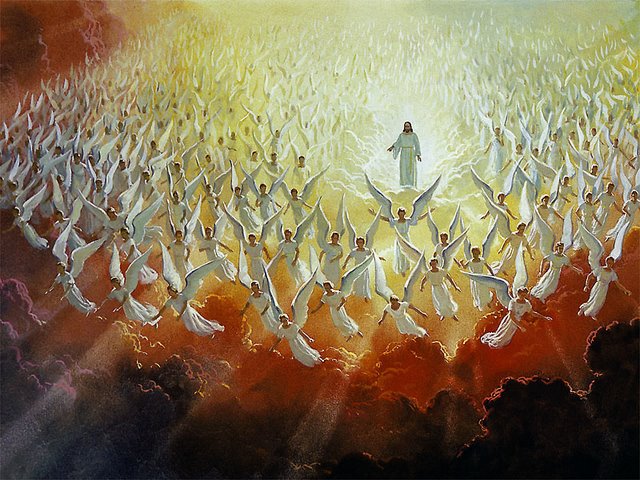
The book of Hebrews, which we begin reading today, isn’t a book per se, but a sermon. We do not know who preached this sermon, but he begins with a list of the top six things you’ll never hear God say to one of his angels. They are:
6. “You are my Son; today I have become your Father.” (verse 5)
5. “I will be his Father, and he will be my Son.” (verse 5)
4. “Let all God’s angels worship him.” (verse 6)
3. “Your throne, O God, will last for ever and ever,
and righteousness will be the scepter of your kingdom. You have loved righteousness and hated wickedness; therefore God, your God, has set you above your companions by anointing you with the oil of joy.” (verses 8-9)
2. “In the beginning, O Lord, you laid the foundations of the earth, and the heavens are the work of your hands. They will perish, but you remain; they will all wear out like a garment. You will roll them up like a robe; like a garment they will be changed. But you remain the same, and your years will never end.” (verses 10-12)
1. “Sit at my right hand until I make your enemies a footstool for your feet.” (verse 13)
This list of top six things, cited from the Old Testament, is meant to argue that, because God has said these things to Jesus while refusing to say these things even to his angels, Jesus is “superior to the angels” (verse 4) and is “the radiance of God’s glory and the exact representation of his being” (verse 3). That is, he is God Almighty himself. In other words, this sermon argues that Jesus isn’t just one divine being among many; rather, he is the divine being who created the very heavens and the earth. No one can compare to him. As such, God says things to Jesus that he would never say to any other divine being.
For the two millennia since he walked this earth, many people have said many things about Jesus. Some have talked about Jesus as a great prophet, others have called him an enlightened teacher. Still others have tried to deny, futilely and unsuccessfully, that Jesus ever existed. He was simply a figure, these scholars would say, of sectarian Jewish Messianic expectations.
In the midst of a world where so many things are said about Jesus, it is important, the preacher of Hebrews argues, to listen to what God has said to Jesus. For it is in the voice of God that we hear a true description and depiction of who Jesus really is. And Jesus, according to God himself, is superior over all. He is superior over all the angels, he is superior over all the earth, he is superior over every problem and every pain and every worry and every care. Jesus is superior over all – even you.
Every day, we face things which, frankly, are superior over us. A sickness, a tragedy, a loss – these things are unstoppable by us because they’re superior over us. There are many things in this world over which we have no say or sway. But as superior as those things might be over us, they’re not superior over Jesus. For Jesus is superior over all. And this means that Jesus can work out even the most gut-wrenching problems of this world, which are all too gleeful to sink their sadistic claws into our souls. They may be superior over us, but they’re not superior over Jesus. So whatever superior problem you might face today, take it to Jesus. For there is nothing he can’t handle.
“Word for Today” – 2 Thessalonians 3 – www.concordialutheranchurch.com
 Oh what sordid stories the office water cooler could tell. Yes, there are the Monday morning conversations about the Sunday afternoon football games. Those are innocuous enough. But then there are the less savory conversations – the ones that tend to be whispered rather than spoken. “Did you hear,” one person might murmur, “that Steve’s wife caught him at a bar with another woman?” “Yeah,” another might respond, “I heard she didn’t let him to come home last night.” Oh what sordid stories that office water cooler could tell. Are they important stories? Perhaps, but they are certainly not appropriate in the context of the water cooler. Are they edifying stories? Most certainly not. Are they juicy and enthralling stories? Yes. And that’s why people can’t resist sharing them in their best tabloid like tenor.
In our reading for today from 2 Thessalonians 3, Paul addresses much of the conversation that is shared around office water coolers. He writes: “We hear that some among you are idle. They are not busy; they are busybodies. Such people we command and urge in the Lord Jesus Christ to settle down and earn the bread they eat” (verses 11-12). Paul warns that those who do not work will find work to do. But it will not be noble work; rather, it will be the sinful work of gossip. Paul’s wordplay in verse 11 is masterful and is retained quite well by the NIV. The Greek word for “busy” is ergazomai while the word for “busybody” is periergazomai. Notice the preposition of the second word – peri – from whence we get our English word “perimeter,” meaning, “around.” Paul’s argument is this: If a person does not work, he will “work around,” so to speak, running around and butting into other people’s affairs. Such busybody work is sinful and dangerous.
True work, not busybody work, is a gift from God. Indeed, when God created the heavens and the earth, one of the things we are told about the first man Adam is: “The LORD God took the man and put him in the Garden of Eden to work it and take care of it” (Genesis 2:15). We were created not for idleness, but for work. Sadly, many people have traded their God-given mandate to work for the allures of laziness and “working around.” One 2005 survey found that the average office worker spends 2.09 hours per day surfing the internet when he or she should be working. Of course, these time wasters had a whole host of excuses as to why they fritter away their work hours. “I’m underpaid for the work I do,” some said. “My co-workers distract me,” others responded. And then there was, “I don’t have enough evening or weekend time to relax.” But regardless of the excuse, the bottom line is this: Such idleness breaks the command of God.
So how are we, as Christians, to respond to the gossip, laziness, and lethargy so prevalent among so many? Paul gives us this answer: “As for you, brothers, do not grow weary in doing good” (verse 13, ESV). We are to roll up our sleeves and do good – yes, even to those who are lazy, lethargic, and busybodies. Idleness and gossip may mark the ways of the world, but it should not mark the way of a Christian. So what good thing can you do today? It may be work, but remember, God made you to find joy in such work. Thank God for the tasks he has given you today.
“Word for Today” – 2 Thessalonians 2 – www.concordialutheranchurch.com
 Our last presidential election battle was a nail biter – at least on the Democrat side of the ticket. Two candidates, neck and neck, dueling it out, and spending exorbitant amounts of campaign cash in hopes of becoming either the first African American or the first female president of the United States.
In her concession speech to now President Obama, now Secretary of State Hillary Clinton uttered some words that have become a rallying cry of sorts for those who continue to hold out hope that there will one day be a female president. She said, “If we can blast 50 women into space, we will someday launch a woman into the White House. And although we weren’t able to shatter that highest, hardest glass ceiling this time, thanks to you, it’s got about 18 million cracks in it” (Clinton, 6.7.2008). Clinton was referring, of course, to her 18 million supporters who voted for her in the presidential primary. And indeed, those glass ceilings, once so prevalent in circles of power, have lost much of their assumed invulnerability as both men and women have risen to meet the daunting challenges of the twenty first century.
In our reading for today from 2 Thessalonians 2, we meet a leader who is seeking to shatter the high, hard glass ceilings of this world’s positions of power, except that this leader is seeking to shatter them for his own sinister purposes. The apostle Paul warns:
Now concerning the coming of our Lord Jesus Christ and our being gathered together to him, we ask you, brothers, not to be quickly shaken in mind or alarmed, either by a spirit or a spoken word, or a letter seeming to be from us, to the effect that the day of the Lord has come. Let no one deceive you in any way. For that day will not come, unless the rebellion comes first, and the man of lawlessness is revealed, the son of destruction, who opposes and exalts himself against every so-called god or object of worship, so that he takes his seat in the temple of God, proclaiming himself to be God. (verses 1-4, ESV)
Shortly before the return of Christ, there will come a man of lawlessness. And this man of lawlessness, according to verse 4, will seek to “oppose and exalt himself against” the authority of the world’s most powerful leaders who, in the days referred to here, will consider themselves to be “gods.” The Greek for the phrase “oppose and exalt” is antikeimenos kai hyperairomenos. Notice the prefixes: anti and hyper. Anti for “oppose” and hyper for “exalt.” This man of lawlessness, it seems, will be both contrary to others and consider himself better than others. In the midst of many “so-called gods” (verse 4), all of whom have ego problems because they think of themselves as divine, this guy will have the ultimate ego problem. And it is his ego problem that will relentlessly drive him to shatter the glass ceilings of this world’s power structures.
But for all of the glass ceilings that this man of lawlessness may be able to shatter, there is one glass ceiling through which he will never be able to rise: the glass ceiling above which the true sovereign of the universe, God Almighty, sits. Yes, this man of lawlessness might try to “proclaim himself to be God” (verse 4), but he will fail miserably. For Paul continues: “The lawless one will be revealed, whom the Lord Jesus will kill with the breath of his mouth and bring to nothing by the appearance of his coming” (verse 8). With just his breath, Jesus will destroy the coming man of lawlessness. For although the man of lawlessness can stand against and rise above other wicked rulers of the world, he cannot stand against and rise above the good Creator of the world. And although the man of lawlessness might be able to shatter the glass ceilings of this world’s power structures, when it comes to the glass ceiling of God, he won’t be able to put even a single crack in it, much less 18 million cracks. And that’s good news. Because for all the glass ceilings we might want to see shattered, God’s glass ceiling is one we want to see stand strong. Because God’s highest, hardest glass ceiling means that our salvation is secure. Praise be to God!


 Pastor Zach's Blog