Archive for July, 2009
“Word for Today” – Matthew 26 – www.concordialutheranchurch.com
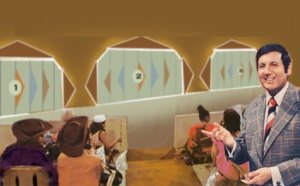 One of the most popular game shows of all time was “Let’s Make A Deal” with Monty Hall. If you came of age in the sixties, then you surely remember the premise. Monty Hall would call contestants at random from the audience and ask them to trade whatever item they happened to have on them, such as their shoes or their coat or even their purse, for what was behind door number one, door number two, or door number three. Sometimes, the prizes behind a door were fabulous: a trip, a fur coat, electronics, furniture, an appliance, or even a new car. Other times, contestants would just assume leave their “prize” of a matchbox car, a wheelbarrow, or a t-shirt on the stage and simply walk away.
Even decades after “Let’s Make A Deal” has faded from the primetime airwaves, the allure of what’s behind door number one, door number two, or door number three has remained seared in the public consciousness. Jimmy Buffett even sang a song about these famous doors: “My whole world lies waiting behind door number three. And I don’t want what Jay’s got on his table, or the box Carol Merrill points to on the floor. No, I’ll hold out just as long as I am able, or until I can unlock that lucky door.”
In our reading for today from Matthew 26, we find Jesus in the throws of his final hours. And for his closing act, he decides to celebrate with his disciples a most sacred meal: the Passover. A traditional Jewish celebration of the Passover would involve eating matza, or unleavened bread, parsley, lamb, and sharing four cups of wine, a highly significant event, echoing God’s words in Exodus 6:6-7: “I am the LORD, and I will bring you out from under the yoke of the Egyptians. I will free you from being slaves to them, and I will redeem you with an outstretched arm and with mighty acts of judgment. I will take you as my own people, and I will be your God. Then you will know that I am the LORD your God, who brought you out from under the yoke of the Egyptians.” Each of the four cups of the Passover corresponded to each of the four divine statements in this passage: “I will bring…I will free…I will redeem…I will take.” The third cup, the cup of redemption, was especially poignant because it spoke to the exact moment that God bought the people of Israel out of their slavery in Egypt and instead made them his servants. And God accomplishes this redemption, the author of Exodus says, with an outstretched arm.
Jesus could have chosen any cup he wanted. But on this Passover night, when he institutes a new meal – his meal – Jesus chooses cup number three: the cup of redemption. “Then he took the cup, gave thanks and offered it to his disciples, saying, ‘Drink from it, all of you. This is the blood of the covenant which is poured out for many for the forgiveness of sins” (verses 27-28). Jesus uses the cup shared immediately after the Passover meal – the third cup – to share his blood with his disciples.
Jesus could have chosen any cup he wanted. But on this Passover night, when he institutes a new meal – his meal – Jesus chooses cup number three: the cup of redemption. For God, through Christ, is once again redeeming his people. Not from slavery in Egypt, but from slavery to sin so that he can make them servants of himself. And God, once again, is doing it with an outstretched arm, or, should I say, with outstretched arms. For the two arms of Jesus, outstretched on a cross, won for us redemption from sin, death, and the devil.
Jesus could have chosen any cup he wanted. But on this Passover night, when he institutes a new meal – his meal – Jesus chooses cup number three: the cup of redemption. Jesus “makes a deal,” as it were, for our souls. Not with a pair of shoes, a coat, or even a purse, but with his very blood, shed on a cross and shared in a supper. And now Jesus invites us to partake with him in what’s in cup number three. For in cup number three is the very taste of forgiveness. In cup number three is the very taste of our salvation. In cup number three is the very taste of our redemption. And so this Sunday, I can’t wait to not only see, but drink of, what’s in cup number three. I hope you’ll join me.
“Word for Today” – Matthew 25 – www.concordialutheranchurch.com
 A couple of weeks ago, I was having a conversation with a friend when, all of a sudden, what seemed to me to be out of the clear blue sky, they said to me, “Zach, I want you to know that I really appreciated last Tuesday.” Immediately, my mind sprang into action. “Last Tuesday. Last Tuesday? What did I do last Tuesday?” Although I tried to hide that puzzled stare that I’m sure emerged all over my face, my friend quickly figured out that I was lost. “The funeral that you attended last Tuesday. It really meant a lot to the family and it really meant a lot to me.”
I have to admit, at that moment, I was more than a little embarrassed. It humiliated me that I would so quickly forget about an event as significant as a funeral. But it wasn’t for lack of care and concern that I forgot about it. It was simply because I didn’t consider my attendance at that funeral to be that big of a deal. I was there, not because I felt I had to be, but because I wanted to remember the deceased and lift up his family in prayer. Honestly, I never imagined the family would notice or care whether or not I was there. But I was wrong. Because they did notice. And they did care. And they appreciated it more than I ever thought they would.
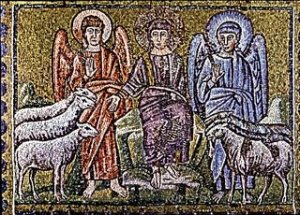
In our reading for today from Matthew 25, Jesus offers one of the most famous and memorable descriptions of his second coming: “When the Son of Man comes in his glory, and all the angels with him, he will sit on his throne in heavenly glory. All the nations will be gathered before him, and he will separate the people one from another as a shepherd separates the sheep from the goats” (verses 31-32). The sheep, of course, are those who are commended and brought to salvation. The goats, conversely, are those who are condemned and sent to damnation.
I have always found Jesus’ commendation of the sheep to be especially fascinating:
“Come, you who are blessed by my Father; take your inheritance, the kingdom prepared for you since the creation of the world. For I was hungry and you gave me something to eat, I was thirsty and you gave me something to drink, I was a stranger and you invited me in, I needed clothes and you clothed me, I was sick and you looked after me, I was in prison and you came to visit me.” Then the righteous will answer him, “Lord, when did we see you hungry and feed you, or thirsty and give you something to drink? When did we see you a stranger and invite you in, or needing clothes and clothe you? When did we see you sick or in prison and go to visit you?” The King will reply, “I tell you the truth, whatever you did for one of the least of these brothers of mine, you did for me.” (verses 34-40)
Did you catch what the sheep say to Jesus? They say, “We did what again? You were hungry and we fed you? You were in need of clothes and we clothed you? You were sick and we looked after you? You were in prison and we went and visited you? We don’t remember any of that!”
It seems as though the Last Day will, in some ways, echo my funereal forgetfulness. Because to us, so much of what we do just isn’t that big of a deal. So often, just as Jesus instructs, we are so forgetful that our right hand doesn’t even remember what our left hand is doing (cf. Matthew 6:3). But to Jesus remembers. And Jesus cares. Because to Jesus, what we do for others, we also do for him. And to Jesus, that is a big deal.
So today, recall something charitable, something gracious, perhaps even something life-altering you have done for another person and didn’t even think about it until you were later reminded. And if you can’t think of anything, that’s okay. That just means you’re doing great. You’re not supposed to remember the good things you do anyway. But don’t worry, you’ll be reminded eventually. For Jesus will remind you. And Jesus will thank you. What a glorious day that will be.
“Word for Today” – Matthew 24 – www.concordialutheranchurch.com
 It was not a pleasant experience. At the tender age of nine, my mother left me home alone for the first time. She had a couple of errands to run and figured now would be as good a time as any to teach me some independence. After all, she was only going to be gone for half an hour. I, however, was mortified at the prospect of having to spend a full thirty minutes alone in our big, creaky, creepy house. Nevertheless, my mother drove off and left me behind. I immediately dashed into my room and shut the door, petrified by the thought of burglars, which I was certain were lurking right outside the front door. Fifteen minutes passed. Then twenty. Then twenty-five. Then thirty minutes. And mom wasn’t home yet! Finally, after a full thirty-four minutes, I couldn’t take it anymore. I emerged from my room, dashed to the kitchen, and called my dad at work. “Dad,” I said misty-eyed, “Mom said she was going to be gone half an hour and she’s already been gone thirty-four minutes!” My mother came home three minutes later.
Although at age nine I was already having preteen moments of rebellion, trying to assert my independence, I still was not ready to be too independent. I still wanted to have someone around to protect me at all times. I still did not want to be left behind by my mother.
My sentiment as a child echoes the sentiment of many when it comes to the way the end times are talked about in popular Christian movies and literature. On the final day of 1995, a novel by Tim LaHaye and Jerry Jenkins hit bookshelves everywhere and changed the way millions viewed that last days of history. The novel’s title was Left Behind. The plot line tracks the life of an airplane pilot and his family after they are “left behind” following a rapture of the faithful. The moral of the story is self-evident: The end of history will be a dark, scary, tumultuous time. You don’t want to live through it. So make sure you believe in Jesus and don’t get left behind.
This may come as a shock to many, especially in light of my reticence even to be left behind at home by my mother as a child, but I actually want to be left behind. Not in the way that Tim LaHaye and Jerry Jenkins talk about it, but in the way that our text for today from Matthew 24 talks about it. Jesus says, “As it was in the days of Noah, so it will be at the coming of the Son of Man. For in the days before the flood, people were eating and drinking, marrying and giving in marriage, up to the day Noah entered the ark; and they knew nothing about what would happen until the flood came and took them all away. That is how it will be at the coming of the Son of Man. Two men will be in the field; one will be taken and the other left. Two women will be grinding with a hand mill; one will be taken and the other left” (verses 37-41).
These words from Jesus are often marshaled to teach a rapture near the end of time. There will be groups of people, the doctrine goes, and some will be taken to be with the Lord, while others will be “left behind” to suffer the pain and misery and agony of the earth’s final days.
Now, before you accuse me of losing my mind, wanting to endure such misery, it is first worth asking, “Is this what Jesus actually teaches here? Does Jesus really teach a rapture where some are taken to be with him while others are left behind?” Notice the analogy that Jesus draws in these verses. He begins with the days of Noah. He says in verse 39 that a “flood came and took them all away.” In other words, in Jesus’ analogy, it is bad to be “taken away.” Because being “taken away” means suffering judgment and death. Conversely, then, it is good to be “left behind.” Because being “left behind” means surviving judgment thanks to God’s strong salvation. Thus, when Jesus speaks of two people, one being taken while the other is left behind, he wants us to be the ones who are left behind! Because being “left behind” means being “left behind” with Jesus! Indeed, this is tone that Jesus sets from the very beginning of this chapter: “See that no one leads you astray. For many will come in my name, saying, ‘I am the Christ,’ and they will lead many astray” (verses 4-5). Jesus says, “Don’t get led astray and taken away by all the false christs and false doctrines and false messiahs out there. Instead, stay behind with me! For I am your only hope for salvation.” Peter reminds us likewise: “Be on guard so that you will not be carried away by the errors of these wicked people and lose your own secure footing” (2 Peter 3:17).
So today, declare your intention to be “left behind.” Not as a result of some rapture where you have to suffer some terrible tribulation, but declare your intention to be left behind from the leadings of sin, lies, and wickedness. For when those leave you behind, you are left standing with Jesus. And he’s a guy I’m happy to be left behind with any day.


 Pastor Zach's Blog