Archive for May, 2009
“Word for Today” – Romans 7 – www.concordialutheranchurch.com
 One of the most marvelous days of my life was when I married my true love, Melody. I can still remember the morning with crystal clarity. The music, the guests, me with my knocking knees and sweaty tuxedo, and, of course, my beautiful bride, adorned in a dress that took my breath away. And then came the moment when I spoke that sacred vow to my beloved mate: “I, Zach, in the presence of God and these witnesses, take you, Melody, to be my wife, to have and to hold from this day forward, for better, for worse, for richer, for poorer, in sickness and in health, to love and to cherish, ‘til death do us part.”
Out of all the lines in this vow, it’s the final line that still takes my breath away: “‘Til death do us part.” For it is in this line that we find the true strength of the wedded promise. We declare, “No matter what happens, we will not be parted. Only death can break our marriage bond.”
Paul alludes to this strong marriage bond in our reading for today from Romans 7 when he writes, “By law, a married woman is bound to her husband as long as he is alive, but if her husband dies, she is released from the law of marriage” (verse 2). Paul says, “The bond of marriage stands until one spouse dies. ‘Til death do us part.” Paul continues, however, by talking about something even bigger, deeper, and more profound than marriage: “So, my brothers, you also died to the law through the body of Christ” (verse 4). Paul’s analogy is this: Just as a wife is parted from her husband when he dies, so also are we parted from the law when we die. What law is Paul speaking of here? The law which accuses us of our sin and convicts us of our guilt. But now, death has done us part from this law which would consign us to hell. But death has done something else too: “So, my brothers, you also died to the law through the body of Christ, that you might belong to another, to him who was raised from the dead” (verse 4).
Death, Paul says, at the same time it estranges us from the law, also unites us to Christ! For this death does not merely kill us off, it also promises new life. This death asks us to die to ourselves, our sinful nature, and a law which would condemn us so that we can rise into a newer, better, fuller life in Christ. As Paul writes elsewhere, “Count yourselves dead to sin but alive to God in Christ Jesus” (Romans 6:1). Thus, to the law we say, “Death has done us part! You no longer have privilege to condemn me to hell!” But to Christ we say, “Death has done us…together! For I have died to all the sin which has separated me from God and have arisen as his redeemed child.”
In this world, nothing parts us as finally and completely as does death. It parts us from our friends. It parts us from our loved ones. It parts us from our marriages. It even, to look on a brighter side, parts us from our worries, our cares, our ailments, our wounds, and our bills. Death parts us from everything…except Christ. For in Christ we can exclaim, “‘Til death do us…together!” And death will indeed do us together. For upon our deaths, we have the hope of being together with Christ in heaven. This, then, is Christ’s vow to us: “‘Til death do us together.” Praise be to God for Christ’s strong vow!
“Word for Today” – Romans 6 – www.concordialutheranchurch.com
 In 1848, the wife of an Anglican clergyman from Ireland, Cecil Frances Alexander, penned these now famous words concerning the wonder of God’s creation:
All things bright and beautiful,
All creatures great and small,
All things wise and wonderful,
The Lord God made them all!
These words constitute what has proven to be one of history’s most beloved Christian hymns. Perhaps you have even sung these words before.
The portrait that Alexander paints of God’s glorious creation throughout this hymn is stirring. She speaks of “each little flower that opens” and “the purple headed mountains.” Indeed, the imagery is so rich that you almost feel as if you’re the one gazing with wonder on what she describes.
As much as I appreciate hymns which celebrate God’s creation, I have always found them to be a little disingenuous. All thingsbright and beautiful? Really? Honestly, I can think of several things that I would call neither bright nor beautiful. Take fire ants, for instance.
During my college years, I worked at a country radio station in Austin. One evening, as I was pulling the night shift, I decided to step out for a breath of fresh air when my foot, which was protected by no more than a flip flop, landed right in the center of a massive fire ant mound. The burning bites began instantaneously. I quickly searched for relief. Thankfully, there was a fountain at the entrance to the radio station. And so, I flung off my flip flop and doused my foot in the fountain’s cooling water, all the while screaming, “Die fire ants! Die!” The hymn may call fire ants “bright and beautiful,” but I prefer my fire ants “cold and dead.”
Unfortunately, as I learned that evening, fire ants are quite hearty creatures. They just wouldn’t die. Their stings continued even with my foot in the fountain. I finally had to carefully search my foot while it remained submerged in the water and ruthlessly pry everylast fire ant I could find from my now red and swollen skin.
In our reading for today from Romans 6, Paul writes these glorious words: “For we know that since Christ was raised from the dead, he cannot die again; death no longer has mastery over him” (verse 9). Some 2,000 years ago, Paul says, Satan consorted with the evil entities of this world to make an attempt on the life of Christ. They accused him, arrested him, mocked him, beat him, and finally murdered him on a cross. And they thought they had the Savior just the way they preferred him: not “bright and beautiful,” but “cold and dead.” But three days later, much to the surprise and chagrin of Satan and his minions, they discovered that Jesus was heartier than they ever imagined. For Jesus could not and would not stay dead. And now, upon his resurrection, Paul reminds us, “He cannot die again.” For he has conquered death.
But that’s not all. Because the Savior’s incredulity toward death marks our lives as well: “Now if we died with Christ, we also believe that we will live with him as well” (verse 8). In other words, just as Christ cannot die again, we, at our own resurrections on the Last Day,will also not die again. Indeed, not even a suffocating dip in a fountain can rob us of this life. In fact, drowning water is actually the very vehicle which God uses to give us a resurrected life: “We were therefore buried with Christ through baptism into death in order that, just as Christ was raised from the dead through the glory of the Father, we too may live a new life” (verse 4).
So today, celebrate the Savior who just can’t seem to stay dead. And hold out hope that he will keep us from staying dead too. For he, in the midst of a broken world in which so much is dark and ugly, is truly “bright and beautiful.”
“Word for Today” – Romans 5 – www.concordialutheranchurch.com
 In 1992, one of the most memorable series of television commercials of all time hit the airwaves. These commercials featured children singing, playing, smiling, and drinking a well-known sports drink, all the while gazing with awe and wonder at a six foot six giant of a man who wore a jersey with the number twenty three emblazoned on it: Michael Jordan. The song that these children sang to this prince of basketball was simple, yet catchy: “I want to be like Mike.” And the tag of the commercial was unapologetically straightforward: “Be like Mike. Drink Gatorade.”
Growing up, we all have people we want to “be like.” And in many ways, this is perfectly healthy and normal. For we all need mentors who inspire our hearts and motivate us to reach new heights. However, sometimes the drive to be like someone can turn dangerous and sinister. Take, for instance, history’s first sin. Satan comes to Adam and Eve with this allurement: “When you eat of the fruit of this tree, your eyes will be opened, and you will be like God, knowing the difference between good and evil” (Genesis 3:5). Satan asks, “You want to be like God? Don’t drink Gatorade; instead, eat this fruit in spite of God’s prohibition” (cf. Genesis 2:17). So Adam and Eve eat of the forbidden fruit. And sin comes into the world.
Although we are perfectly free to try to “be like” many people, the one person we are not free to try to “be like” is God. Yes, we are called to imitate God’s moral character, but we are strictly prohibited from seeking to usurp God’s authority or claim for ourselves his essence and nature. For God is utterly unique. No mortal is like him. As the Psalmist rhetorically asks: “Who is like the LORD our God, enthroned on high” (Psalm 113:5)? The understood answer, of course, is “no one.” No one can “be like” the Lord.
In our reading for today from Romans 5, Paul revisits and reminds us of the devastating effects wreaked by those who would try to be like God: “Sin entered the world through one man, and death through sin, and in this way death came to all men, because all sinned” (verse 12). Paul says that it is not just Adam who sinned and tried to be like God, rather, we all have sinned and tried to be like God. How have we done this? Whenever we have broken God’s ways to go our own ways, for then we assume that we know better than God. Whenever we have belligerently sought to control our own destiny rather than leaving our destiny in the Divine’s hands, for then we assume that we assume that our power over the future is greater than God’s. Any time we try to usurp God’s authority, we try to be like God. Indeed, we are trying to be beyond God, more powerful and wise than he, which, of course, is utter silliness and lunacy.
It is into the context of this supercilious desire to be beyond God that Paul writes, “Adam was a pattern of the one to come” (verse 14). The “one to come,” of course, is Jesus Christ. Thus, for people who would try to be like God, God decides that he will take on human flesh and be like us. This is why Paul calls Adam a “pattern.” God looks at Adam, and all of us sinful, broken people, and uses us as a “pattern” for his work in Christ. It is in Christ that God decides to be like us. As Paul writes elsewhere, “Christ was found in appearance as a man” (Philippians 2:8).
Unlike us, however, God does not decide that he will be like us out of his own selfish ambition or so that he can control or condemn us; instead, he decides that he will be like us so that he can love and save us. Paul says as much when he writes, “God’s grace…came by the grace of the one man, Jesus Christ” (verse 15).
Thus, the call of Romans 5 is to stop trying to be like God and start being ourselves: creatures so precious in God’s sight that even God himself would be like us so that he can save us. And who would want to be anything else but that?
“Word for Today” – Romans 4 – www.concordialutheranchurch.com
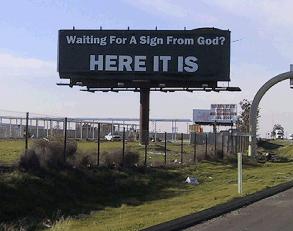 To study to become a pastor, I went to seminary in St. Louis. And over the course of my educational career, beginning in grade school and stretching all the way through seminary, I always looked forward to my academic breaks with a sense of eager anticipation. This was especially true in seminary, because I was a long way from my home in Austin. And I can still remember, the first day of every extended break, waking up at 3:30 am, hopping in my truck, and hitting the road for a thirteen and half hour trek home.
Because I drove this route from St. Louis to Austin many times, I became quite familiar with it. I had appointed stops and would even buy the same snack foods every time I made my journey. I also noticed that things seem to change slower in the country, even if that country has an interstate racing through it, than in the city. This was especially true of billboards. There was one billboard in Missouri on I-44 which, over my four years in seminary, never changed. It read, “Waiting for a sign from God? Here it is.”
More than one person, especially in a time of trial or crisis of faith, has asked God for a sign. Disappointingly, I have heard far fewer stories about how God did deliver a sign than stories of how he didn’t. Indeed, many of us intuitively know that it is dangerous for us to ask for some heavenly omen because, more often than not, we’ll be disappointed.
The animated cartoon character Homer Simpson, who, although not a particularly astute theologian, is funnily folksy, once offered this prayer: “Dear Lord, the gods have been good to me. For the first time in my life, everything is absolutely perfect just the way it is. So here’s the deal. You freeze everything the way it is, and I won’t ask for anything more. If that is okay, please give me absolutely no sign. Okay, deal. In gratitude, I present you this offering of cookies and milk. If you want me to eat them for you, give me no sign. Thy will be done.” Although we would never pray such a crass prayer as this, this is the way many of us by default operate: God is not in the business of giving signs.
In our reading for today from Romans 4, Paul argues that a person is made righteous not by what he does, but by faith in Christ’s salvific work alone. Indeed, Paul says that even those before Christ were justified by their faith and not by their works. For instance, Abraham: “What then shall we say that Abraham, our forefather, discovered in this matter? If, in fact, Abraham was justified by works, he had something to boast about – but not before God. What does the Scripture say? ‘Abraham believed God, and it was credited to him as righteousness’” (verses 1-3). Abraham’s faith, Paul says, not his good works, made him righteous in God’s sight.
In order to bolster his argument, Paul continues by noting that Abraham was declared righteous by God before he himself had done anything righteous. Thus, Abraham’s righteousness could not have come from anything he had done: “Under what circumstances was Abraham’s righteousness credited? Was it after he was circumcised, or before? It was not after, but before” (verse 10)!
In first century Jewish society, circumcision was the ultimate “sign” that a person was a child of God. As Paul says, “Abraham received the sign of circumcision” (verse 11). But now, in Romans 4, Paul is arguing for a new sign that a person is a child of God. And this is a sign that is not done by human hands as some righteous work, as is circumcision, this is a sign that is effected by God himself: the sign of faith. This is why Paul writes, “Abraham is the father of all who believe but have not been circumcised, in order that righteousness might be credited to them” (verse 11). Paul says, in order to be a righteous child of God, the sign you really need is faith in Jesus Christ.
So perhaps it isn’t such a bad thing to ask for a sign from God after all. But this sign will probably not come in an experience that rends the heavens or in a voice that rumbles into your soul. It probably won’t even come in large words plastered on a billboard along some country boulevard. No, the sign from God that you most need is a sign that you already have: faith in your heart. Thank God for that most precious sign today.
“Word for Today” – Romans 3 – www.concordialutheranchurch.com
 In 1954, Stanford social psychologist Leon Festinger published a paper titled, “A Theory of Social Comparison Processes.” In this paper, Festinger hypothesized that “there exists, in the human organism, a drive to evaluate his opinions and abilities.” This evaluation is accomplished by “comparison respectively with the opinions and abilities of others.” This evaluation can involve both “upward comparison,” where a person evaluates themselves against someone who is more advanced in a particular area than they are, and “downward comparison,” where a person evaluates themselves against someone of a perceived lower status than they are.
Interestingly, in the moral realm, most people tend to engage in “downward comparison.” “At least I’m not as bad as her,” a person might say. “I would never do what he did,” another might opine. We engage in this kind of “downward comparison” because it allows us to feel secure in our own moral righteousness rather than suffering guilt that inevitably results from our immoral sinfulness.
Our reading for today from Romans 3 leaves no room for the kind of “downward comparison” that many of us like to engage in. Rather, it brings out, with stinging clarity, the depths of our immorality: “There is no one who does good, not even one. Their throats are open graves; their tongues practice deceit. The poison of vipers is on their lips. Their mouths are full of cursing and bitterness. Their feet are swift to shed blood” (verses 12-15).
The language that Paul uses here is gripping. He begins with the depravity of human throats, tongues, lips, and mouths. He then drops to our feet. The implication is this: From our head to our toes, we are sinful, we are not good, we are unrighteous, we are wicked, and we are depraved. And no amount of “downward comparison” can rescue us from our plight.
Happily, Paul does not leave us in this sorry state of sin. For he continues:
But now a righteousness from God, apart from law, has been made known, to which the Law and the Prophets testify. This righteousness from God comes through faith in Jesus Christ to all who believe. There is no difference, for all have sinned and fall short of the glory of God, and are justified freely by his grace through the redemption that came by Christ Jesus. God presented him as a sacrifice of atonement, through faith in his blood. (verses 21-24)
True righteousness, Paul maintains, does not come from comparing ourselves to others who are morally “inferior” to us, but from faith in Jesus Christ. True righteousness is “apart from the law.” That is, it is apart from what we do and connected only to what Christ has done.
Thus, there is no room for boasting by comparing our morality to the morality of another. As Paul writes, “Where, then, is boasting? It is excluded. On what principle? O n that of observing the law? No, but on that of faith. For we maintain that a man is justified by faith apart from observing the law” (verses 27-28). The upshot, then, is this: no one is better than anyone else. For the ground is level at the foot of the cross.
With this in mind, today, when you are tempted to engage in “downward comparison” and compare your extraordinary performance to the lesser performance of another, can you pause and instead celebrate what you share in common: the righteousness that comes from Christ? Although this may be humbling, for you can no longer engage in comparisons that allow you superiority over another, it is also liberating, for you no longer have to fret over someone who is “better” than you. For our superior righteousness comes not from ourselves, it comes from Christ. And I think I’d rather have his righteousness than mine anyway.
“Word for Today” – Romans 2 – www.concordialutheranchurch.com
 The other day, I was having a conversation with a friend about the merits of Kindle, an electronic unit from Amazon.com on which you can purchase, download, and read books. “I don’t know if I could ever read a whole book on a computer screen,” I told my friend. “It doesn’t look like a computer screen, though,” my friend informed me. “It’s designed to be easy on the eyes.” “I still don’t know,” I responded skeptically. “Well,” my friend finally said, “I think it’s pretty cool. Although I don’t do a whole lot of reading.”
As much as it frustrates me, because I love to read, I, like my friend, don’t read as regularly as I’d like to. Commitments, appointments, and the affairs of daily life cut, sometimes deeply, into my reading time. That is why today’s text from Romans 2 is of special interest to me:
Indeed, when Gentiles, who do not have the law, do by nature things required by the law, they are a law for themselves, even though they do not have the law, since they show that the requirements of the law are written on their hearts, their consciences also bearing witness, and their thoughts now accusing, now even defending them. (verses 14-15)
Paul here speaks to those who have not had a chance to catch up on their reading. In the first century, it was the Jewish people who were the keepers of the written law of God. And they were fervently devoted to reading it, parsing it, and memorizing it. Indeed, an ancient rabbi would have the entire Old Testament memorized. The Gentiles, on the other hand, were not familiar with the Word of God. For they lived in a pagan context in which there were no readily available Bibles. Thus, any Gentile convert to a nascent first century Christianity had some reading to catch up on – the whole of God’s written revelation!
Paul, however, in these verses, says that even those who do not read Scripture have some knowledge of what it says: “Even though they do not have the law…the requirements of the law are written on their hearts.” In theological parlance, we call this “natural law.” That is, even someone who has never read the Bible still has a basic “moral compass,” as it were, because God has etched his laws into each and every human heart. That is why, for instance, societies, whether Christian or not, consider murder to be wicked. It is part of God’s natural law. The first century Jewish philosopher Philo states it thusly:
The world is in harmony with the law, and the law with the world, and the man who observes the law is constituted thereby a loyal citizen of the world, regulating his doings by the purpose and will of nature. (On the Creation, 3)
In other words, Philo maintains that there is an unwritten inexorable order to this world, by which people are encouraged to live and by which we judge. And that unwritten inexorable standard is natural law. C.S. Lewis states similarly:
Everyone has heard people quarrelling. Sometimes it sounds funny and sometimes it sounds merely unpleasant; but however it sounds, I believe we can learn something very important from listening to the kind of things they say…[For in quarrels, a man is often] appealing to some kind of standard of behavior which expects the other man to know about…It looks, in fact, very much as if both parties had in mind some kind of law or rule of fair play or decent behavior or morality or whatever you like to call it, about which they really agreed…Now this law or rule about right in wrong [is] called the law of nature. (C.S. Lewis, The Case for Christianity, 3-4)
Standards that are not written, but simply known, agreed upon, and assumed. These are the standards of natural law.
Evil, therefore, has no excuse. One cannot say, “I didn’t know it wasn’t okay not to murder.” Or, likewise, “I didn’t know I had to tell the truth.” Yes, you did know. Even if you’re not much of a reader. Thus, we all stand convicted by the law of God. For what we do not know from the pages of Scripture we know from the guilt which riddles our hearts.
It is for this reason that Paul writes the book of Romans. For Paul knows that Jews and Gentiles alike stand condemned under God’s written and natural law. But Paul wants to free them from this condemnation and bring them into salvation in Jesus Christ. As Paul later writes, “There is now no condemnation for those who are in Christ Jesus, because through Christ Jesus the law of the Spirit of life set me free from the law [whether written or unwritten] of sin and death” (Romans 8:1-2).
This, then, is why we should read: for although we can know God’s law apart from reading the Scriptures, we cannot know Jesus apart from reading the Scriptures. Without the Scriptural gospel, we stand condemned. What’s written on our hearts can lead us only to despair and not hope, only to guilt and not joy, only to slavery and not freedom. So perhaps it’s time for us all to do a little more reading of and a little bit more listening to the gospel. For it is in the gospel that we find hope and healing from Jesus. And that’s something I love to read all about. I hope you do too.
“Word for Today” – Romans 1 – www.concordialutheranchurch.com
 Kids are funny. A couple of weeks ago, we had some friends staying with us who brought with them their two children – a two year old daughter and a six month old son. They were both endearingly precious and hilariously entertaining as we experienced all the idiosyncrasies that young children can bring.
Around supper one evening, the two year old, named Allie, wanted some cheese which, her father informed me, is her favorite food, as it is mine. As a fellow “cheese-head,” I happily went to the refrigerator to get Allie some cheese. Upon delivering the cheese to her, her mother gave a gentle reminder. “What do you say, Allie?” she asked. Allie turned beat red and dropped her face to the floor. “What do you say?” her mother reminded again, this time in a mildly more serious tone. In her best sheepish voice, Allie replied, “Thank you.”
I have found that there are two things that children are regularly remiss to say: “Thank you” and “I’m sorry.” What’s fascinates me, however, is that it’s not just children who have a hard time giving gratitude and offering apologies when they’re due. Adults have this problem as well. Sure, we may not turn beat red and drop our faces to the floor, but just try to get a politician to admit a massive mistake. Or consider how many times we have selfishly taken credit for something when we really owed those working behind the scenes a hearty and public thanks.
As we begin reading through Romans, Paul, in Romans 1, opens with these words: “First, I thank my God through Jesus Christ for all of you” (verse 8). Paul, without a red face and a downward countenance, without any prompting and prodding from his mother, and without any smug tributes to his own accomplishments, says “thank you” to God. And notice, it’s the first thing he does: “First, I thank my God through Jesus Christ for all of you.” Paul, it seems, is very liberal and quick with his gratitude.
Sadly, all too often, thankfulness is not a primary posture of our hearts, but a fleeting addendum to our souls, loosely appended to our prayers to God and our relationships with others. We pray to God concerning all our of our pressing needs and overwhelming worries and then wrap up with, “Oh, by the way, thanks for all your blessings, God.” Or, a friend helps us with a daunting and challenging task, lending their elbow grease when it is needed the most, only to receive from us a couple of days later, “Oh, by the way, thanks for your help the other day.” And thankfulness gets relegated to a paltry postscript again and again.
Rather than subtly tucking his acknowledgments away in some footnote or endnote to his epistle, Paul opens his letter by proudly announcing his gratitude. “First,” Paul opens, “I want to say thank you.” Shortly, Paul will wade into the tough stuff of life. For instance, in verse 18, when he writes, “The wrath of God is being revealed from heaven against all the godlessness and wickedness of men.” Shortly, Paul will confront sinners (cf. 1:18-32) and demand righteousness (cf. 6:17-18) and ask for assistance (cf. 16:1-2). But now is a time for thankfulness.
So how about with you? Is a thankful heart a hallmark of your habits, or a mere obligatory appendix to a lengthy laundry list of requests and complaints? Today, begin your activities with a “thank you.” Put thankfulness first. Who knows? You may spend so much time being thankful that you find you don’t have much time left over to fuss and fret over the worries and cares of this life. Less time to fuss and fret? Why, that’s something you can be thankful for right there. I bet you can find more.
“Word for Today” – 2 Timothy 4 – www.concordialutheranchurch.com
 “A boy scout is always prepared,” the old saying goes. I was never a boy scout. And it shows every once in a while.
Every Christmas at Concordia, we hold a drive-thru nativity. Literally thousands of people drive through our campus from station to station as we share the blessed story of Christ’s birth for people to enjoy from the comfort and warmth of their cars. Fortunately, this year, unlike in some years past, it was comparatively warm outside. In fact, one evening, it was warm enough to walk around without so much as a coat. You have to love those balmy San Antonio Decembers! But even in San Antonio, it is only a matter of time before a cold-snap hits in the “dead” of a Texas winter. And one did hit the following Tuesday.
Unfortunately, the following Tuesday was the day which we had scheduled to take down our drive-thru nativity sets – all ten of them. Thankfully, a hearty group of our church elders volunteered in the biting cold and piercing wind to help with the breakdown. They all came wearing Carhart jackets and overalls with thick gloves and woolen caps. They, apparently, were boy scouts. I came in a light leather jacket. I, as I already mentioned, was not.
I was miserable. My fingers went numb. My ears turned red. Even my tongue began to freeze to my mouth making it difficult for me to talk. Something unheard of for me! As I broke down sets, trying to stave off what I was sure to be immanent hypothermia by drinking coffee by the gallon, I kept thinking to myself: “You knew it was going to be cold today and you were going to be outside. Why didn’t you come prepared?”
“Preach the Word; be prepared in season and out of season; correct, rebuke and encourage – with great patience and careful instruction” (2 Timothy 4:2). These are some of the closing words penned by the apostle Paul to the young pastor Timothy in 2 Timothy 4. And Paul’s admonition is that of a true, blue boy scout: “Be prepared in season and out season.” Bring a coat in the summer and a tank top in the winter. Never come unprepared.
But Paul is speaking of something much more profound and significant than mere preparation for inclement weather. He is speaking of the preparation that is involved with sharing God’s teachings. For Paul warns, “The time will come when men will not put up with sound doctrine. Instead, to suit their own desires, they will gather around them a great number of teachers to say what their itching ears want to hear” (verse 3). Paul reminds us that we need to be ready and able to refute false doctrine and confront those who would seek to tear down the gospel, for many will try. Are you prepared?
Of course, no one can be perfectly prepared to refute every objection and counter every attack. Thankfully, this is not what Paul calls for. The Greek word for “be prepared” is ephistemi, meaning literally, “to stand by.” This, then, is Paul’s call: not to have any and every answer for any and every theological question, but to “stand by,” ready for action at a moment’s notice. Ready to learn new truths about God’s Word. Ready to comfort a friend in need. Ready to share the gospel with someone who needs to hear it. So stand by. After all, your standing on the message of the cross could be the very stadning that changes a human heart.
“Word for Today” – 2 Timothy 3 – www.concordialutheranchurch.com
 Have you ever had one of those experiences where someone begins talking to you as if they’re your long lost best friend and, although you know you should remember who they are, you’re honestly clueless as to their identity? Once, I received a phone call from a number I did not know. In fact, it was from an area code I did not know. The caller began, “Zach?” “Yes,” I responded. “Hey,” the man on the other end of the line continued, “It’s Rufus.”
I have known a lot of people over the course of my life: Justins, Marks, Pauls, Joshs, Jamess, Josiahs, and even a couple of Jedidiahs. But I have never known a Rufus. But Rufus seemed to know me. So I played along. “Oh hi, Rufus,” I said with a mixture of curiosity and nervousness in my voice. “What’s up?” “I was wondering if you got that fax I sent you,” Rufus continued. Rufus? A fax? I was totally lost. I finally cracked. “Who is this again?” I asked. “Rufus,” the man replied. “And who are you?” “Zach,” I said, “Zach McIntosh.” “Oops,” Rufus responded. “I was trying to get a hold of a Zach Allen. Sorry! Wrong number.” And we both hung up the phone.
Honestly, at the end of our conversation, I breathed a sigh of relief. “So I’m not going crazy,” I thought to myself. “I really don’t know a Rufus.” But then I read our text for today from 2 Timothy 3: “Just as Jannes and Jambres opposed Moses, so also these men oppose the truth – men of depraved minds, who, as far as the faith is concerned, are rejected” (verse 8). Jannes and Jambres. Am I supposed to know these guys? I don’t remember them from the story of the exodus. Thankfully, I shouldn’t remember them. Because their names are not actually in the story of the exodus.
Paul, in naming Jannes and Jambres as men who oppose Moses, draws from an ancient Jewish tradition which names Pharaoh’s magicians who compete against Moses and Aaron in Exodus 7:10-12:
Moses and Aaron went to Pharaoh and did just as the LORD commanded. Aaron threw his staff down in front of Pharaoh and his officials, and it became a snake. Pharaoh then summoned wise men and sorcerers, and the Egyptian magicians also did the same things by their secret arts: Each one threw down his staff and it became a snake. But Aaron’s staff swallowed up their staffs.
Notice that in the original text of Exodus, Pharaoh’s magicians remain nameless.
But now consider this text from the Targum of Jonathan, a second century commentary on this passage:
Moses and Aaron went unto Pharaoh, and did as the Lord had commanded. And Aaron threw down the rod before the sight of Pharaoh, and before the sight of his servants, and it became a snake. But Pharaoh called the diviners and magicians; and they also, Jannes and Jambres, magicians of Mizraim, did the same by their burnings of divination. Each man threw down his rod, and they became snakes; but were forthwith changed to be what they were at first; and the rod of Aaron swallowed up their rods.
Pharaoh’s magicians now have names. And Paul quotes these names in today’s reading.
Why is this important? Because it means that Paul was a man thoroughly familiar with his Scriptures and even with what other people had said about the Scriptures. He had read his Bible. He had consulted his commentaries. He had sat at the feet of great Bible teachers. That is why he knew even the lesser known names of Jannes and Jambres. Because he had so diligently studied theology. And Paul encourages us to do the same:
But as for you, continue in what you have learned and have become convinced of, because you know those from whom you learned it, and how from infancy you have known the holy Scriptures, which are able to make you wise for salvation through faith in Christ Jesus. All Scripture is God-breathed and is useful for teaching, rebuking, correcting and training in righteousness, so that the man of God may be thoroughly equipped for every good work. (verses 14-17)
Paul says, “Continue in what you have learned.” Keep on studying the Scriptures. Keep on peering into God’s book. Keep on discovering new things about the Bible. For the words of Scripture are the words of God. That’s why Jannes and Jambres matter. Not because they’re historically important. They’re mere blips in the history of God’s people, and godless blips at that. But Paul takes the time to remember and mention them because they relate to Scripture. And for Paul, there is nothing more precious, more life-giving, and more worthwhile than God’s Word. Is the same true for you?
“Word for Today” – 2 Timothy 2 – www.concordialutheranchurch.com
 My first birthday after Melody and I got married, she presented me with a card which was supposed to express her undying affection, allegiance, and affinity for me. Because Melody and I were friends some ten years before a “romantic spark” developed between the two of us, she gave me a card that read appropriately, “You’re not only my husband, you’re also my friend.” What a sweet affirmation of a marriage that is grounded not merely in quixotic attraction, but in steady friendship.
But have you ever had one of those instances where your eyes inadvertently switched around two words while you were reading them? This is what happened to me. The card read, “You’re not only my husband.” But I read, “You’re not my only husband.” Two little words – a world of difference. Thankfully, as soon as I read the card, I knew I had misread the card. So I did a double take. Melody and I laugh about my misreading to this day.
Words matter. That is why newspaper editors meticulously review columns. That is why presidents carefully craft speeches. That is why pastors carefully prepare blogs. Because words matter. A good word can paint a picture, enrapture a spirit, or grip a soul. Conversely, a misused word can cause confusion, cast doubt, and wound hearts. Because words matter.
In our reading for today from 2 Timothy 2, Paul warns against a reckless use of words: “Warn before God against quarreling about words; it is of no value, and ruins those who listen” (verse 14). Paul pens this verse against a backdrop of a heresy known as Gnosticism, a Greek word meaning “knowledge.” This heresy taught if a person could gain secret knowledge concerning matters such as good, evil, the cosmos, and mystic spirituality, one could become enlightened and ascend to a higher spiritual plane. This religious system taught such secret knowledge through cryptic writings and rituals. Not surprisingly, such enigmatic writings and rituals led to quarreling over what it all meant. This is why Paul warns against quarreling about words. For such quarreling is of no value. It does not solve Gnosticism’s riddles. And besides, Gnosticism isn’t true. This is why Paul finally calls its teachings “gangrene” (verse 17).
In the midst of Gnosticism’s many and baffling words, Paul invites us to concern ourselves with the Word: “Do your best to present yourself to God as one approved, a workman who does not need to be ashamed and who correctly handles the word of truth” (verse 15). There is a Word of truth and it is God’s Word of truth. And unlike the Gnostics, we ought to be careful and conscious of how we use this Word. We ought to “correctly handle” God’s Word of truth. What does this mean? It means standing on the historicity and accuracy of Scripture. It means sensitively and compassionately sharing God’s grace with those who are crushed by the cares of this world. It means voraciously and unapologetically proclaiming that Jesus is Lord. For words matter. And how we handle God’s Word – that really matters.
So today, be careful what you say. Be careful what you write. Be careful what you text. Ask yourself, before firing off an email or carelessly making a phone call, “How can I reflect God’s Word in my words?” And then choose your words cautiously. Because your words, used carefully, may just be the words that someone else needs to hear – for their encouragement, for their conviction, and, by the power of God’s Spirit, even for their salvation.


 Pastor Zach's Blog